Rose Moss (Portulaca grandiflora)
Formerly Portulaca fluvialis, Portulaca immersostellulata, Portulaca rupicola
Rose moss needs full sun. Its water needs run from dry to medium. Well-drained soil is recorded for it. It is 6 to 9 in (15 to 23 cm) tall. It spreads 12 to 18 in (30 to 46 cm). Aphids and slugs are its recorded pests. Toxicity to cats and dogs is not documented.
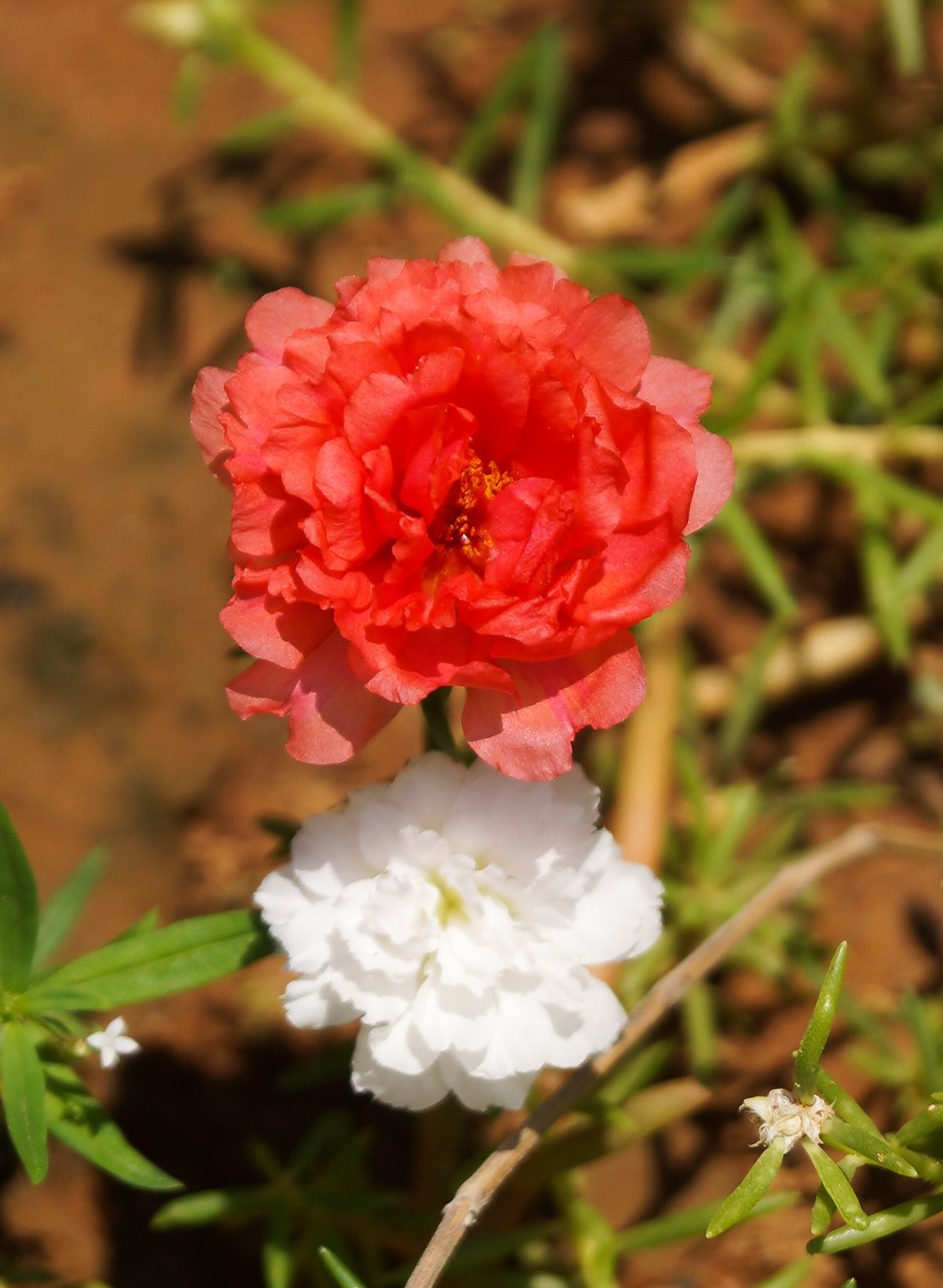
Photo: Rjcastillo, CC BY-SA 3.0 via Wikimedia Commons

Quick facts
| Light: | Full sun11 source |
|---|---|
| Water: | Dry to medium11 source |
| Soil: | Well drained21 source |
| Size: | 0.5–0.7 ft (0.15–0.23 m) × 1–1.5 ft (0.3–0.46 m)41 source |
| Bloom: | Orange, pink, purple, red, white and yellow11 source |
| Cats: | Not documented by major sources |
| Dogs: | Not documented by major sources |
| Native range: | AGE, AGS, AGW, BOL, BZC, BZE, BZL, BZS, PAR, PER, URU5 |
| Family: | Portulacaceae |
How much light does a Rose Moss need?
Give rose moss full sun, which means 6 or more hours of direct sunlight a day. Full sun is the only outdoor light level recorded for it. It has a high heat tolerance. It needs to be planted in full sun. Its light need is recorded together with a dry-to-medium water range.
- Light: Full sun1
How often to water a Rose Moss
Water needs for this plant fall between dry and medium. The lowest level recorded is dry and the highest is medium. It has a high drought and heat tolerance. Water needs sit alongside a light need of full sun. Rots of the stem or roots are recorded in wet soils.
- Water: Dry to medium1
Best soil for a Rose Moss
Well-drained soil is what rose moss needs. It needs to be planted in well-drained sandy or rocky soils in full sun. It prefers dry, sun-baked areas. Crown rot and root rot are recorded as problems in wet soils. Its drainage record lists only one class: well drained.
- Soil drainage: Well drained2
Pruning a Rose Moss
Deadheading is the only pruning type recorded for rose moss. Deadheading will deter self-seeding. Its mature height is 0.5–0.7 ft (0.15–0.23 m) and its mature spread is 1–1.5 ft (0.3–0.46 m). Full sun is its recorded outdoor light level. Its soil drainage is recorded as well drained, and it prefers dry, sun-baked areas.
- Pruning: Deadheading1
How to propagate a Rose Moss
You can propagate rose moss from seed or from stem cuttings. Seed and stem cuttings are the only two methods recorded. Stem cuttings are the second method recorded, after seed. Deadheading will deter self-seeding. Its flowers come in orange, pink, purple, red, white or yellow. In the lower 48 US states and Puerto Rico its status is introduced. Timing and rooting steps for either method are not documented.
- Propagation: Seed and stem cuttings3
Common problems
Aphids and slugs may occasionally be a problem on rose moss. These are the two pests recorded. Stem or root rots can be a problem in wet soils. The two diseases recorded are crown rot and root rot. Well-drained soil is recorded for this plant.
| Problem | Kind |
|---|---|
| Aphids | Pest |
| Slugs and snails | Pest |
| Crown rot | Disease |
| Root rot | Disease |
Is Rose Moss toxic to cats and dogs?
Recommended supplies
- Soil: a free-draining mix, and a pot with a drainage hole.
Questions and answers
- How much sun does rose moss need?
- Rose moss needs full sun, which is 6 or more hours of direct sunlight a day. It has a high drought and heat tolerance. Full sun is the only outdoor light level recorded for it.
- What colors do rose moss flowers come in?
- The recorded flower colors are orange, pink, purple, red, white and yellow. It needs well-drained soil in full sun. Deadheading is also recorded as its pruning type.
- Where is rose moss native?
- The native range record for Portulaca grandiflora lists the region codes AGE, AGS, AGW, BOL, BZC, BZE, BZL, BZS, PAR, PER and URU. Its native status is introduced in the lower 48 states and in Puerto Rico.
Sources
- NC State Extension Gardener Plant Toolbox. https://plants.ces.ncsu.edu/plants/portulaca-grandiflora/. Accessed 21 October 2026.
- Clemson Cooperative Extension Home & Garden Information Center. https://hgic.clemson.edu/factsheet/plants-that-tolerate-drought/. Accessed 21 October 2026.
- University of Wisconsin-Madison Division of Extension (Wisconsin Horticulture). https://hort.extension.wisc.edu/articles/moss-rose-portulaca-grandiflora/. Accessed 21 October 2026.
- Clemson Cooperative Extension Home & Garden Information Center. https://hgic.clemson.edu/factsheet/hanging-baskets-window-boxes/. Accessed 14 October 2026.
- Royal Botanic Gardens, Kew (World Checklist of Vascular Plants). https://sftp.kew.org/pub/data-repositories/WCVP/wcvp.zip. Accessed 4 June 2026.
How this page was made
- Written with AI assistance from the sources listed on this page. AI is never the source of a fact.