Sweetwilliam (Dianthus barbatus)
Formerly Caryophyllus barbatus, Cylichnanthus barbatus, Silene barbata
Sweet william prefers full sun outdoors, though it also tolerates part shade. It prefers well-drained soil that stays moist. Soil pH between 6 and 8 suits it well. It is hardy from USDA zones 3a to 9b. It grows at a medium rate and needs medium maintenance. This page does not have a documented watering guideline for the species. It is toxic to cats and to dogs.
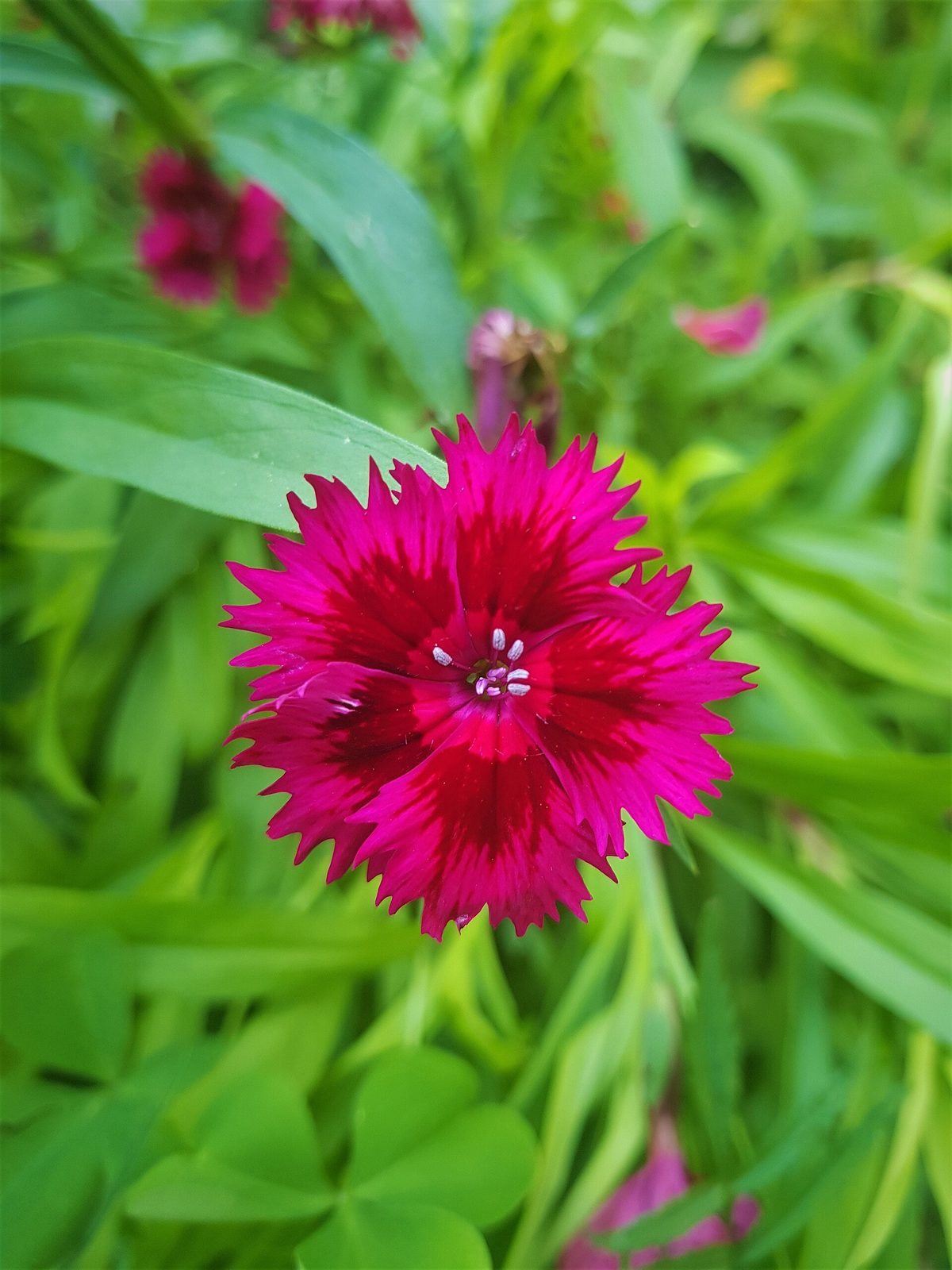
Photo: Sabina Bajracharya, CC BY-SA 4.0 via Wikimedia Commons

Quick facts
| Light: | Full sun and part shade (full sun preferred)11 source |
|---|---|
| Soil: | Well drained and moist; pH 6–811 source |
| Hardiness: | Zones 3a–9b11 source |
| Size: | 1–2 ft (0.3–0.61 m) × 0.5–1 ft (0.15–0.3 m)11 source |
| Growth rate: | Moderate11 source |
| Bloom: | Pink, purple, red, white and multicoloured11 source |
| Cats: | Toxic to cats (1 source) 1 |
| Dogs: | Toxic to dogs (1 source) 1 |
| Native range: | AUT, BUL, CHM, CZE, FRA, HUN, ITA, KOR, POL, PRM, ROM, SPA, TUE, UKR, YUG3 |
| Family: | Caryophyllaceae |
How much light does a Sweetwilliam need?
Full sun outdoors suits sweet william best, with at least six hours of direct sunlight a day. It also tolerates part shade. Full sun is the light level listed as its preference, while part shade is the other condition it tolerates. This species is classed as a shrub. Its flowers appear in pink, purple, red, white, or multicolor combinations.
- Light: Full sun and part shade (full sun preferred)1
Best soil for a Sweetwilliam
Sweet william needs soil with good drainage that also stays moist. A soil pH between 6 and 8, a near-neutral range, suits it well. It grows at a medium rate, and its maintenance need is rated medium. At maturity, it typically reaches 1 to 2 ft (0.3 to 0.6 m) tall and 6 in to 1 ft (0.15 to 0.3 m) wide.
Hardiness and temperature
USDA zones 3a through 9b cover the outdoor hardiness range for sweet william. That span runs from the coldest zone, 3a, to the warmest, 9b. A gardener anywhere within that range can grow it outdoors year-round. Deer and rabbits are also reported to avoid this plant.
- Hardiness: Zones 3a–9b1
How to plant a Sweetwilliam
Outdoors, sweet william is hardy in USDA zones 3a through 9b. Its native range includes Austria, Bulgaria, France, Hungary, Italy, Poland, Romania, Spain, Ukraine, and several neighboring countries across Europe and Asia. In the continental United States and in Alaska, it is recorded as introduced rather than native. Deer and rabbits are also reported to leave this plant alone.
- Hardiness: Zones 3a–9b1
Winter care
Sweet william is hardy outdoors from USDA zone 3a to zone 9b. It needs soil with good drainage that also stays moist. It has a medium maintenance rating. Its growth rate is also rated medium. Its native range reaches from parts of Europe to Korea.
- Hardiness: Zones 3a–9b1
How to propagate a Sweetwilliam
Sweet william can be propagated from seed or by division. Both of these methods are listed as the ways this source names for starting new sweet william plants. It is classed as a shrub. Its flowers come in pink, purple, red, white, or multicolor forms. This species also has a medium growth rate and a medium maintenance need.
- Propagation: Seed and division1
Common problems
Sweet william can be bothered by slugs and snails, especially in shaded areas. Other pests recorded for it include Ditylenchus dipsaci, Liriomyza huidobrensis, Naupactus leucoloma, and Spodoptera ornithogalli. It is also susceptible to crown rot and rust, particularly in poorly drained soils. Other diseases recorded for it include Dickeya dianthicola, Erwinia chrysanthemi, Phialophora cinerescens, Phymatotrichopsis omnivora, and Candidatus Phytoplasma solani. Deer and rabbits are reported to avoid this plant.
| Problem | Kind |
|---|---|
| Ditylenchus dipsaci | Pest |
| Liriomyza huidobrensis | Pest |
| Naupactus leucoloma | Pest |
| Spodoptera ornithogalli | Pest |
| Slugs and snails | Pest |
| Snails | Pest |
| Candidatus phytoplasma solani | Disease |
| Dickeya dianthicola | Disease |
| Erwinia chrysanthemi | Disease |
| Phialophora cinerescens | Disease |
| Phymatotrichopsis omnivora | Disease |
| Crown rot | Disease |
| Rust | Disease |
Is Sweetwilliam toxic to cats and dogs?
This plant is toxic to cats. For cats, it is described as having low toxicity if eaten, along with minor skin irritation. This plant is also toxic to dogs. For dogs, the same source describes low toxicity if eaten and minor skin irritation. Both cats and dogs are listed with the same poison characteristics: low toxicity if eaten and minor skin irritation.
Pet-safe alternatives
Recommended supplies
- Soil: a free-draining mix, and a pot with a drainage hole.
Questions and answers
- Is sweet william toxic to cats and dogs?
- Yes, sweet william is toxic to both cats and dogs. The poison characteristics listed for both are low toxicity if eaten and minor skin irritation.
- What light does sweet william need outdoors?
- Sweet william grows best outdoors in full sun, and it also tolerates part shade. It is hardy outdoors from USDA zone 3a to zone 9b.
- How do you propagate sweet william?
- You can propagate sweet william from seed or by division. Both methods are listed as the ways this source names for starting new plants of this species.
Sources
- NC State Extension Gardener Plant Toolbox. https://plants.ces.ncsu.edu/plants/dianthus-barbatus/. Accessed 14 October 2026.
- EPPO Global Database. https://gd.eppo.int/taxon/DINBA/pests. Accessed 14 October 2026.
- Royal Botanic Gardens, Kew (World Checklist of Vascular Plants). https://sftp.kew.org/pub/data-repositories/WCVP/wcvp.zip. Accessed 4 June 2026.
How this page was made
- Written with AI assistance from the sources listed on this page. AI is never the source of a fact.