Woolly Hedgenettle (Stachys byzantina)
Formerly Stachys taurica, Stachys olympica, Eriostomum lanatum
Give woolly hedgenettle full sun, though part shade is also listed, and soil that is dry to medium in moisture. A mature plant stays 1–1.5 ft (0.3–0.46 m) tall and wide. No cited source records whether it is toxic to cats or to dogs, so its pet-toxicity position is not documented here.
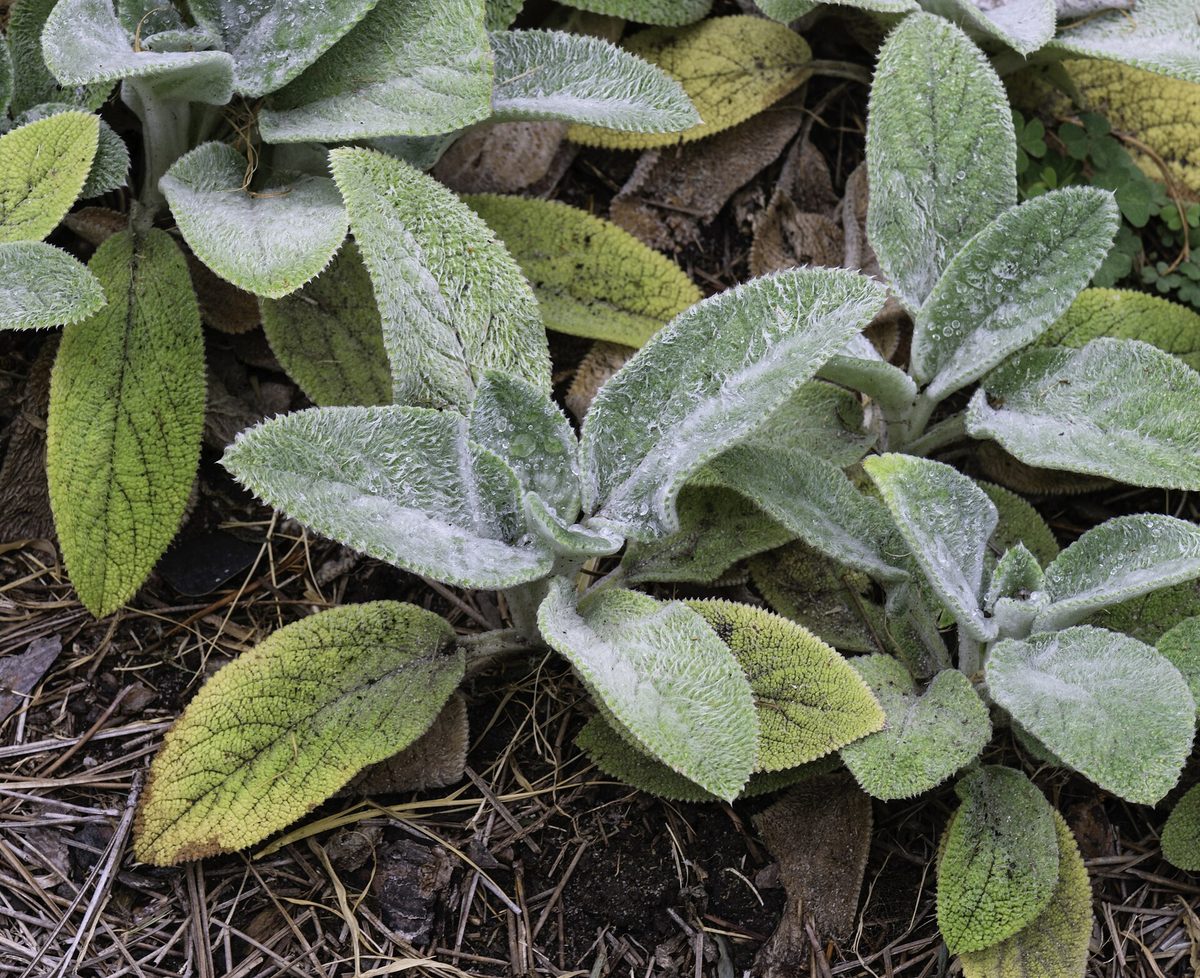
Photo: PumpkinSky, CC BY-SA 4.0 via Wikimedia Commons

Quick facts
| Light: | Full sun and part shade (full sun preferred)12 |
|---|---|
| Water: | Dry to medium11 source |
| Soil: | Well drained and occasionally dry12 |
| Hardiness: | Zones 4a–9b11 source |
| Size: | 1–1.5 ft (0.3–0.46 m) × 1–1.5 ft (0.3–0.46 m)11 source |
| Growth rate: | Moderate11 source |
| Bloom: | May–Jul, Purple1451 source |
| Cats: | Not documented by major sources |
| Dogs: | Not documented by major sources |
| Native range: | IRN, KRY, NCS, TCS, TUE, TUR6 |
| Family: | Lamiaceae |
How much light does a Woolly Hedgenettle need?
Woolly hedgenettle grows in full sun to part shade, and full sun is the preferred exposure. The listed range runs from full sun to partial shade, or from sun to light shade. Choose the sunniest spot you have, and treat part shade as the alternative. That light is paired with very well-drained soil in the plant's description.
How often to water a Woolly Hedgenettle
Woolly hedgenettle grows well in soil that ranges from dry to medium in moisture. The same description calls for very well-drained soil, and the drainage record adds that the soil may be occasionally dry. The plant is also described as moderately drought-tolerant. Excessive rain or high humidity can bring on leaf rot in this plant.
- Water: Dry to medium1
Best soil for a Woolly Hedgenettle
This plant grows well in average soil, with moisture from dry to medium, provided the drainage is very good. Its drainage is recorded as well drained and occasionally dry. Clemson Cooperative Extension also gives well-drained soil. That soil sits alongside an exposure of full sun to partial shade. No cited source gives a soil pH range, so none is stated here.
Hardiness and temperature
Woolly hedgenettle is listed for hardiness zones 4a through 9b. Gardeners in zone 4 and in zone 9 both fall inside that range. No cited source records a minimum temperature, so no cold limit in degrees is given. Humidity appears in the record only as a condition linked to leaf rot, which follows high humidity or excessive rain.
- Hardiness: Zones 4a–9b1
How to plant a Woolly Hedgenettle
Plant woolly hedgenettle where your winters fall within hardiness zones 4a to 9b. Choose a site with very well-drained soil and full sun, or part shade if full sun is not available. Leave room for a mature width of 1–1.5 ft (0.3–0.46 m). Expect a height of 1–1.5 ft (0.3–0.46 m) as well. The plant type is recorded as a shrub. In the lower 48 states, its status is introduced.
- Hardiness: Zones 4a–9b1
Winter care
Winter planning starts with knowing your zone, because the listed range for this plant is 4a through 9b. Zone 4a is the coldest end of that range, and 9b is the warmest. If your garden falls outside 4a–9b, the hardiness listing does not cover you. No cited source gives a minimum temperature or describes winter protection, so no degree figure or method is stated.
- Hardiness: Zones 4a–9b1
How to propagate a Woolly Hedgenettle
You can propagate woolly hedgenettle by seed or by division. Division of the plant may be required about every 2 to 4 years. A mature plant is 1–1.5 ft (0.3–0.46 m) wide. No cited source describes cuttings or any seed-sowing steps, so none are given here.
- Propagation: Seed and division1
Common problems
Three diseases are recorded for woolly hedgenettle: leaf rot, alphanucleorhabdovirus tuberosum and begomovirus citrulli. The leaf rot is tied to high humidity or excessive rain. No cited source lists pests for this plant. Deer resistance is reported for it.
| Problem | Kind |
|---|---|
| Peruvian mealybug | Pest |
| Leaf rot | Disease |
| Alphanucleorhabdovirus tuberosum | Disease |
| Begomovirus citrulli | Disease |
Is Woolly Hedgenettle toxic to cats and dogs?
Recommended supplies
- Soil: a free-draining mix, and a pot with a drainage hole.
Questions and answers
- How much sun does woolly hedgenettle need?
- It grows well in full sun to partial shade, and full sun is the preferred exposure. Part shade is within the listed range. Pair the light with very well-drained soil.
- How big does woolly hedgenettle get?
- A mature plant is 1–1.5 ft (0.3–0.46 m) tall and 1–1.5 ft (0.3–0.46 m) wide. Its growth rate is moderate, and its maintenance level is low. It is recorded as a shrub.
- Is woolly hedgenettle native to the United States?
- It is listed as introduced in the lower 48 states. Its native range is recorded as the region codes IRN, KRY, NCS, TCS, TUE and TUR. The record gives codes only.
Sources
- NC State Extension Gardener Plant Toolbox. https://plants.ces.ncsu.edu/plants/stachys-byzantina/. Accessed 14 October 2026.
- Clemson Cooperative Extension HGIC. https://hgic.clemson.edu/factsheet/plants-that-tolerate-drought/. Accessed 14 October 2026.
- EPPO Global Database. https://gd.eppo.int/taxon/STABY. Accessed 14 October 2026.
- Clemson Cooperative Extension Home & Garden Information Center. https://hgic.clemson.edu/factsheet/groundcovers/. Accessed 15 October 2026.
- Chicago Botanic Garden. https://www.chicagobotanic.org/plant-information/plant-finder/stachys-byzantina-lambs-ears. Accessed 15 October 2026.
- Royal Botanic Gardens, Kew (World Checklist of Vascular Plants). https://sftp.kew.org/pub/data-repositories/WCVP/wcvp.zip. Accessed 4 June 2026.
How this page was made
- Written with AI assistance from the sources listed on this page. AI is never the source of a fact.