Velvetleaf (Abutilon theophrasti)
Formerly Sida tenax, Side abutila, Sida abutilon
Give velvetleaf full sun. It is an annual. Plants usually reach 2 to 4 ft (0.61–1.22 m) tall. The flowers are yellow and orange. It grows from seed. In zones 8a to 11b it can grow as a short-lived perennial. Watering needs and pet toxicity for cats and dogs are not documented here.
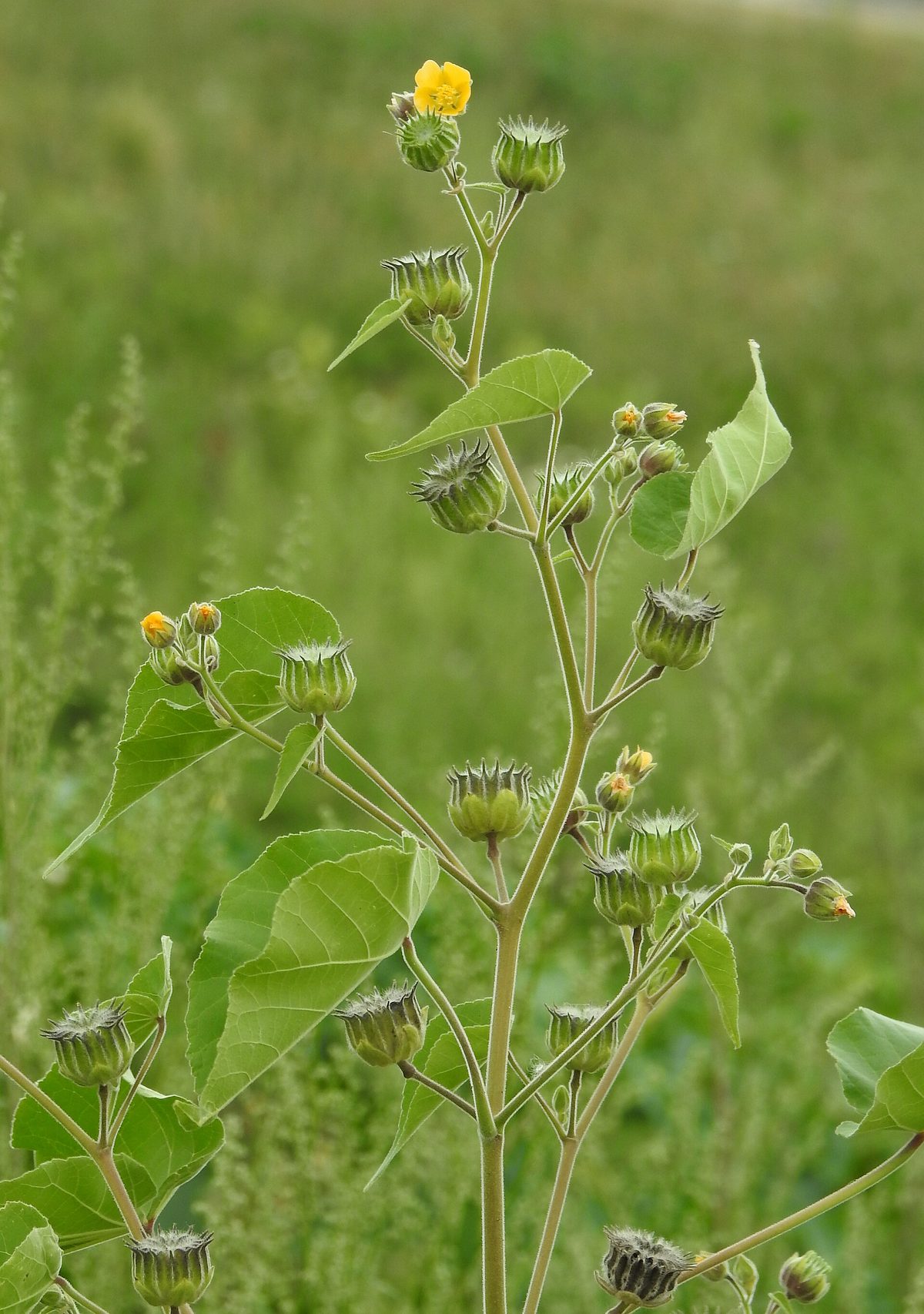
Photo: Robert Flogaus-Faust, CC BY 4.0 via Wikimedia Commons

Quick facts
| Light: | Full sun11 source |
|---|---|
| Hardiness: | Zones 8a–11b12 |
| Size: | 2–4 ft (0.61–1.22 m)11 source |
| Bloom: | Yellow and orange1452 |
| Cats: | Not documented by major sources |
| Dogs: | Not documented by major sources |
| Native range: | CHC, CHI, CHM, CHN, CHS, CHX, KAZ, KGZ, MON, TAI, TKM, TZK, UZB6 |
| Family: | Malvaceae |
How much light does a Velvetleaf need?
Place velvetleaf in full sun. Full sun is the outdoor light level listed for this annual. It also prefers fertile loam or clay-loam soils. Full sun and fertile soil are the two site conditions the record names. Plants usually reach 2 to 4 ft (0.61–1.22 m) tall. The flowers are yellow and orange, with five petals each.
- Light: Full sun1
Hardiness and temperature
Zone 8a is the coldest hardiness zone listed for this plant. Zone 11b is the warmest zone listed. Together they give a range of zones 8a–11b. In zones 8 to 11 it can sometimes act as a short-lived perennial. The plant type recorded for it is annual. Full sun is its preferred outdoor light. No minimum temperature or humidity preference is documented.
How to plant a Velvetleaf
Check that your hardiness zone falls between 8a and 11b. In those zones it can grow as a short-lived perennial. Plant it in full sun. Fertile loam or clay-loam soils are preferred. Mature plants usually reach 2 to 4 ft (0.61–1.22 m) tall. It is an annual that grows from seed. The flowers are yellow and orange. Frost dates, spacing and planting depth are not documented.
Winter care
In zones 8a to 11b, velvetleaf can grow as a short-lived perennial. Its recorded plant type is annual. Zones colder than 8a fall outside the listed range. A grower in zone 8a or warmer is within the listed range. A grower in zone 7 or colder is outside it. Seed is the only propagation method listed for it. No minimum temperature or frost-protection method is documented.
How to propagate a Velvetleaf
You propagate velvetleaf by seed. Each plant produces 700 to 17,000 viable seeds. The count varies widely from plant to plant, from 700 up to 17,000. Seed is the only propagation method listed for it. The plant type recorded for it is annual. Sowing depth, germination temperature and timing are not documented. Check back for those details once a source records them.
- Propagation: Seed1
Common problems
Cotton root rot is a disease recorded for velvetleaf. Tomato chlorosis virus is also recorded. A third record names tobacco ringspot virus. Velvetleaf is named among common weed hosts of tobacco ringspot virus in the lower Rio Grande Valley of Texas. That makes three diseases on record. Tobacco ringspot virus is the one tied to a named place. Insect pests are not documented.
- Common diseases: cotton root rot, tomato chlorosis virus and tobacco ringspot virus3
| Problem | Kind |
|---|---|
| Cotton root rot | Disease |
| Tomato chlorosis virus | Disease |
| Tobacco ringspot virus | Disease |
Is Velvetleaf toxic to cats and dogs?
Questions and answers
- How much sun does velvetleaf need?
- Velvetleaf prefers full sun. It also prefers fertile loam or clay-loam soils. Plants usually reach 2 to 4 ft (0.61–1.22 m) tall. Its flowers are yellow and orange.
- Which hardiness zones suit velvetleaf?
- The listed range is zones 8a to 11b. Zone 8a is the coldest zone in that range. In zones 8 to 11 it can sometimes act as a short-lived perennial. Its recorded plant type is annual.
- How is velvetleaf propagated?
- Velvetleaf is propagated by seed. Each plant produces 700 to 17,000 viable seeds. Seed is the only method listed for it. It is an annual.
Sources
- University of Wisconsin-Madison Division of Extension (Wisconsin Horticulture). https://hort.extension.wisc.edu/articles/velvetleaf-abutilon-theophrasti/. Accessed 15 October 2026.
- Oregon State University Extension Service. https://extension.oregonstate.edu/crop-production/field-crops/velvetleaf-have-you-seen-weed. Accessed 14 October 2026.
- EPPO Global Database. https://gd.eppo.int/taxon/ABUTH/pests. Accessed 14 October 2026.
- UC Statewide Integrated Pest Management Program. https://ipm.ucanr.edu/weeds-identification-gallery/velvetleaf/. Accessed 28 October 2026.
- University of Minnesota Extension. https://extension.umn.edu/agriculture/crop-production/weed-management/annual-broadleaf-weeds. Accessed 28 October 2026.
- Royal Botanic Gardens, Kew (World Checklist of Vascular Plants). https://sftp.kew.org/pub/data-repositories/WCVP/wcvp.zip. Accessed 4 June 2026.
How this page was made
- Written with AI assistance from the sources listed on this page. AI is never the source of a fact.