California Poppy (Eschscholzia californica)
Formerly Eschscholzia crocea, Eschscholzia menziesiana, Eschscholzia arvensis
California poppy wants full sun and a dry site. The source describes it as a drought-tolerant, cool-season annual. It grows 1–2 ft (0.3–0.61 m) tall and blooms in orange and yellow. Deadhead it to keep the flowers coming. Toxicity for cats and dogs is not documented on this page.
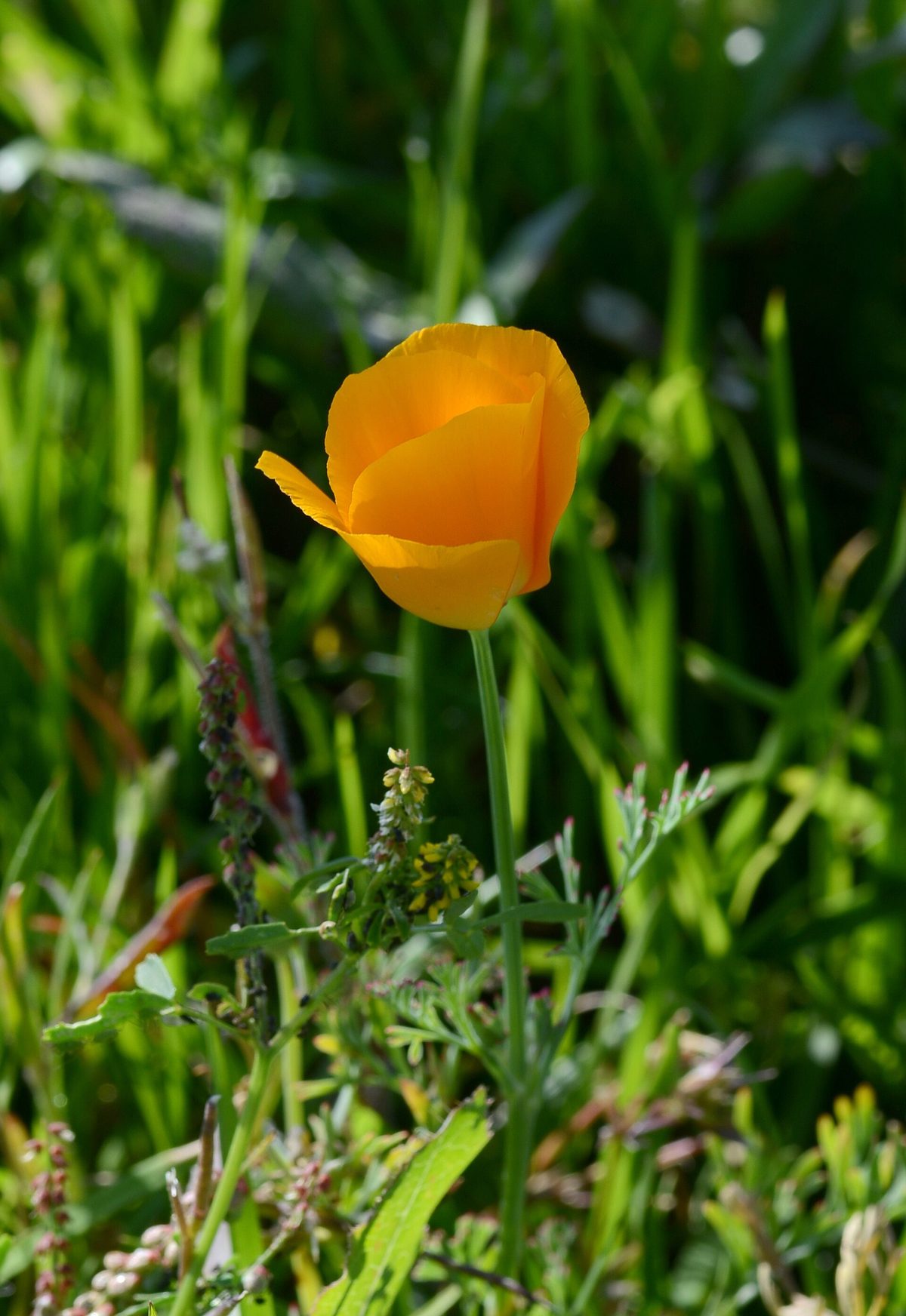
Photo: Alvesgaspar, CC BY-SA 3.0 via Wikimedia Commons

Quick facts
| Light: | Full sun12 |
|---|---|
| Water: | Dry11 source |
| Soil: | Well drained; pH 6–812 |
| Hardiness: | Zones 6a–10b11 source |
| Size: | 1–2 ft (0.3–0.61 m) × 1–2 ft (0.3–0.61 m)124 |
| Growth rate: | Rapid11 source |
| Bloom: | Feb–Oct, Orange and yellow5121 source |
| Cats: | Not documented by major sources |
| Dogs: | Not documented by major sources |
| Native range: | ARI, CAL, MXE, MXN, NEV, NWM, ORE, TEX, UTA, WAS6 |
| Family: | Papaveraceae |
How much light does a California Poppy need?
Full sun is what California poppy prefers outdoors, and the source defines it as 6 or more hours of direct sunlight a day. Pick a spot that gets at least that much direct light. Full sun is the only light condition listed for it. No source on file lists shade or part shade for this plant.
How often to water a California Poppy
A dry water rating applies to this plant. The source calls it a drought-tolerant, cool-season annual. Both the minimum and the maximum moisture level recorded are dry. Its soil is listed as well-drained, and the source notes good drainage. Dry is the only moisture level recorded, so no wetter range is given for this plant.
- Water: Dry1
Best soil for a California Poppy
Well-drained soil is the drainage class listed for California poppy. One source notes good drainage, and another describes nutrient-poor, well-drained soils. Soil pH is recorded as neutral, from 6.0 to 8.0. Pick a bed that fits both conditions, with good drainage and a pH between 6 and 8. Well-drained is the only drainage class on file, with no other class listed.
Hardiness and temperature
USDA hardiness zones 6a through 10b are listed for California poppy. The listing names each step: 6a, 6b, 7a, 7b, 8a, 8b, 9a, 9b, 10a and 10b. The source also calls it a cool-season annual. No cited source records a minimum temperature or a humidity preference.
- Hardiness: Zones 6a–10b1
Pruning a California Poppy
Deadheading is the pruning task recorded for California poppy. The source advises deadheading flowers regularly to promote additional bloom. It also says to leave some flower heads on the plant if you want it to self-seed. Deadheading is the only pruning type listed, so no cutting back or shaping is documented.
- Pruning: Deadheading1
How to plant a California Poppy
Plant in USDA zones 6a to 10b, where California poppy is rated. Sow seeds directly where you want the poppies, since they do not transplant well. Allow 1–2 ft (0.3–0.61 m) of width for each plant. It reaches 1–2 ft (0.3–0.61 m) tall. Full sun and well-drained soil are the conditions listed. It is native to the lower 48 US states and introduced in Alaska and Hawaii.
- Hardiness: Zones 6a–10b1
Winter care
Zone 6a is the coldest rating listed for California poppy, and 10b is the warmest. No cited source records a minimum temperature, so no cold limit is documented. The source describes it as a cool-season annual. Leaving some flower heads on the plant allows self-seeding, according to the pruning advice.
- Hardiness: Zones 6a–10b1
How to propagate a California Poppy
Growing new poppies means starting from seed, the only method listed. The source says to plant seeds directly where you want the poppies, since they do not transplant well. Leaving some flower heads on the plant is one way to allow self-seeding, according to the pruning advice.
- Propagation: Seed2
Common problems
Bean thrips and spotted cucumber beetle are the pests recorded for California poppy. The beetle's record uses the name Diabrotica undecimpunctata undecimpunctata. Those two are the only pests listed, so no others are documented here. No cited source on file records diseases for this plant.
- Common pests: bean thrips and spotted cucumber beetle3
| Problem | Kind |
|---|---|
| Bean thrips | Pest |
| Spotted cucumber beetle | Pest |
Is California Poppy toxic to cats and dogs?
Recommended supplies
- Soil: a free-draining mix, and a pot with a drainage hole.
Questions and answers
- Does California poppy need full sun?
- California poppy prefers full sun, defined as 6 or more hours of direct sunlight a day. It is also described as a drought-tolerant, cool-season annual that suits well-drained soil.
- Can you transplant California poppy?
- The source says to plant seeds directly where you want the poppies, since they do not transplant well. Leave some flower heads on the plant if you want it to self-seed.
- How big does California poppy get?
- It grows 1–2 ft (0.3–0.61 m) tall and 1–2 ft (0.3–0.61 m) wide. The flowers range from creamy yellow to bright orange.
Sources
- NC State Extension Gardener Plant Toolbox. https://plants.ces.ncsu.edu/plants/eschscholzia-californica/. Accessed 12 October 2026.
- Lady Bird Johnson Wildflower Center. https://www.wildflower.org/plants/result.php?id_plant=esca2. Accessed 12 October 2026.
- EPPO Global Database. https://gd.eppo.int/taxon/ESHCA/pests. Accessed 12 October 2026.
- Utah State University Extension. https://extension.usu.edu/ecorestore/assessment-tool?plant=188. Accessed 12 October 2026.
- Lady Bird Johnson Wildflower Center (Native Plant Database). https://www.wildflower.org/plants/result.php?id_plant=ESCA2. Accessed 31 October 2026.
- Royal Botanic Gardens, Kew (World Checklist of Vascular Plants). https://sftp.kew.org/pub/data-repositories/WCVP/wcvp.zip. Accessed 4 June 2026.
How this page was made
- Written with AI assistance from the sources listed on this page. AI is never the source of a fact.