White Clover (Trifolium repens)
Formerly Amoria repens, Trifolium nothum, Trifolium anomalum
Keep white clover going with full sun to part shade. Full sun is preferred. Water needs run from medium to wet. It is a spreading herbaceous perennial. It grows about 0.3–0.5 ft (0.1–0.15 m) tall. It spreads about 1 ft (0.3 m) wide. Toxicity to cats and dogs is not documented here.
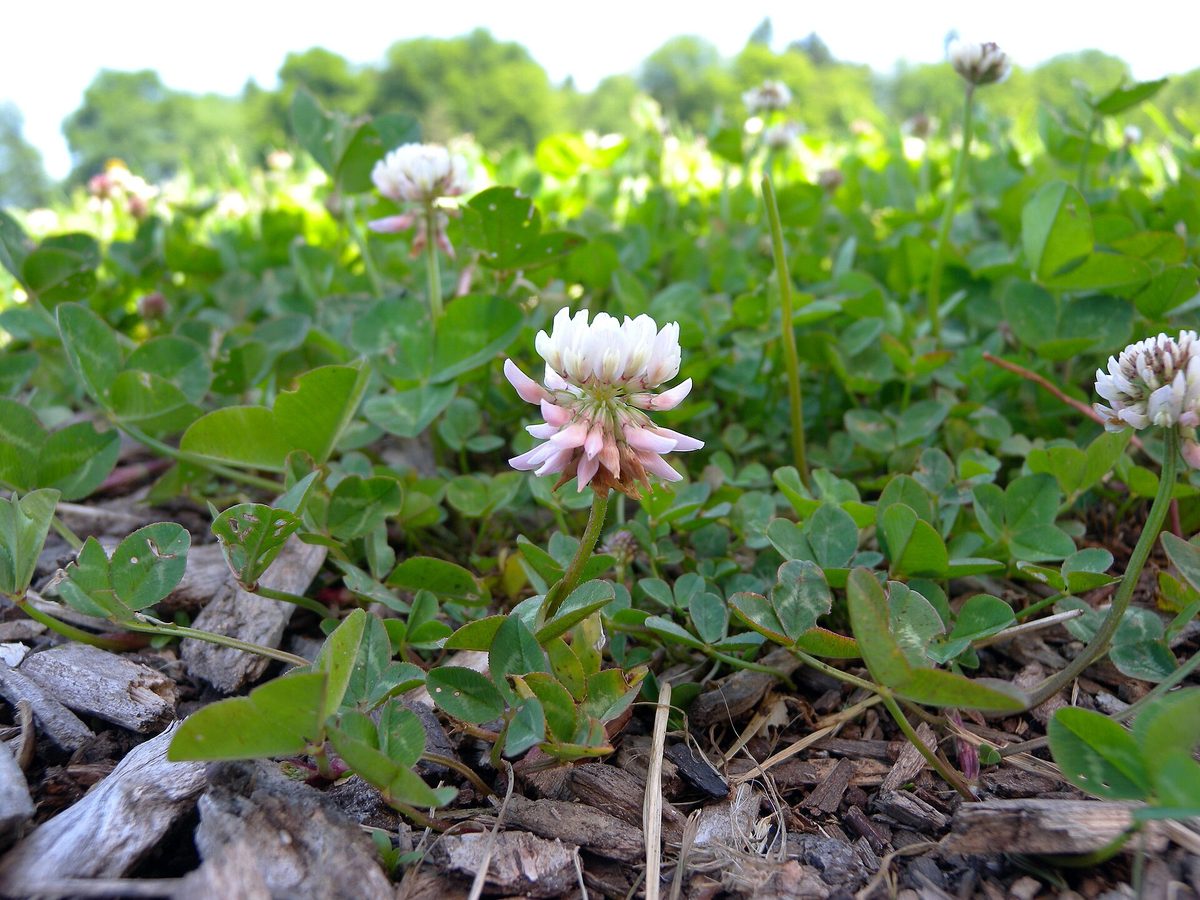
Photo: MurielBendel, CC BY-SA 4.0 via Wikimedia Commons

Quick facts
| Light: | Full sun and part shade (full sun preferred)11 source |
|---|---|
| Water: | Medium to wet11 source |
| Soil: | Well drained and moist; pH 6–7121 source |
| Hardiness: | Zones 3a–10b11 source |
| Size: | 0.3–0.5 ft (0.1–0.15 m) × 1 ft (0.3 m)11 source |
| Growth rate: | Rapid11 source |
| Bloom: | May–Oct, White511 source |
| Cats: | Not documented by major sources |
| Dogs: | Not documented by major sources |
| Native range: | AFG, ALB, ALG, ALT, AUT, AZO, BAL, BGM, BLR, BLT, BRY, BUL, COR, CZE, DEN, EAI, EGY, EHM, ETH, FIN, FOR, FRA, GER, GRB, GRC, HUN, ICE, IND, IRE, IRK, IRN, IRQ, ITA, KAZ, KEN, KGZ, KRA, KRI, KRY, LBS, MDR, MON, MOR, NCS, NEP, NET, NOR, PAK, PAL, POL, POR, ROM, RUC, RUE, RUN, RUS, RUW, SAR, SIC, SPA, SWE, SWI, TAN, TCS, TKM, TUE, TUN, TUR, TVA, TZK, UKR, UZB, WHM, WSB, YUG, ZIM6 |
| Family: | Fabaceae |
How much light does a White Clover need?
White clover takes full sun and part shade, with full sun preferred. Full sun means 6 or more hours of direct sunlight a day. Partial shade means direct sunlight for only part of the day, about 2–6 hours. The minimum sun on file is 2 hours a day. Sites with 6 or more hours of direct sun match its preferred light.
How often to water a White Clover
Water needs for white clover run from medium to wet. Medium is the low end of its range, and medium wet is the high end. The source says it likes moist soil, sun to part shade. Drainage is listed as well drained and moist. The plant is also listed as tolerant of clay soil.
- Water: Medium to wet1
Best soil for a White Clover
Aim for a soil pH between 6 and 7, which gives the best results. Drainage is listed as well drained and moist. The source lists good drainage for this plant. Clay soil is on its list of tolerances. So are black walnut and erosion. It can fix its own nitrogen, so it thrives in unfertilized areas. Its water range is medium to wet.
Hardiness and temperature
USDA hardiness zones 3a through 10b are listed for white clover. The minimum temperature on file is 24.8 °F (-4 °C). The source describes complete loss of a stand from severe freezes below 25 °F during the seedling stage. Seedlings are the stage at risk from a severe freeze. Zone 3a is the coldest end of its listed range.
Fertilizing a White Clover
Fertilizer is listed as not needed for white clover. The source says it is capable of fixing its nitrogen. That is the reason given for its success in unfertilized areas. The recorded feeding frequency is none. It is also listed as a rapid grower.
- Fertilizer: Not needed4
How to plant a White Clover
Plant it anywhere in zones 3a through 10b. Give each plant about 1 ft (0.3 m) of room to spread. Mature height is 0.3–0.5 ft (0.1–0.15 m). Pick a site with 6 or more hours of direct sun, though part shade is also listed. Aim for a soil pH between 6 and 7. In the United States, it is recorded as introduced in the lower 48 states, Alaska and Hawaii. Its growth rate is rapid.
- Hardiness: Zones 3a–10b1
Winter care
A severe freeze below 25 °F can cause complete loss of a stand at the seedling stage. The recorded minimum is 24.8 °F (-4 °C). Its listed hardiness runs through every half-zone from 3a to 10b. Zone 3a is the coldest end of that range. White clover is a herbaceous perennial. Its habit is spreading.
How to propagate a White Clover
Seed and layering are the two propagation methods listed. The source says white clover reproduces by seed and by creeping stolons. Creeping is also the growth habit recorded, with a rapid growth rate. A mature plant spreads about 1 ft (0.3 m). White clover is a herbaceous perennial. Seed is listed first, and layering second.
- Propagation: Seed and layering4
Common problems
Clover rot is the disease named for white clover. The source says clover is a host to clover rot. It adds that clover should not be used too frequently as a cover crop. No cited source records common pests for this page. It tolerates black walnut. It also tolerates clay soil. Erosion is another listed tolerance.
- Common diseases: clover rot1
| Problem | Kind |
|---|---|
| Clover rot | Disease |
Is White Clover toxic to cats and dogs?
Recommended supplies
- Soil: a free-draining mix, and a pot with a drainage hole.
Questions and answers
- Does white clover need fertilizer?
- Fertilizer is listed as not needed. The source says white clover can fix its own nitrogen, which lets it thrive in unfertilized areas. The recorded feeding frequency is none.
- When does white clover bloom, and what color are the flowers?
- The flowers are white. Bloom time is long, usually from the end of May to October, with a peak of flowering in June. Bees, butterflies and moths are recorded as pollinator value.
- How tall and wide does white clover grow?
- It reaches about 0.3–0.5 ft (0.1–0.15 m) tall. The spread is about 1 ft (0.3 m). Its growth rate is rapid and its habit is spreading.
Sources
- NC State Extension Gardener Plant Toolbox. https://plants.ces.ncsu.edu/plants/trifolium-repens/. Accessed 21 October 2026.
- Penn State Extension. https://extension.psu.edu/white-clover. Accessed 24 October 2026.
- University of Florida IFAS Extension (EDIS). https://ask.ifas.ufl.edu/publication/AA198. Accessed 21 October 2026.
- Clemson Cooperative Extension Home & Garden Information Center. https://hgic.clemson.edu/factsheet/white-clover/. Accessed 21 October 2026.
- University of Minnesota Extension. https://extension.umn.edu/garden-and-home/yard-and-garden/lawns-and-landscapes-in-minnesota/planting-and-maintaining-a-bee-lawn. Accessed 24 October 2026.
- Royal Botanic Gardens, Kew (World Checklist of Vascular Plants). https://sftp.kew.org/pub/data-repositories/WCVP/wcvp.zip. Accessed 4 June 2026.
How this page was made
- Written with AI assistance from the sources listed on this page. AI is never the source of a fact.