Parsley (Petroselinum crispum)
Formerly Petroselinum sativum, Apium petroselinum, Petroselinum hortense
Give parsley full sun, though part shade is also accepted, and keep its soil moist and well drained. Its water needs run from medium to wet. Parsley is a biennial that is usually grown as an annual. The ASPCA lists it as toxic to cats and toxic to dogs.
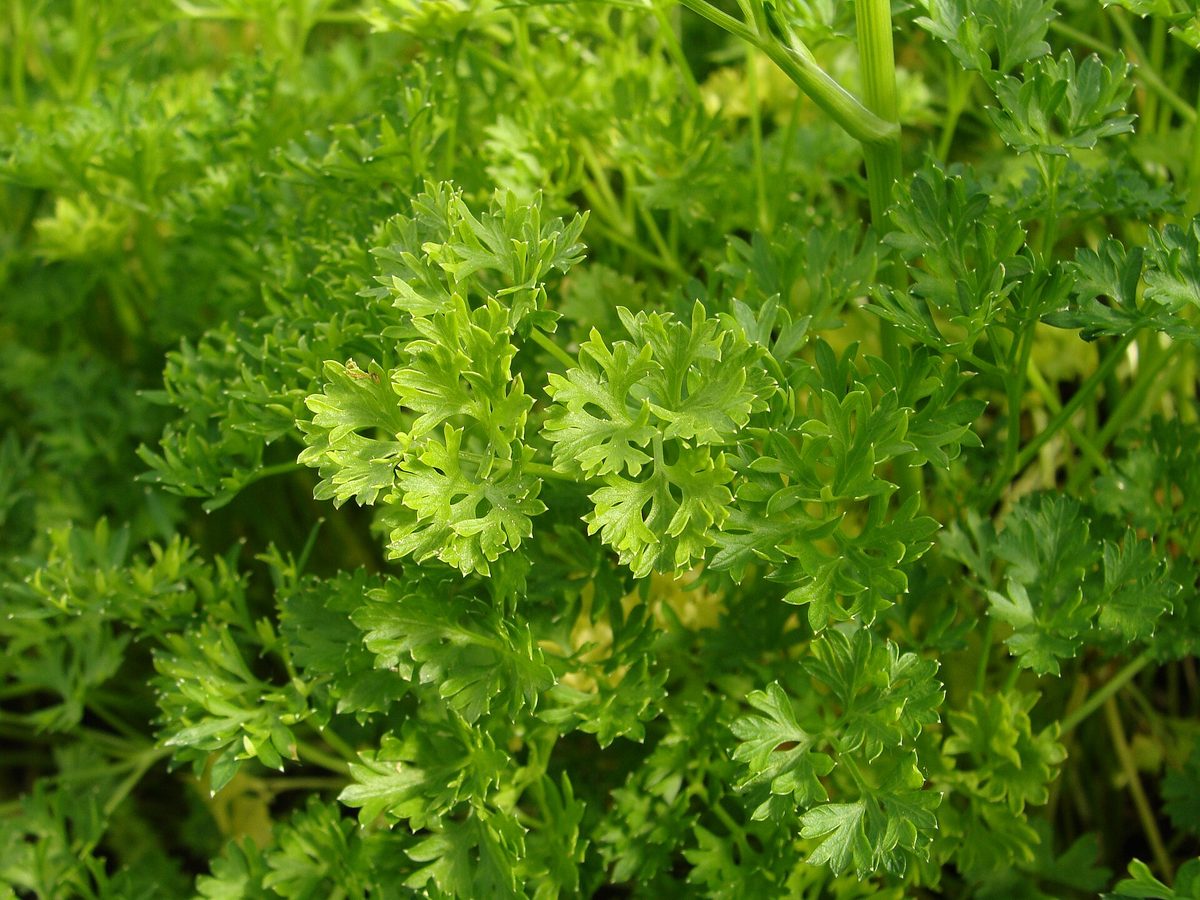
Photo: Blackerking, CC BY-SA 4.0 via Wikimedia Commons

Quick facts
| Light: | Full sun and part shade (full sun preferred)123 |
|---|---|
| Water: | Medium to wet11 source |
| Soil: | Well drained and moist; pH 6–714 |
| Size: | 1–1.5 ft (0.3–0.46 m) × 0.7–1 ft (0.2–0.3 m)511 source |
| Growth rate: | Moderate111 source |
| Bloom: | Yellow and green15 |
| Cats: | Toxic to cats (1 source) 6 |
| Dogs: | Toxic to dogs (1 source) 6 |
| Native range: | ALG, GRC, MOR, YUG7 |
| Family: | Apiaceae |
How much light does a Parsley need?
Parsley grows best in full sun, which NC State Extension defines as six or more hours of direct sunlight a day. It also accepts part shade, and Clemson Cooperative Extension suggests light shade for growing it. Grown indoors, parsley does best with high light and a cool growing location. The indoor light record is listed as direct sun.
How often to water a Parsley
Parsley's water needs run from medium to wet. NC State Extension describes the ideal as consistently moist, well-drained rich soil. The University of Minnesota Extension also advises well-drained soil that is rich in organic matter. Clemson Cooperative Extension pairs rich, moist soil with light shade.
- Water: Medium to wet1
Best soil for a Parsley
Parsley soil should be well drained and moist. NC State Extension describes consistently moist, well-drained rich soil. The University of Minnesota Extension says parsley grows best in well-drained soil that is rich in organic matter. Clemson Cooperative Extension recommends rich, moist soil in light shade. Both drainage and moisture matter, and the record lists the two together. No cited source records a soil pH range for parsley, so that value is not documented here.
When and how to harvest Parsley
Cut the outer stalks close to the ground once the leaves are large enough to use. You can keep harvesting until the plant bolts to seed in its second year. The University of Minnesota Extension describes the end point as the plant sending up a seed stalk and dying. No cited source gives a days-to-maturity figure, so that value is not documented here.
- Harvest: Cut outer stalks close to the ground once leaves are large enough to use, continuing until the plant bolts to seed in its second year3
How to propagate a Parsley
Parsley is propagated by seed. The University of Minnesota Extension calls direct seeding the easiest way to start parsley. The University of Wisconsin-Madison Division of Extension suggests starting seeds indoors 8 to 10 weeks before the last spring frost. Seed is the only method recorded for this page.
Common problems
Common pests include carrot weevil, flea beetles, leafhoppers and tarnished plant bugs. Aphids are listed too, and the University of Wisconsin-Madison Division of Extension calls them the most common. The black swallowtail caterpillar is also on the list. Septoria leaf spot and stem rot are the diseases NC State Extension names. Bacterial blight is also recorded.
| Problem | Kind |
|---|---|
| Carrot weevil | Pest |
| Flea beetles | Pest |
| Leafhoppers | Pest |
| Tarnished plant bugs | Pest |
| Aphids | Pest |
| Black swallowtail caterpillar | Pest |
| Septoria leaf spot | Disease |
| Stem rot | Disease |
| Bacterial blight | Disease |
Is Parsley toxic to cats and dogs?
The ASPCA Animal Poison Control Center lists parsley as toxic to cats. The same center lists parsley as toxic to dogs. Cats and dogs each have their own record, and each is marked toxic. The position is the same for both animals. In the ASPCA listing, neither cats nor dogs are marked as non-toxic. The records give no severity, no affected plant parts and no clinical signs, so none are stated here.
Pet-safe alternatives
Recommended supplies
- Soil: a free-draining mix, and a pot with a drainage hole.
Questions and answers
- Is parsley toxic to cats and dogs?
- The ASPCA lists parsley as toxic to cats and as toxic to dogs. The records give no severity, plant parts or signs, so this page does not state any.
- How much sun does parsley need?
- Parsley grows best in full sun, meaning six or more hours of direct sunlight a day, and it also accepts part shade. Indoors, it does best with high light and a cool growing location.
- Is parsley an annual or a biennial?
- NC State Extension calls parsley a hardy biennial that is usually grown as an annual. Its greenish-yellow flowers grow in compound umbels in the second year.
Sources
- NC State Extension. https://plants.ces.ncsu.edu/plants/petroselinum-crispum/. Accessed 11 October 2026.
- Clemson Cooperative Extension HGIC. https://hgic.clemson.edu/factsheet/herbs/. Accessed 11 October 2026.
- University of Minnesota Extension. https://extension.umn.edu/vegetables/growing-parsley. Accessed 11 October 2026.
- University of Minnesota Extension. https://extension.umn.edu/garden-and-home/yard-and-garden/gardening-in-minnesota/growing-parsley. Accessed 11 October 2026.
- University of Wisconsin-Madison Division of Extension. https://hort.extension.wisc.edu/articles/parsley-petroselinum-crispum/. Accessed 11 October 2026.
- ASPCA Animal Poison Control Center. https://www.aspca.org/pet-care/aspca-poison-control/toxic-and-non-toxic-plants/parsley. Accessed 11 October 2026.
- Royal Botanic Gardens, Kew (World Checklist of Vascular Plants). https://sftp.kew.org/pub/data-repositories/WCVP/wcvp.zip. Accessed 4 June 2026.
How this page was made
- Written with AI assistance from the sources listed on this page. AI is never the source of a fact.