Sinkwa Towelsponge (Luffa acutangula)
Formerly Cucurbita acutangula, Luffa gosa, Luffa amara
Sinkwa towelsponge, Luffa acutangula, needs well drained soil. It also requires high moisture. Its water need runs from medium to wet. It is a fast-growing, warm-climate vine. The vines can reach 30 ft (9.14 m) long. It needs a sturdy trellis. Indoor light and toxicity to cats and dogs are not documented.
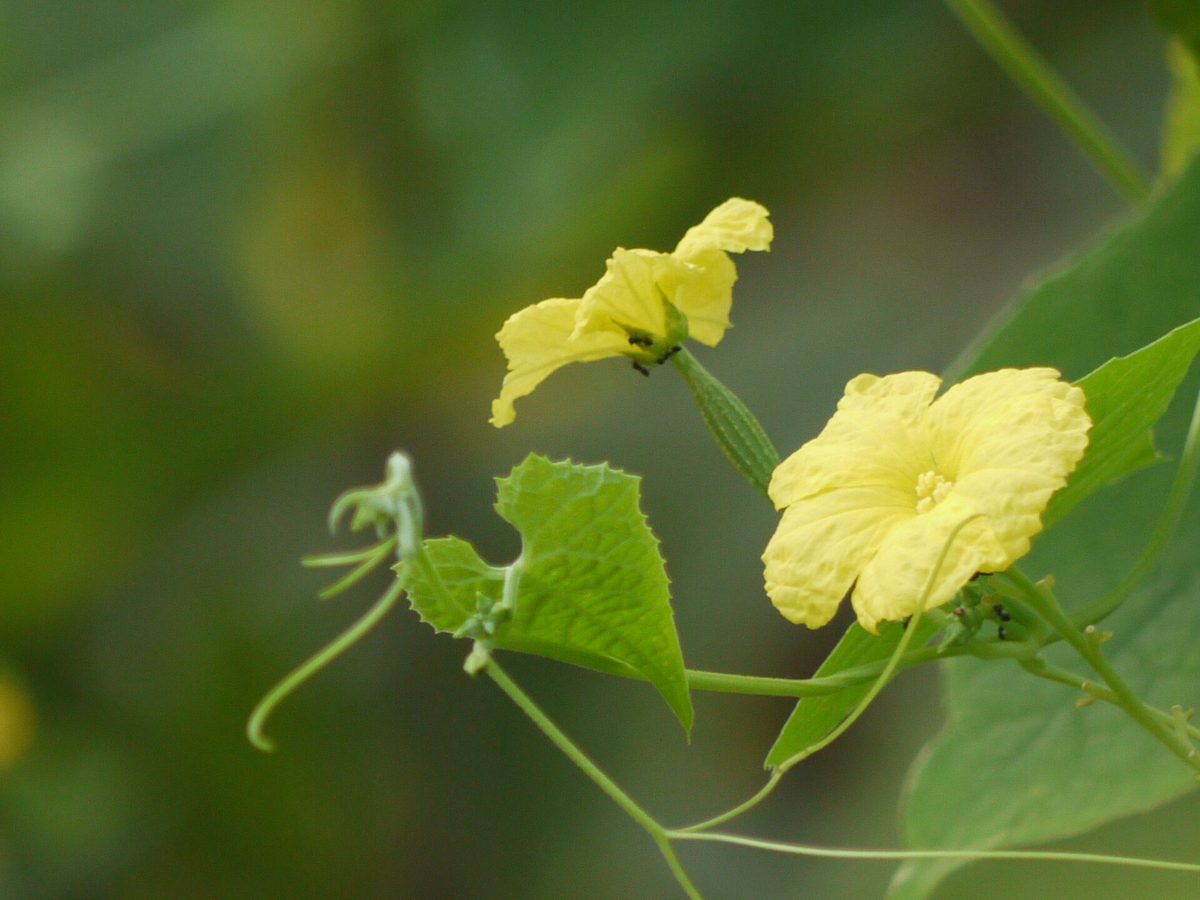
Photo: Dinesh Valke from Thane, India, CC BY-SA 2.0 via Wikimedia Commons

Quick facts
| Water: | Medium to wet11 source |
|---|---|
| Soil: | Well drained; pH 6–6.521 source |
| Size: | 30 ft (9.14 m) × 23–29.9 ft (7–9.1 m)211 source |
| Growth rate: | Rapid2322 |
| Bloom: | Yellow and orange23 |
| Cats: | Not documented by major sources |
| Dogs: | Not documented by major sources |
| Native range: | ASS, BAN, EHM, IND, PAK, SRL, WHM5 |
| Family: | Cucurbitaceae |
How often to water a Sinkwa Towelsponge
High moisture conditions are a requirement for luffa. Its water need is recorded as medium to wet. At the same time, luffa must have well drained soil. Moisture and drainage are both requirements, not a choice between the two. The medium end of the range is the lowest moisture level recorded.
- Water: Medium to wet1
Best soil for a Sinkwa Towelsponge
The target soil pH for luffa is 6.0 to 6.5. Luffa is also described as preferring neutral to slightly alkaline soil conditions. Luffa must have well drained soil. It also requires high moisture conditions. Its recorded drainage need is well drained. Its water range is medium to wet. Luffa is a fast-growing, long-season, warm-climate crop. The pH figure is given as a range of 6 to 6.5, not a single value.
How to propagate a Sinkwa Towelsponge
Seed is the only propagation method on file for this plant. Start luffas from seeds in warm soil. Luffa is a long-season, warm-climate crop. Vine length is up to 30 ft (9.14 m). The vines grow fast and need a sturdy trellis to keep the fruit off the ground.
- Propagation: Seed3
Common problems
Leafminer is a common insect pest targeting luffa. Other recorded pests are melon fruit fly, whiteflies and melon thrips. Recorded diseases are fruit rot, black rot, yellow stunting disorder virus and reniform nematode. Fruit rot is a common disease and can lead to losses if fruits are grown near the ground. A sturdy trellis keeps the luffas off the ground so they do not rot.
| Problem | Kind |
|---|---|
| Leafminer | Pest |
| Melon fruit fly | Pest |
| Whiteflies | Pest |
| Melon thrips | Pest |
| Fruit rot | Disease |
| Black rot | Disease |
| Yellow stunting disorder virus | Disease |
| Reniform nematode | Disease |
Is Sinkwa Towelsponge toxic to cats and dogs?
Recommended supplies
- Soil: a free-draining mix, and a pot with a drainage hole.
Questions and answers
- How tall does sinkwa towelsponge grow?
- Vine length is up to 30 ft (9.14 m). The vines are fast-growing and need a sturdy trellis to keep luffas off the ground. Luffa is a fast-growing, long-season, warm-climate crop.
- What color are the flowers?
- Both male and female flowers are yellow or orange. They are 2 to 3 inches (5 to 7.6 cm) in diameter. Yellow and orange are the colors recorded for the species.
- Is sinkwa towelsponge native to the United States?
- In the lower 48 states its native status is introduced. In Puerto Rico its native status is also introduced. The record covers US-L48 and US-PR only.
Sources
- UF/IFAS EDIS. https://ask.ifas.ufl.edu/hs1285. Accessed 29 October 2026.
- UF/IFAS EDIS. https://ask.ifas.ufl.edu/publication/HS1285. Accessed 14 October 2026.
- Clemson Cooperative Extension HGIC. https://hgic.clemson.edu/growing-luffa/. Accessed 14 October 2026.
- EPPO Global Database. https://gd.eppo.int/taxon/LUFAC/pests. Accessed 14 October 2026.
- Royal Botanic Gardens, Kew (World Checklist of Vascular Plants). https://sftp.kew.org/pub/data-repositories/WCVP/wcvp.zip. Accessed 4 June 2026.
How this page was made
- Written with AI assistance from the sources listed on this page. AI is never the source of a fact.