Pride of India (Lagerstroemia speciosa)
Formerly Murtughas speciosa, Munchausia speciosa, Adambea glabra
Grow pride of India in full sun with medium to wet soil, and expect a fast-growing deciduous tree. It suits USDA hardiness zones 10b to 11b, and no cited source records its toxicity to cats or dogs. In the right climate it can reach 30 to 60 ft (9.14–18.29 m) tall.
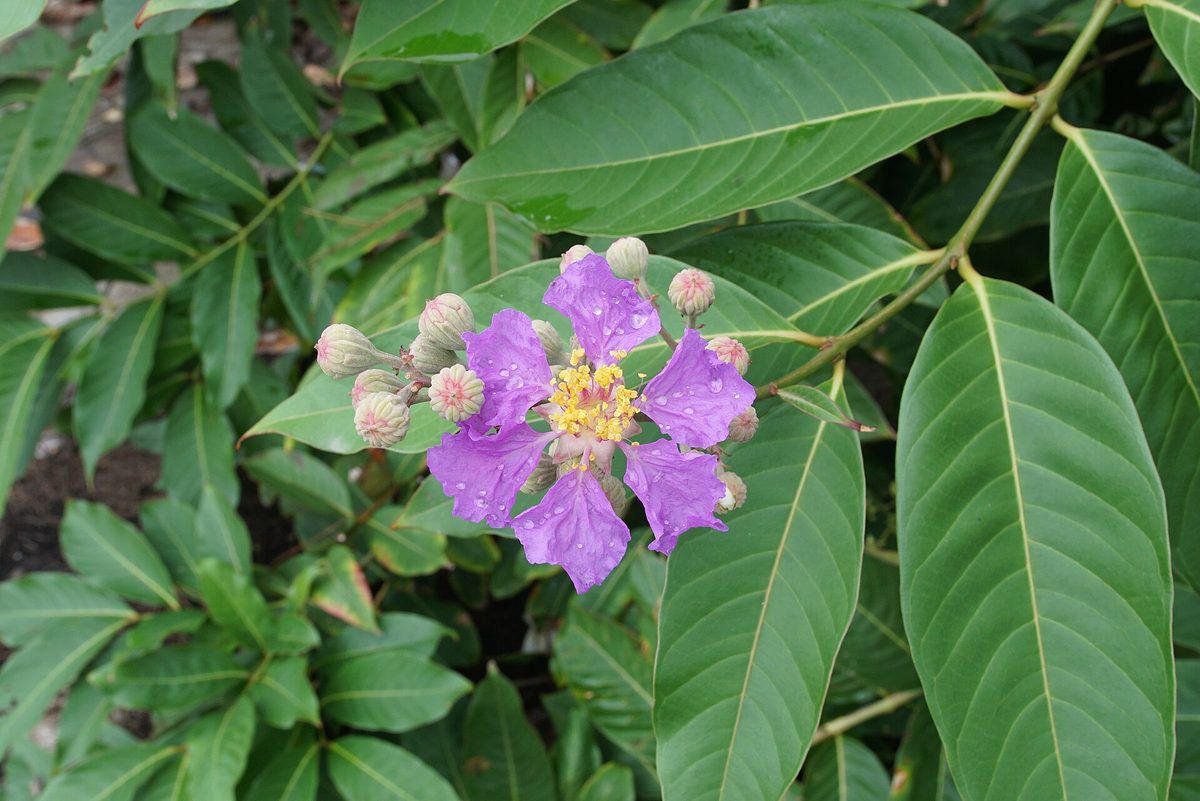
Photo: Vengolis, CC BY-SA 4.0 via Wikimedia Commons

Quick facts
| Water: | Medium to wet11 source |
|---|---|
| Soil: | Well drained, moist and occasionally wet21 source |
| Size: | 30–60 ft (9.14–18.29 m) × 30–40 ft (9.14–12.19 m)211 source |
| Growth rate: | Rapid21 source |
| Bloom: | Jun–Jul, Pink and purple21 source |
| Cats: | Not documented by major sources |
| Dogs: | Not documented by major sources |
| Native range: | ASS, BAN, BOR, CBD, CHC, EHM, IND, JAW, LAO, LSI, MLY, MOL, MYA, NWG, PHI, SRL, SUL, SUM, THA, VIE3 |
| Family: | Lythraceae |
How often to water a Pride of India
Pride of India has a medium to wet water need. It prefers warm, humid and moist soils. It can also tolerate some standing water. Its listed drainage range runs from well drained to moist and occasionally wet. Think of its range as medium at the dry end and wet at the other.
- Water: Medium to wet1
Best soil for a Pride of India
Pride of India will grow in full sun on a wide range of well-drained soils. Its listed drainage conditions are well drained, moist and occasionally wet. It prefers warm, humid and moist soils, and it can tolerate some standing water. The water range is medium to wet. Full sun is the preferred light outdoors. Leave room for a spread of 30 to 40 ft (9.14–12.19 m) when you choose a planting site.
- Soil drainage: Well drained, moist and occasionally wet2
How to propagate a Pride of India
You can propagate pride of India by seed, division or stem cuttings. The division method uses root suckers. Seed is listed as germinating readily. Cuttings are the third method named, alongside seed and division. Whichever you choose, the resulting tree will need full sun and space for a spread of 30 to 40 ft (9.14–12.19 m).
- Propagation: Seed, division and stem cuttings2
Common problems
Aphids and scale are occasional insect pests. Powdery mildew and fungal leaf spot are common disease problems. Pests here are described as occasional, while the diseases are described as common. In all, four problems are recorded: aphids, scale, powdery mildew and leaf spot. Two are insects and two are diseases.
| Problem | Kind |
|---|---|
| Aphids | Pest |
| Scale insects | Pest |
| Powdery mildew | Disease |
| Leaf spot | Disease |
Is Pride of India toxic to cats and dogs?
Recommended supplies
- Soil: a free-draining mix, and a pot with a drainage hole.
Questions and answers
- How much sun does pride of India need?
- Pride of India prefers full sun, listed as six or more hours of direct sunlight a day. It will grow in that light on a wide range of well-drained soils. Plan for a tree that reaches 30 to 60 ft (9.14–18.29 m).
- Which USDA zones suit pride of India?
- It is listed for USDA zones 10b to 11b. The tree is deciduous and has a fast growth rate. Its habit is erect and its plant type is tree. It is listed as introduced in Puerto Rico (US-PR).
- How does pride of India grow and flower?
- Pride of India has a fast growth rate and an erect habit. Its blooms are pink and purple. They appear from June to July in dense terminal panicles about a foot long.
Sources
- NC State Extension Gardener Plant Toolbox. https://plants.ces.ncsu.edu/plants/lagerstroemia-speciosa/. Accessed 21 October 2026.
- University of Florida IFAS Extension (EDIS). https://ask.ifas.ufl.edu/publication/ST349. Accessed 21 October 2026.
- Royal Botanic Gardens, Kew (World Checklist of Vascular Plants). https://sftp.kew.org/pub/data-repositories/WCVP/wcvp.zip. Accessed 4 June 2026.
How this page was made
- Written with AI assistance from the sources listed on this page. AI is never the source of a fact.