Wild Hydrangea (Hydrangea arborescens)
Formerly Hydrangea acuta, Hydrangea cordata, Viburnum alnifolium
To keep wild hydrangea healthy outdoors, give it full sun to full shade and keep the soil at medium moisture. It tolerates a range of light but full sun suits it best. This shrub is toxic to both cats and dogs, so keep pets away from it.
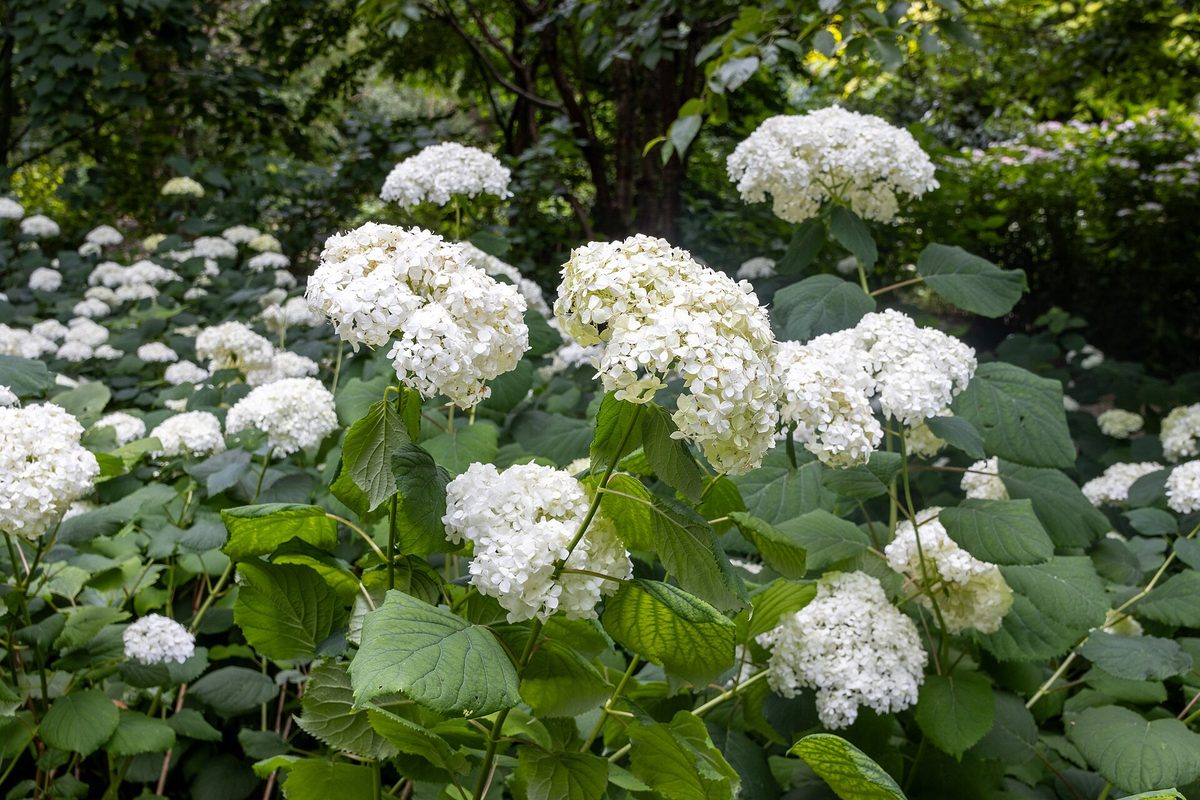
Photo: Wikimedia Commons contributor, CC BY-SA 4.0 via Wikimedia Commons

Quick facts
| Light: | Full sun, part shade and full shade (full sun preferred)12 |
|---|---|
| Water: | Medium11 source |
| Soil: | Well drained and moist; pH 5–8132 |
| Hardiness: | Zones 3a–9b11 source |
| Size: | Sources differ: Penn State Extension; Oregon State University Extension Service; Penn State Extension × 3–6 ft (0.91–1.83 m)482910111Sources differ |
| Growth rate: | Rapid11 source |
| Bloom: | White and green4918 |
| Cats: | Toxic to cats 67 |
| Dogs: | Toxic to dogs 67 |
| Native range: | ALA, ARK, DEL, FLA, GEO, ILL, INI, KTY, LOU, MRY, MSI, MSO, NCA, NWJ, NWY, OHI, OKL, PEN, SCA, TEN, VER, VRG, WDC, WVA12 |
| Family: | Hydrangeaceae |
How much light does a Wild Hydrangea need?
Full sun works best for wild hydrangea, though it also grows well in part shade or full shade. More sun usually means more flowers, while shade suits hot, dry climates better. Pick a spot with at least some direct light each day for the strongest bloom.
How often to water a Wild Hydrangea
Wild hydrangea does best with medium, consistent moisture in the soil. Check the top few inches of soil and water when it starts to dry out, rather than on a fixed schedule. Soil that drains well but still holds some moisture suits this shrub, since soggy ground can cause problems. Avoid letting the root zone dry out completely, especially during its fast growth phase.
- Water: Medium1
Best soil for a Wild Hydrangea
Plant wild hydrangea in soil that drains well but still stays moist, not soggy or bone-dry. A soil pH between 5 and 8 suits this shrub, so it tolerates acidic to mildly alkaline ground. Heavy clay that holds standing water can lead to root problems, so work in organic matter if your soil is dense. Raised beds or amended planting holes help in areas where drainage is poor.
Hardiness and temperature
USDA zones 3a through 9b all support wild hydrangea outdoors. That range covers hard winters in the north and warm, humid summers in the south. Zone 3a gardeners see regular hard freezes, while zone 9b gardeners see mild winters. No cited source for this page gives a minimum survivable temperature. Use your zone rating as the main guide to how much cold this shrub takes. The wide zone range already spans humid and dry climates, so humidity alone is not a separate limit. Outside zones 3a to 9b, expect more cold or heat stress than the plant handles well.
- Hardiness: Zones 3a–9b1
Pruning a Wild Hydrangea
Prune wild hydrangea hard in late winter, before new growth starts. This hard renewal cut means removing old stems back close to the ground to make room for fresh growth. A hard renewal cut like this keeps old, woody growth from building up over the years. Because this shrub grows fast, it recovers quickly and still blooms the same year. Wait until the coldest part of winter has passed so new cuts are not exposed to a hard freeze.
How to plant a Wild Hydrangea
This shrub grows outdoors in USDA zones 3a through 9b, which covers most of the continental US. Choose a planting spot that matches the light range it tolerates, from full sun to full shade. Give it room to spread, since a mature plant reaches about 3-6 ft (0.9-1.8 m) wide. Gardeners from zone 3a up through zone 9b can grow this shrub without worrying that their local climate rules it out. Work compost into the planting hole if your soil is heavy, since this shrub prefers ground that drains well but stays moist.
- Hardiness: Zones 3a–9b1
Winter care
Cold winters are not a problem for wild hydrangea within its hardiness range of USDA zones 3a to 9b. Gardeners at the colder end of that range can expect the top growth to die back each winter. Because you prune this shrub back hard in late winter anyway, winter dieback on old stems is not a concern. A layer of mulch over the root zone helps protect it through the coldest part of the year.
- Hardiness: Zones 3a–9b1
How to propagate a Wild Hydrangea
Three methods work for starting new wild hydrangea plants: stem cuttings, layering, and seed. Stem cuttings taken from soft new growth root fastest and give you a plant identical to the parent. Layering works by bending a low stem to the ground and letting it root before you cut it free. Seed takes longer and grows more slowly to a mature size, since this shrub is otherwise a fast grower.
- Propagation: Layering, seed and stem cuttings1
Common problems
Watch for aphids, mites, scale, and nematodes on wild hydrangea, since these are the pests most likely to show up. Common diseases include bud blight, bacterial wilt, leaf spots, mold, rust, and powdery mildew. Good airflow and soil that drains well cut down on fungal problems like mold and powdery mildew. Catching an aphid or mite problem early makes it easier to treat before it spreads.
| Problem | Kind |
|---|---|
| Aphids | Pest |
| Mites | Pest |
| Scale insects | Pest |
| Nematodes | Pest |
| Bud blight | Disease |
| Bacterial wilt | Disease |
| Leaf spots | Disease |
| Mold | Disease |
| Rust | Disease |
| Powdery mildew | Disease |
Is Wild Hydrangea toxic to cats and dogs?
Wild hydrangea is toxic to cats. It is also toxic to dogs. Keep cats and dogs away from the leaves, flowers, and stems of this shrub, and do not let them chew on cuttings or fallen plant material. This toxicity applies to the whole plant, not just one part of it. If your pet eats part of this plant, contact your vet or a pet poison line right away. Watch for signs of illness after exposure, since even a small amount can cause a reaction in a cat or dog.
Pet-safe alternatives
Recommended supplies
- Soil: a free-draining mix, and a pot with a drainage hole.
Questions and answers
- Is wild hydrangea toxic to pets?
- Yes, wild hydrangea is toxic to both cats and dogs, so keep your pets from chewing on its leaves or flowers. Contact your vet or a pet poison line if your pet eats any part of the plant.
- How much sun does wild hydrangea need?
- Wild hydrangea grows well in full sun, part shade, or full shade, though full sun usually gives you the most blooms. Pick a spot with at least some direct sun each day if you want strong flowering.
- When should I prune wild hydrangea?
- Prune it back hard in late winter, before new growth starts for the season. This hard renewal cut keeps the shrub a manageable size and still allows it to bloom that year, since it grows fast.
Sources
- NC State Extension Gardener Plant Toolbox. https://plants.ces.ncsu.edu/plants/hydrangea-arborescens/. Accessed 14 October 2026.
- Cornell University CALS Woody Plants Database. https://woodyplants.cals.cornell.edu/plant/113. Accessed 14 October 2026.
- Clemson Cooperative Extension Home & Garden Information Center. https://hgic.clemson.edu/hydrangeas/. Accessed 14 October 2026.
- Clemson Cooperative Extension Home & Garden Information Center. https://hgic.clemson.edu/native-hydrangeas/. Accessed 14 October 2026.
- Penn State Extension. https://extension.psu.edu/when-to-prune-which-hydrangea-species. Accessed 14 October 2026.
- ASPCA Animal Poison Control Center. https://www.aspca.org/pet-care/aspca-poison-control/toxic-and-non-toxic-plants/hydrangea. Accessed 14 October 2026.
- Pet Poison Helpline. https://www.petpoisonhelpline.com/poison/hydrangea/. Accessed 14 October 2026.
- Lady Bird Johnson Wildflower Center. https://www.wildflower.org/plants/result.php?id_plant=HYAR. Accessed 14 October 2026.
- Lady Bird Johnson Wildflower Center (Native Plant Database). https://www.wildflower.org/plants/result.php?id_plant=hyar. Accessed 14 October 2026.
- Penn State Extension. https://extension.psu.edu/wild-hydrangeas. Accessed 14 October 2026.
- Oregon State University Extension Service. https://extension.oregonstate.edu/news/hydrangeas-bring-beauty-variety-oregon-gardens. Accessed 14 October 2026.
- Royal Botanic Gardens, Kew (World Checklist of Vascular Plants). https://sftp.kew.org/pub/data-repositories/WCVP/wcvp.zip. Accessed 4 June 2026.
How this page was made
- Written with AI assistance from the sources listed on this page. AI is never the source of a fact.