Eastern Cottonwood (Populus deltoides)
Formerly Populus angulata, Populus sargentii, Populus monilifera
Give eastern cottonwood full sun outdoors for best growth. It also tolerates part shade and full shade. It tolerates soil moisture from dry to wet. It grows in USDA hardiness zones 3a to 9b outdoors. It is considered the fastest-growing native tree in North America. It is classified as a tree. No cited source lists its toxicity to cats or dogs.
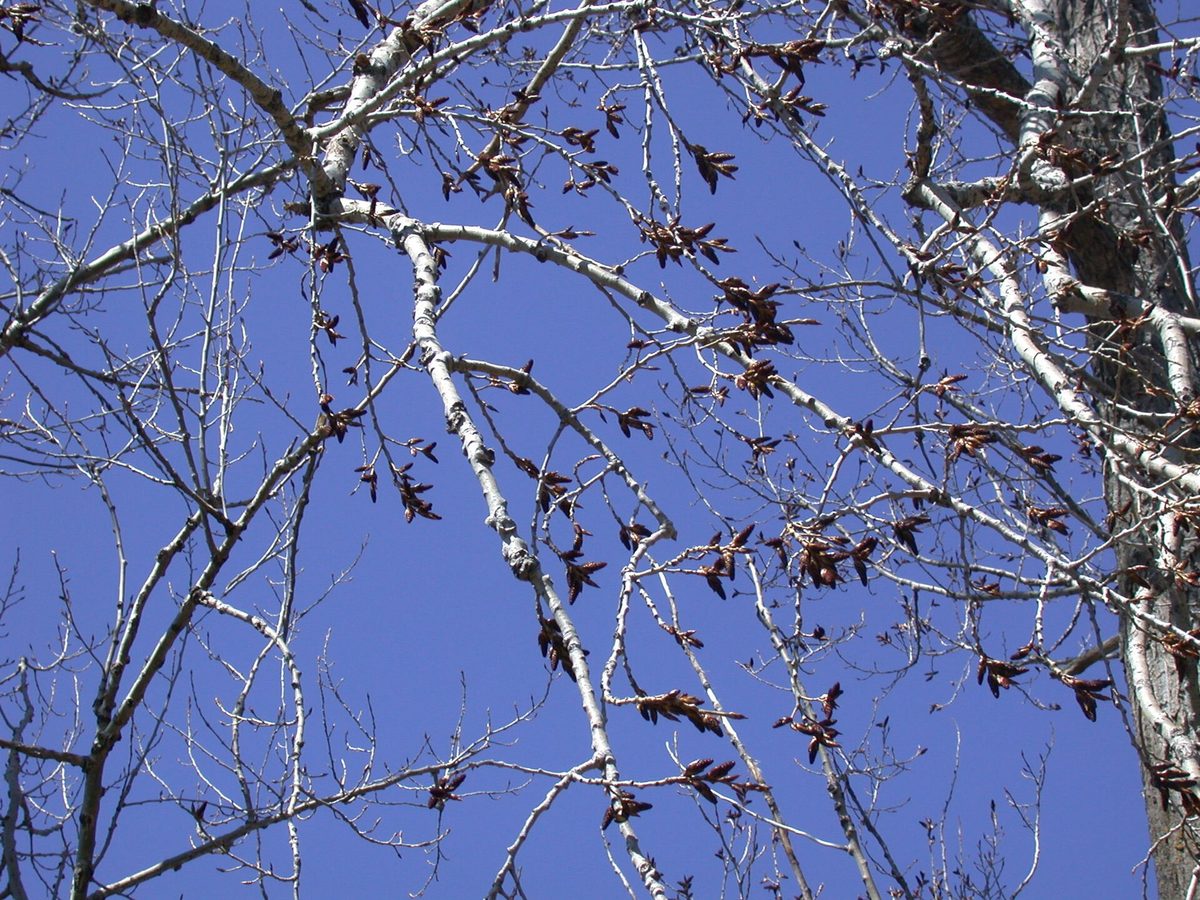
Photo: Wikimedia Commons contributor, CC BY-SA 4.0 via Wikimedia Commons

Quick facts
| Light: | Full sun, part shade and full shade (full sun preferred)12 |
|---|---|
| Water: | Dry to wet23 |
| Soil: | Well drained, moist, occasionally dry and occasionally wet; pH 4.5–8411 source |
| Hardiness: | Zones 3a–9b11 source |
| Size: | 75–100 ft (22.86–30.48 m) × 50–75 ft (15.24–22.86 m)16 |
| Growth rate: | Rapid15 |
| Bloom: | Yellow and red11 source |
| Cats: | Not documented by major sources |
| Dogs: | Not documented by major sources |
| Native range: | ABT, ALA, ARI, ARK, CNT, COL, DEL, FLA, GEO, IDA, ILL, INI, IOW, KAN, KTY, LOU, MAN, MAS, MIC, MIN, MNT, MRY, MSI, MSO, MXE, MXG, MXN, MXS, NCA, NDA, NEB, NWH, NWJ, NWM, NWY, OHI, OKL, ONT, ORE, PEN, QUE, SAS, SCA, SDA, TEN, TEX, UTA, VER, VRG, WAS, WDC, WIS, WVA, WYO7 |
| Family: | Salicaceae |
How much light does an Eastern Cottonwood need?
Full sun suits eastern cottonwood best outdoors, with six or more hours of direct light a day. It also tolerates part shade and even full shade. This tree has a rapid growth rate and is considered the fastest-growing native tree in North America. At maturity it reaches 75 to 100 ft (22.9-30.5 m) tall.
How often to water an Eastern Cottonwood
Soil moisture tolerance for this tree ranges from dry to wet. It grows in soils that stay dry as well as those that stay wet. Sources list the species as suited to dry, moist, and wet sites. It also tolerates a wide range of soil pH, from 4.5 to 8.0.
Best soil for an Eastern Cottonwood
Eastern cottonwood accepts soil anywhere from fairly acidic to slightly alkaline, a pH of 4.5 up to 8.0. That is a wide range for a single species to tolerate. The tree also tolerates soils that stay consistently wet as well as those that stay dry. It grows across USDA hardiness zones 3a to 9b outdoors.
Hardiness and temperature
Eastern cottonwood grows outdoors in USDA hardiness zones 3a to 9b. That range spans from cold northern climates to warm southern ones. The species is native across a wide swath of North America, including much of the United States and parts of Canada and Mexico. It is classified as a tree.
- Hardiness: Zones 3a–9b1
How to plant an Eastern Cottonwood
Plant eastern cottonwood in full sun, the preferred exposure, though it also tolerates part shade and full shade. At maturity, this tree reaches a spread of 50 to 75 ft (15.2-22.9 m). It also tolerates soils that stay wet as well as those that stay dry, and a pH from 4.5 to 8.0. Outdoors, it grows across USDA hardiness zones 3a to 9b. Male catkins have red stamens, and female catkins have yellow stigmas with a round green ovary.
- Hardiness: Zones 3a–9b1
Winter care
The species ranges natively from southern Canada down through much of the United States into parts of Mexico. Within the contiguous United States, it is classified as native. Outdoor winter survival spans USDA hardiness zones 3a to 9b. Zone 3a covers some of the coldest regions where the species is grown.
- Hardiness: Zones 3a–9b1
How to propagate an Eastern Cottonwood
Growers propagate eastern cottonwood from seed or from stem cuttings. Typical cuttings used in the northern United States and Canada run 8 to 12 in (20-30 cm) long. It also occurs naturally across much of the United States and into Canada and Mexico. It grows outdoors across USDA hardiness zones 3a to 9b.
Common problems
Eastern cottonwood can have insect problems including the cottonwood leaf beetle, borers, aphids, caterpillars, and scales. It is also susceptible to several diseases, including dieback, canker, leaf spots, rust, and powdery mildew. One source notes that canker is a serious problem among the many it can face.
| Problem | Kind |
|---|---|
| Cottonwood leaf beetle | Pest |
| Borers | Pest |
| Aphids | Pest |
| Caterpillars | Pest |
| Scales | Pest |
| Dieback | Disease |
| Canker | Disease |
| Leaf spots | Disease |
| Rust | Disease |
| Powdery mildew | Disease |
Is Eastern Cottonwood toxic to cats and dogs?
Recommended supplies
- Soil: a free-draining mix, and a pot with a drainage hole.
Questions and answers
- Does eastern cottonwood need full sun?
- Eastern cottonwood grows best in full sun, but it also tolerates part shade and full shade outdoors. It is considered the fastest-growing native tree in North America.
- How wet or dry can the soil be for eastern cottonwood?
- Eastern cottonwood tolerates soil moisture from dry to wet, and sources list it as suited to dry, moist, and wet sites. It also tolerates a wide range of soil pH, from 4.5 to 8.0.
- What pests and diseases affect eastern cottonwood?
- This tree can face insect problems such as the cottonwood leaf beetle, borers, aphids, caterpillars, and scales. It is also susceptible to dieback, canker, leaf spots, rust, and powdery mildew.
Sources
- NC State Extension Gardener Plant Toolbox. https://plants.ces.ncsu.edu/plants/populus-deltoides/. Accessed 15 October 2026.
- Lady Bird Johnson Wildflower Center. https://www.wildflower.org/plants/result.php?id_plant=pode3. Accessed 15 October 2026.
- Iowa State University Extension and Outreach (Yard and Garden). https://yardandgarden.extension.iastate.edu/how-to/trees-and-shrubs-wet-soils. Accessed 15 October 2026.
- University of Missouri Extension. https://extension.missouri.edu/publications/g5006. Accessed 27 October 2026.
- USDA Forest Service Fire Effects Information System. https://www.fs.usda.gov/database/feis/plants/tree/popdel/all.html. Accessed 15 October 2026.
- Cornell University CALS Woody Plants Database. https://woodyplants.cals.cornell.edu/plant/186. Accessed 15 October 2026.
- Royal Botanic Gardens, Kew (World Checklist of Vascular Plants). https://sftp.kew.org/pub/data-repositories/WCVP/wcvp.zip. Accessed 4 June 2026.
How this page was made
- Written with AI assistance from the sources listed on this page. AI is never the source of a fact.