Trumpet Creeper (Campsis radicans)
Formerly Bignonia radicans, Tecoma radicans, Gelseminum radicans
Keep trumpet creeper in full sun or part shade, with water needs that run from dry to medium. No cited source on this page records toxicity for cats or dogs, so it is not documented here. This deciduous vine reaches 30–40 ft (9.14–12.19 m) tall.
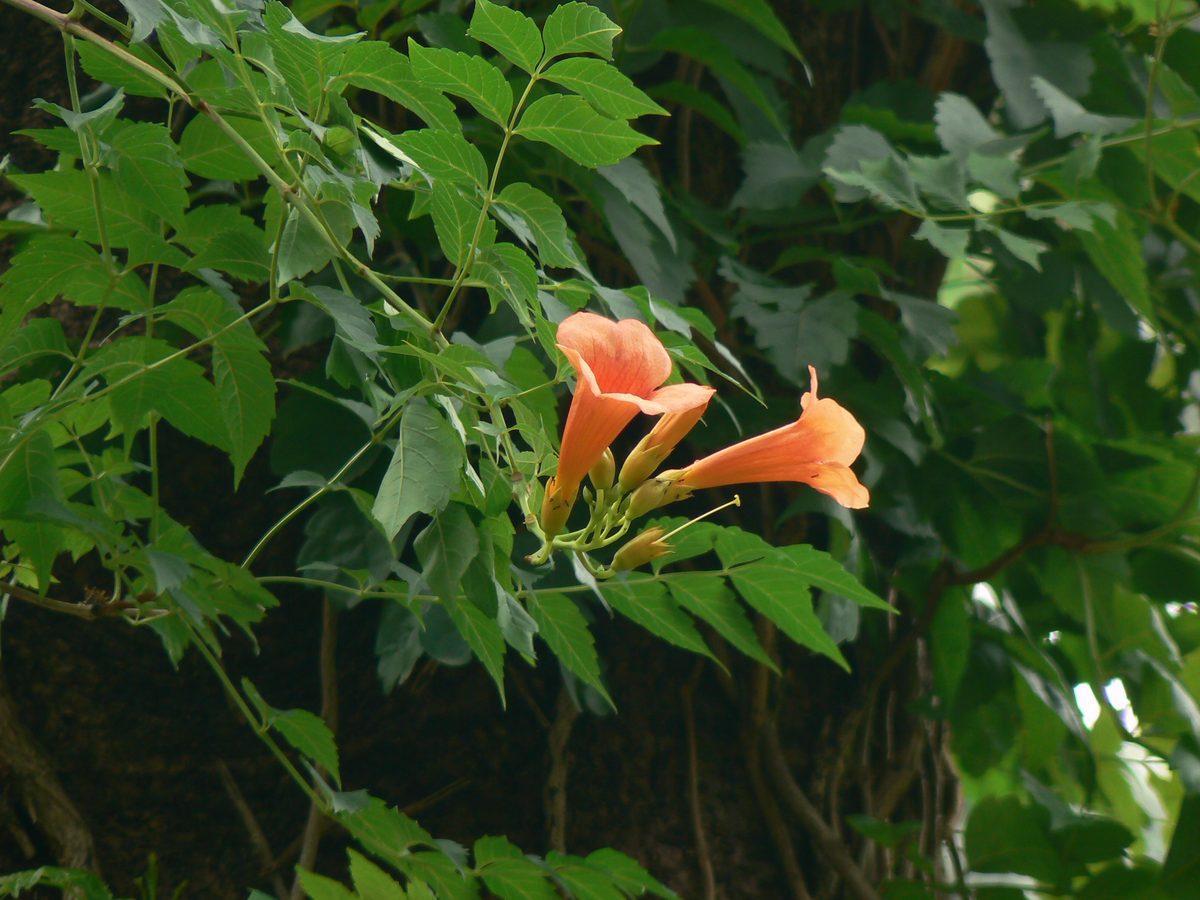
Photo: Dinesh Valke from Thane, India, CC BY-SA 2.0 via Wikimedia Commons

Quick facts
| Light: | Full sun and part shade (full sun preferred)11 source |
|---|---|
| Water: | Dry to medium21 source |
| Soil: | Well drained, moist and occasionally dry; pH 5–8123 |
| Hardiness: | Zones 4a–10b41 source |
| Size: | 30–40 ft (9.14–12.19 m) × 4–10 ft (1.22–3.05 m)13 |
| Growth rate: | Rapid14144 |
| Bloom: | Jun–Sep, Orange, red and yellow712 |
| Cats: | Not documented by major sources |
| Dogs: | Not documented by major sources |
| Native range: | ALA, ARK, CNT, DEL, FLA, GEO, ILL, INI, IOW, KAN, KTY, LOU, MAI, MRY, MSI, MSO, NCA, NDA, NEB, NWH, NWJ, NWY, OHI, OKL, PEN, SCA, SDA, TEN, TEX, UTA, VRG, WDC, WIS, WVA8 |
| Family: | Bignoniaceae |
How much light does a Trumpet Creeper need?
Full sun is the preferred exposure for trumpet creeper. The listing defines it as 6 or more hours of direct sunlight a day. Part shade is also listed as a condition it takes. Its flowers are orange, red and yellow, and they appear from June to September.
- Light: Full sun and part shade (full sun preferred)1
How often to water a Trumpet Creeper
Trumpet creeper has low water use, and its listed water range is dry to medium. The soil it takes can be well drained, moist or occasionally dry. Good drainage is one of the soil conditions named for it. Full sun is the preferred exposure alongside these water needs, and part shade is also listed.
- Water: Dry to medium2
Best soil for a Trumpet Creeper
Trumpet creeper is listed for soils that are well drained, moist or occasionally dry. Good drainage is the condition named for it, along with various well-drained soils. Soil pH in the range of 5 to 8 is listed for this vine. That range runs from acid to alkaline, and the vine can tolerate soil across it. Its water range, dry to medium, sits alongside these soil conditions.
Hardiness and temperature
A hardiness range of USDA zones 4a to 10b is listed for this vine. The range spans zone 4a at one end and zone 10b at the other. No cited source records a minimum temperature for it, so a lowest tolerated temperature is not documented here. Humidity needs are not documented either. It is a deciduous vine.
- Hardiness: Zones 4a–10b4
Pruning a Trumpet Creeper
Hard renewal pruning is the type listed for trumpet creeper. The timing recorded for it is hard winter pruning. Other pruning details are not documented here. The vine grows rapidly, to a height of 30–40 ft (9.14–12.19 m). Its spread is 4–10 ft (1.22–3.05 m).
- Pruning: Hard renewal pruning (Feb–Mar)5
How to plant a Trumpet Creeper
Trumpet creeper is listed for USDA hardiness zones 4a to 10b. Its listed spread is 4–10 ft (1.22–3.05 m), and its height is 30–40 ft (9.14–12.19 m). It is a vine that is native to the lower 48 United States. Full sun is preferred, and part shade is also listed. Soil conditions listed include well drained, moist and occasionally dry. Planting dates are not documented here.
- Hardiness: Zones 4a–10b4
Winter care
Trumpet creeper is a deciduous vine. Its listed hardiness runs from zone 4a to zone 10b. No cited source records a minimum temperature, so a lowest safe temperature is not documented here. Hard winter pruning is the pruning type listed for it. Winter protection methods are not documented here. Rapid growth is recorded for the vine.
- Hardiness: Zones 4a–10b4
Care calendar
| Task | Jan | Feb | Mar | Apr | May | Jun | Jul | Aug | Sep | Oct | Nov | Dec |
|---|---|---|---|---|---|---|---|---|---|---|---|---|
| Prune | Prune in Feb | Prune in Mar | ||||||||||
| Bloom | Bloom in Jun | Bloom in Jul | Bloom in Aug | Bloom in Sep |
How to propagate a Trumpet Creeper
Seed, root cuttings and stem cuttings are the propagation methods listed for trumpet creeper. Semi-hardwood cuttings are among the stem cuttings named. Root cuttings are also on that list, as is seed. Timing, rooting hormone and other steps are not documented here. Rapid growth is recorded for the plant. It is a woody, deciduous, perennial vine.
Common problems
Pests listed for trumpet creeper include brown marmorated stink bug, glassy winged sharpshooter, california red scale, candy striped leafhopper, broad headed sharpshooter and whitemarked tussock moth. Listed diseases are xylella fastidiosa bacterial leaf scorch, cotton root rot and tobacco rattle virus. How to treat any of these is not documented here.
| Problem | Kind |
|---|---|
| Brown marmorated stink bug | Pest |
| Glassy winged sharpshooter | Pest |
| California red scale | Pest |
| Candy striped leafhopper | Pest |
| Broad headed sharpshooter | Pest |
| Whitemarked tussock moth | Pest |
| Xylella fastidiosa bacterial leaf scorch | Disease |
| Cotton root rot | Disease |
| Tobacco rattle virus | Disease |
Is Trumpet Creeper toxic to cats and dogs?
Recommended supplies
- Soil: a free-draining mix, and a pot with a drainage hole.
Questions and answers
- How much sun does trumpet creeper need?
- Full sun is preferred, which means 6 or more hours of direct sunlight a day. Part shade is also listed as a condition it takes.
- What zones does trumpet creeper grow in?
- USDA hardiness zones 4a through 10b are listed for it. It is a deciduous vine. Its height is 30–40 ft (9.14–12.19 m).
- What soil does trumpet creeper tolerate?
- Soil can be well drained, moist or occasionally dry. The listed pH range is 5 to 8, from acid to alkaline. Its water needs run from dry to medium.
Sources
- NC State Extension. https://plants.ces.ncsu.edu/plants/campsis-radicans/. Accessed 12 October 2026.
- Lady Bird Johnson Wildflower Center (Native Plant Database). https://www.wildflower.org/plants/result.php?id_plant=CARA2. Accessed 12 October 2026.
- Cornell University CALS Woody Plants Database. https://woodyplants.cals.cornell.edu/plant/40. Accessed 12 October 2026.
- University of Florida IFAS Extension (EDIS). https://ask.ifas.ufl.edu/publication/FP099. Accessed 12 October 2026.
- University of Florida IFAS Extension (EDIS). https://ask.ifas.ufl.edu/fp099. Accessed 13 October 2026.
- EPPO Global Database. https://gd.eppo.int/taxon/CMIRA/pests. Accessed 12 October 2026.
- Lady Bird Johnson Wildflower Center (Native Plant Database). https://www.wildflower.org/plants/result.php?id_plant=cara2. Accessed 31 October 2026.
- Royal Botanic Gardens, Kew (World Checklist of Vascular Plants). https://sftp.kew.org/pub/data-repositories/WCVP/wcvp.zip. Accessed 4 June 2026.
How this page was made
- Written with AI assistance from the sources listed on this page. AI is never the source of a fact.