Field Bindweed (Convolvulus arvensis)
Formerly Strophocaulos arvensis, Convolvulus ambigens, Convolvulus cherleri
Field bindweed is a herbaceous perennial. Give it full sun, though part shade is also listed. Its flowers are white to pink. Growth is rapid. Its mature spread is 2–15 ft (0.61–4.57 m). In the lower 48 states and Hawaii it is recorded as introduced. Water needs and toxicity for cats and dogs are not documented here.
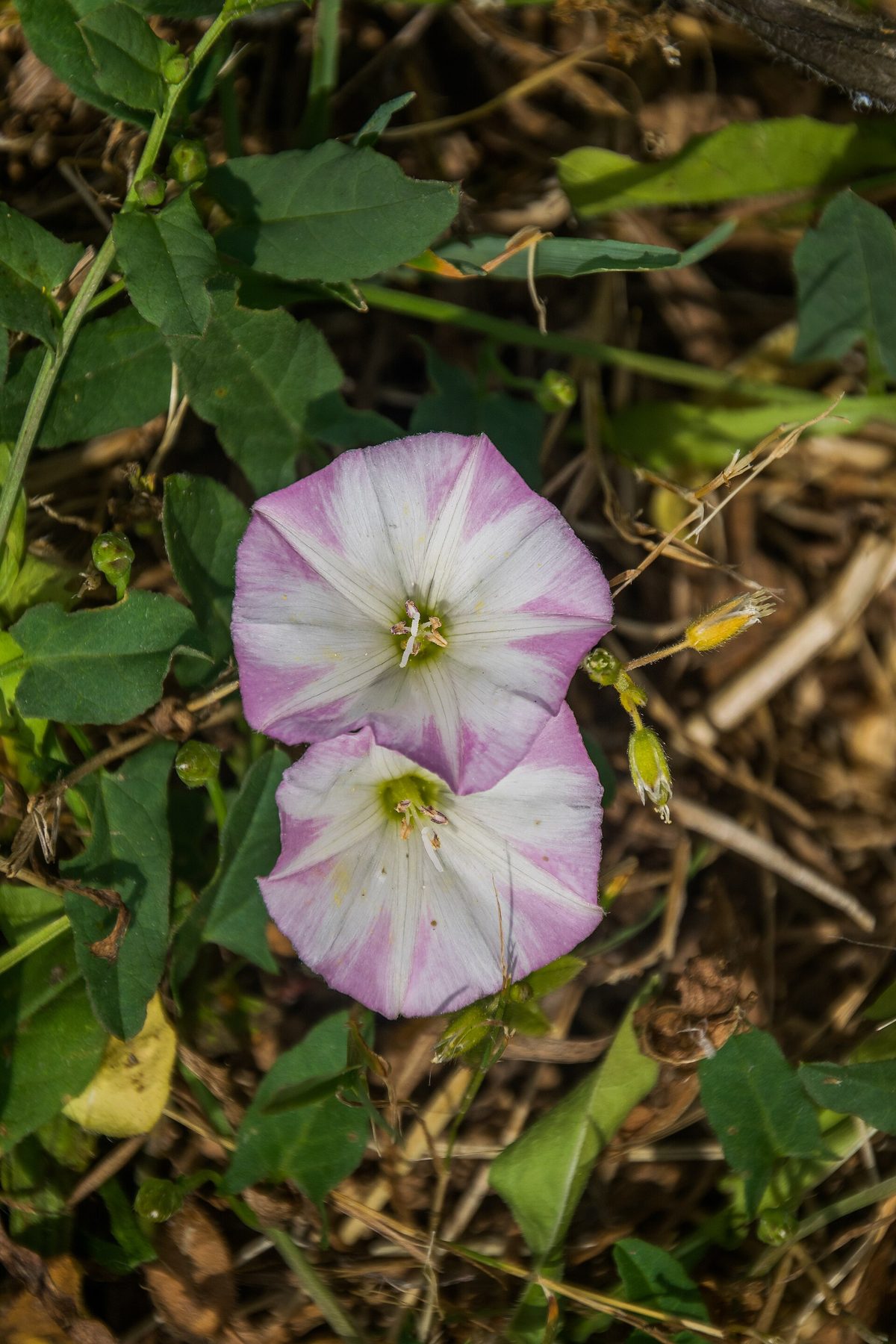
Photo: Krzysztof Golik, CC BY-SA 4.0 via Wikimedia Commons

Quick facts
| Light: | Full sun and part shade (full sun preferred)11 source |
|---|---|
| Soil: | Moist and occasionally dry12 |
| Size: | 2–15 ft (0.61–4.57 m)11 source |
| Growth rate: | Rapid11 source |
| Bloom: | White and pink41 source |
| Cats: | Not documented by major sources |
| Dogs: | Not documented by major sources |
| Native range: | AFG, ALB, ALG, ALT, AMU, AUT, AZO, BAL, BGM, BLR, BLT, BRY, BUL, CHA, CHC, CHH, CHI, CHM, CHN, CHQ, CHS, CHT, CHX, CNY, COR, CTA, CYP, CZE, DEN, EAI, EGY, EHM, FIN, FRA, GER, GRB, GRC, HUN, IND, IRE, IRK, IRN, IRQ, ITA, KAZ, KGZ, KHA, KRA, KRI, KRY, LBS, LBY, MDR, MON, MOR, MTN, MYA, NCS, NEP, NET, NOR, OMA, PAK, PAL, POL, POR, PRM, ROM, RUC, RUE, RUN, RUS, RUW, SAK, SAR, SAU, SIC, SIN, SPA, SUD, SWE, SWI, TCS, TKM, TUE, TUN, TUR, TVA, TZK, UKR, UZB, WHM, WSB, YAK, YUG5 |
| Family: | Convolvulaceae |
How much light does a Field Bindweed need?
Field bindweed prefers full sun outdoors. Full sun means 6 or more hours of direct sunlight a day. It also accepts part shade, which the listing describes as direct sunlight for only part of the day, about 2 to 6 hours. The lowest figure recorded is a minimum of 2 hours of sun a day.
Best soil for a Field Bindweed
The soil drainage recorded for field bindweed is moist and occasionally dry, and no other drainage condition appears in the record. Outside agricultural fields, it is most often found in moist locations on tracts once used for agriculture. Occasionally dry soil is the second listed condition, and it sits alongside moist soil in the record. It is a herbaceous perennial with a rapid growth rate.
How to propagate a Field Bindweed
Field bindweed can be propagated by seed or by root cuttings. Root cutting is listed as a propagation method in the NC State Extension Gardener Plant Toolbox. Oregon State University Extension says it spreads aggressively both by seed and underground rhizomes. Seed appears in both the propagation record and the description of how the plant spreads. Underground rhizomes are named only in that spread description, not in the list of propagation methods.
Is Field Bindweed toxic to cats and dogs?
Recommended supplies
- Soil: a mix that holds moisture without staying wet.
Questions and answers
- How much sun does field bindweed need?
- Full sun is preferred, which means 6 or more hours of direct sunlight a day. It also accepts part shade, which the listing defines as direct sun for only part of the day, about 2 to 6 hours. The recorded minimum is 2 hours a day.
- How fast does field bindweed grow?
- Its growth rate is listed as rapid. The recorded mature spread runs from 2 to 15 ft (0.61–4.57 m). Oregon State University Extension adds that it spreads aggressively both by seed and underground rhizomes.
- What do field bindweed flowers look like?
- The flowers are trumpet shaped and white to pink. Each flower is 1 to 1 1/2 inches (2.5–3.8 cm) wide. Bloom color is recorded as white and pink.
Sources
- NC State Extension Gardener Plant Toolbox. https://plants.ces.ncsu.edu/plants/convolvulus-arvensis/. Accessed 21 October 2026.
- Utah State University Extension. https://extension.usu.edu/rangeplants/forbs-herbaceous/field-bindweed. Accessed 21 October 2026.
- Oregon State University Extension Service. https://extension.oregonstate.edu/news/persistent-bindweed-frustrates-gardeners-can-be-controlled-patience. Accessed 21 October 2026.
- UC Statewide Integrated Pest Management Program. https://ipm.ucanr.edu/home-and-landscape/field-bindweed/. Accessed 31 October 2026.
- Royal Botanic Gardens, Kew (World Checklist of Vascular Plants). https://sftp.kew.org/pub/data-repositories/WCVP/wcvp.zip. Accessed 4 June 2026.
How this page was made
- Written with AI assistance from the sources listed on this page. AI is never the source of a fact.