Tropical Almond (Terminalia catappa)
Formerly Buceras catappa, Juglans catappa, Myrobalanus catappa
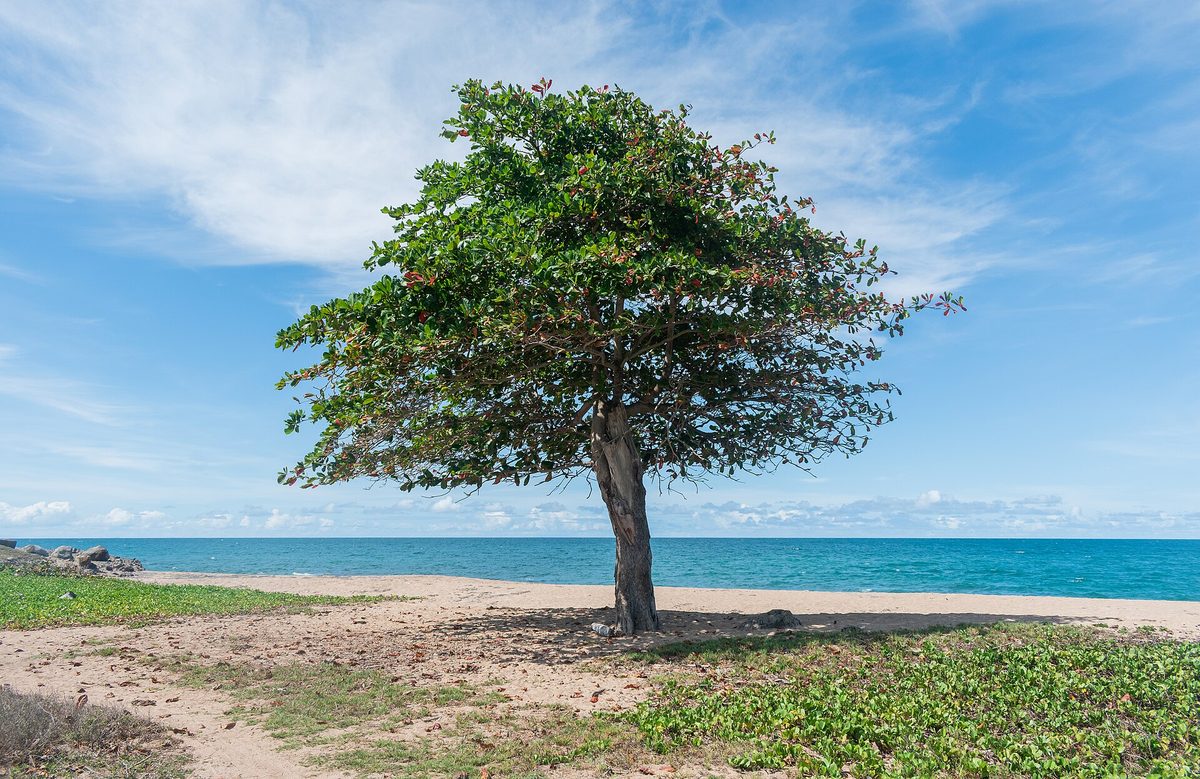
Photo: Tournasol7, CC BY 4.0 via Wikimedia Commons

Quick facts
| Soil: | Well drained11 source |
|---|---|
| Size: | 29.9–55.1 ft (9.1–16.8 m) × 29.9–50 ft (9.1–15.24 m)311 source |
| Growth rate: | Moderate11 source |
| Bloom: | White and green11 source |
| Cats: | Not documented by major sources |
| Dogs: | Not documented by major sources |
| Native range: | AND, ASS, BAN, BIS, BOR, CBD, CHH, CHS, CKI, COM, CRL, EHM, FIJ, IND, JAW, KZN, LSI, MDG, MDV, MLY, MOL, MRN, MRS, MYA, NCB, NEP, NNS, NRU, NTA, NUE, NWC, NWG, OGA, PHI, QLD, SAM, SCS, SOL, SUL, SUM, TAI, THA, TON, VAN, VIE, WAL, XMS4 |
| Family: | Combretaceae |
Best soil for a Tropical Almond
Tropical almond, Terminalia catappa, tolerates clay, sand and loam soils. It also tolerates both alkaline and acidic soil, and well-drained soil is on the same list of tolerances. No cited source records a preferred soil pH range for this tree, so that value is not documented here.
- Soil drainage: Well drained1
How to propagate a Tropical Almond
Seed is the propagation method recorded for tropical almond, Terminalia catappa. No cutting, grafting or other method is documented for this tree. Plan for the mature size, because the tree is deciduous and reaches 30 to 55 ft (9.1–16.8 m) tall with a spread of 30 to 50 ft (9.1–15.24 m).
- Propagation: Seed1
Common problems
The pests recorded for tropical almond are thrips, spider mites, fruit flies, whiteflies, ambrosia beetles, fall armyworm and aphids. Thrips are named as a pest of this tree. Leaf spot disease is the disease recorded for it, and it is described as a problem. No other diseases are documented here.
| Problem | Kind |
|---|---|
| Thrips | Pest |
| Spider mites | Pest |
| Fruit flies | Pest |
| Whiteflies | Pest |
| Ambrosia beetles | Pest |
| Fall armyworm | Pest |
| Aphids | Pest |
| Leaf spot | Disease |
Is Tropical Almond toxic to cats and dogs?
Recommended supplies
- Soil: a free-draining mix, and a pot with a drainage hole.
Questions and answers
- How big does a tropical almond tree get?
- The tree reaches 30 to 55 ft (9.1–16.8 m) tall with a spread of 30 to 50 ft (9.1–15.24 m). As it ages, the crown spreads and flattens on top into a wide vase shape. Its growth rate is moderate.
- Which USDA zones suit tropical almond?
- The listed hardiness range is USDA zones 10b to 11b. In the United States, its native status is introduced in the lower 48 states, Hawaii and Puerto Rico. Well-drained soil is among the soils it tolerates.
- Does tropical almond need full sun?
- Full sun is the outdoor light requirement listed for tropical almond. Its flowers are described as pale green or white, and its growth rate is moderate.
Sources
- UF/IFAS Extension (EDIS). https://ask.ifas.ufl.edu/publication/ST626. Accessed 14 October 2026.
- EPPO Global Database. https://gd.eppo.int/taxon/TEMCA/pests. Accessed 14 October 2026.
- UF/IFAS Extension (EDIS). https://ask.ifas.ufl.edu/st626. Accessed 14 October 2026.
- Royal Botanic Gardens, Kew (World Checklist of Vascular Plants). https://sftp.kew.org/pub/data-repositories/WCVP/wcvp.zip. Accessed 4 June 2026.
How this page was made
- Written with AI assistance from the sources listed on this page. AI is never the source of a fact.