Aztec Marigold (Tagetes erecta)
Formerly Tagetes patula, Tagetes elongata, Tagetes corymbosa
Aztec marigold, Tagetes erecta, prefers full sun and tolerates part shade. Its water needs run from dry to medium. It is an annual. The plant is listed as toxic to both cats and dogs, and the listing describes mild irritation of the gastrointestinal tract when it is eaten.
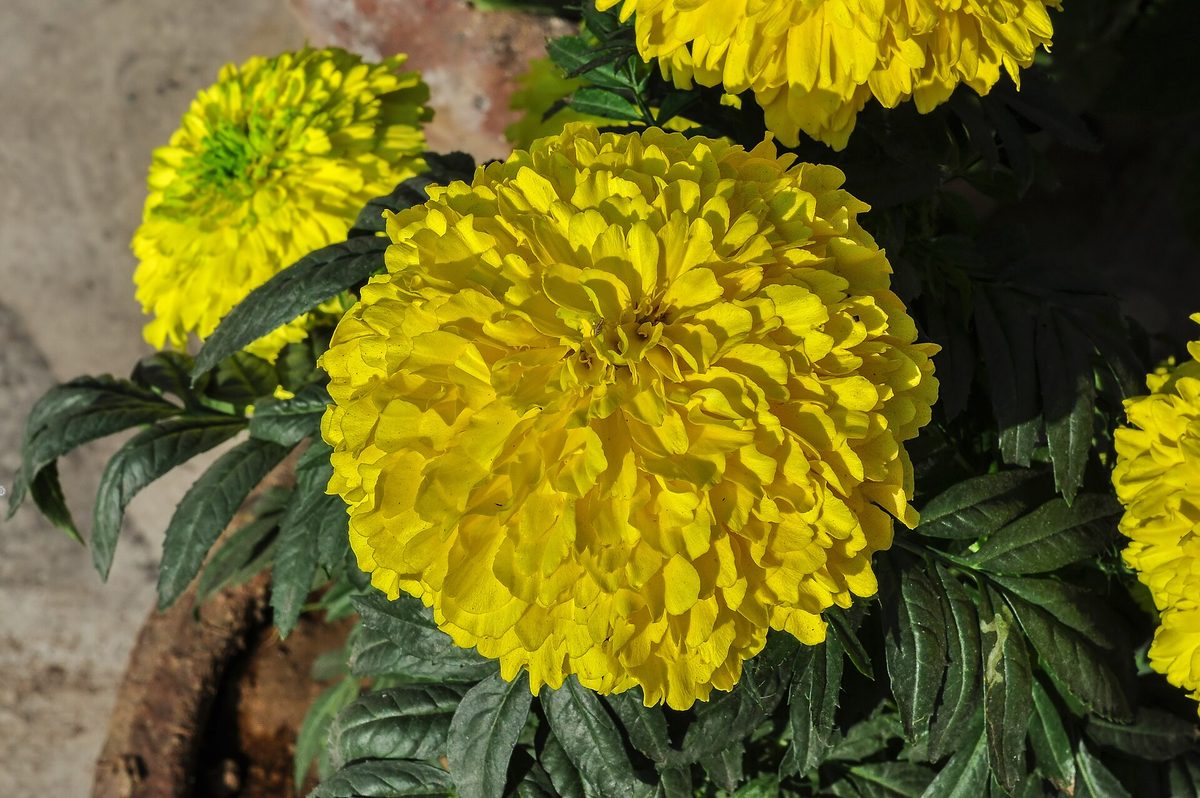
Photo: Joydeep, CC BY-SA 3.0 via Wikimedia Commons

Quick facts
| Light: | Full sun and part shade (full sun preferred)12 |
|---|---|
| Water: | Dry to medium11 source |
| Soil: | Well drained and occasionally dry; pH 5.5–713 |
| Hardiness: | Zones 2a–11b11 source |
| Size: | 1–3 ft (0.3–0.91 m) × 0.5–1 ft (0.15–0.3 m)61 source |
| Growth rate: | Moderate16 |
| Bloom: | May–Oct, Yellow, orange, white and multicoloured711 source |
| Cats: | Toxic to cats (1 source) Severity reported: Mild 5 |
| Dogs: | Toxic to dogs (1 source) 5 |
| Native range: | GUA, MXC, MXE, MXG, MXN, MXS, MXT8 |
| Family: | Asteraceae |
How much light does an Aztec Marigold need?
Choose a site with full sun, which means six or more hours of direct sunlight a day. Full sun is the preferred exposure for this plant, and part shade is also listed as one it tolerates. University of Minnesota Extension says marigolds need full sun all day to provide blooms all season long.
How often to water an Aztec Marigold
Watering needs for this marigold run from dry to medium. The plant tolerates clay and dry soil but prefers soil that is evenly moist and well drained. Good drainage is listed for it, and so is soil that is occasionally dry. Its watering range tops out at medium.
- Water: Dry to medium1
Best soil for an Aztec Marigold
The soil should be well drained, and a loamy soil is described as suitable. The pH range given is 5.5 to 7.0, which is slightly acidic. Drainage is recorded as well drained and occasionally dry. Clay soil and dry soil are both tolerated, though evenly moist ground that drains well is preferred. Soil that drains well and a pH between 5.5 and 7 are the two conditions to match.
Hardiness and temperature
USDA hardiness zones 2a to 11b are listed for Aztec marigold, Tagetes erecta. Zone 2a marks the cold end of that range, and zone 11b marks the warm end. The source lists each half-zone step, from 2a, 2b, 3a and 3b up through 11a and 11b.
- Hardiness: Zones 2a–11b1
Fertilizing an Aztec Marigold
Fertilizer for this marigold is light, and the frequency listed is once a year. Without soil test results, you can incorporate a slow-release fertilizer formulated for annuals. Aztec marigold is an annual, and the feeding listed for it is light and yearly. Slow-release fertilizer is the form named for annual plants.
- Fertilizer: Light, once a year3
Pruning an Aztec Marigold
Deadheading is the pruning listed for this plant. Remove the old flowers as they fade for continued bloom. It is an annual that is pruned by deadheading, with no other pruning type recorded. Faded flowers are the only part of the plant this fact tells you to remove.
- Pruning: Deadheading3
How to plant an Aztec Marigold
Zones 2a to 11b are listed for growing this plant outdoors. Space plants with their mature size in mind, since height is 1–3 ft (0.3–0.91 m) and spread is 0.5–1 ft (0.15–0.3 m). Sow seeds where the plants will grow once the soil has warmed. Pick a spot with full sun, well-drained soil and a pH between 5.5 and 7.
- Hardiness: Zones 2a–11b1
Winter care
This marigold is listed as an annual. The hardiness range recorded for it runs from zone 2a at the cold end to zone 11b at the warm end. Seed is listed as the best propagation method for it. Seeds are sown directly into the spring garden after the soil has warmed.
- Hardiness: Zones 2a–11b1
How to propagate an Aztec Marigold
Seed is the best propagation method for Aztec marigold. Sow seeds directly into the spring garden after the soil has warmed. Seed is the only method recorded, and no cuttings or division are listed. Direct sowing means placing the seeds where the plants will grow.
Common problems
Recorded pests include thrips, slugs, spider mites, whiteflies and leafminers. Recorded diseases include botrytis blight, leaf spot, phytophthora root rot, powdery mildew, bacterial wilt and verticillium wilt. These are listed as potential problems, not as problems every plant will have, and each is named here as a possibility only.
| Problem | Kind |
|---|---|
| Thrips | Pest |
| Slugs and snails | Pest |
| Spider mites | Pest |
| Whiteflies | Pest |
| Leafminers | Pest |
| Botrytis blight | Disease |
| Leaf spot | Disease |
| Phytophthora root rot | Disease |
| Powdery mildew | Disease |
| Bacterial wilt | Disease |
| Verticillium wilt | Disease |
Is Aztec Marigold toxic to cats and dogs?
Both cats and dogs are listed as having a toxic reaction to this plant. For cats, the severity is given as mild. For dogs, the plant is also listed as toxic. The Pet Poison Helpline passage says it may cause mild irritation to the gastrointestinal tract when ingested. Ingestion is the route named in that listing.
Pet-safe alternatives
Recommended supplies
- Soil: a free-draining mix, and a pot with a drainage hole.
Questions and answers
- How much sun does Aztec marigold need?
- It prefers full sun, which means six or more hours of direct sunlight a day, and it also tolerates part shade. University of Minnesota Extension says marigolds need full sun all day to provide blooms all season long.
- Is Aztec marigold toxic to cats and dogs?
- The plant is listed as toxic to both cats and dogs. The listing describes mild irritation of the gastrointestinal tract if it is ingested, and mild is the severity given for cats.
- How do I grow Aztec marigold from seed?
- Seed is the best propagation method, and seeds are sown directly into the spring garden after the soil has warmed. Feeding is light and once a year, and a slow-release fertilizer formulated for annuals can be incorporated when you have no soil test results.
Sources
- NC State Extension Gardener Plant Toolbox. https://plants.ces.ncsu.edu/plants/tagetes-erecta/. Accessed 21 October 2026.
- University of Minnesota Extension. https://extension.umn.edu/garden-and-home/yard-and-garden/gardening-in-minnesota/marigolds. Accessed 21 October 2026.
- Clemson Cooperative Extension Home & Garden Information Center. https://hgic.clemson.edu/factsheet/how-to-grow-and-care-for-marigolds-in-south-carolina/. Accessed 21 October 2026.
- Penn State Extension. https://extension.psu.edu/marigolds-from-folklore-to-the-home-garden. Accessed 1 November 2026.
- Pet Poison Helpline. https://www.petpoisonhelpline.com/poison/marigold/. Accessed 21 October 2026.
- University of Florida IFAS Extension (EDIS). https://ask.ifas.ufl.edu/publication/FP570. Accessed 14 October 2026.
- Chicago Botanic Garden. https://www.chicagobotanic.org/plant-information/plant-finder/tagetes-erecta-lady-gold-lady-gold-african-marigold. Accessed 21 October 2026.
- Royal Botanic Gardens, Kew (World Checklist of Vascular Plants). https://sftp.kew.org/pub/data-repositories/WCVP/wcvp.zip. Accessed 4 June 2026.
How this page was made
- Written with AI assistance from the sources listed on this page. AI is never the source of a fact.