Creeping Jenny (Lysimachia nummularia)
Formerly Ephemerum nummularia, Lysimachusa nummularia, Lysimachia repens
Give creeping jenny full sun and soil from medium to wet, and it grows rapidly. It also tolerates part shade and full shade. Plants reach about 2 to 4 in (5–10 cm) tall and spread 1 to 2 ft (0.3–0.6 m). Pet toxicity for cats and dogs is not documented on this page. It is hardy in zones 3a to 9b.
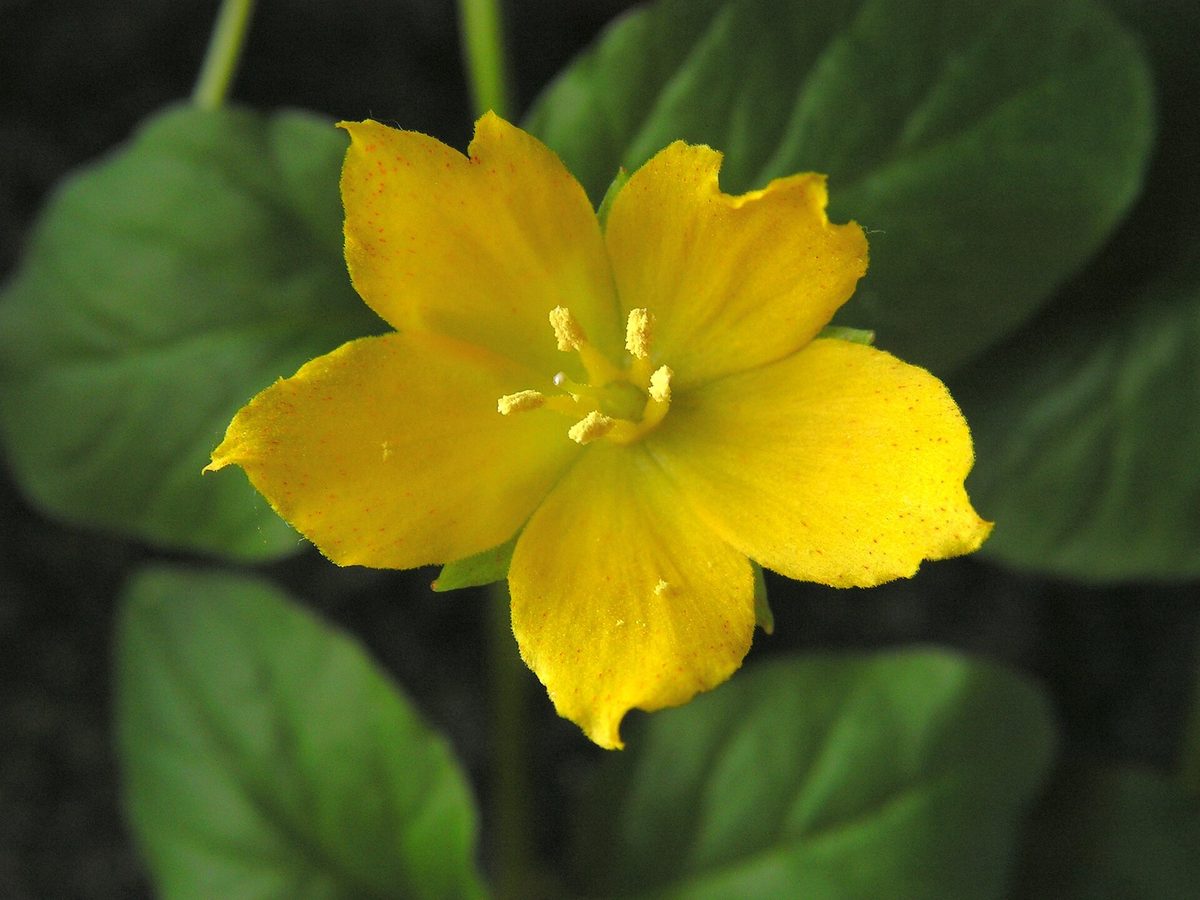
Photo: Bff, CC BY-SA 4.0 via Wikimedia Commons

Quick facts
| Light: | Full sun, part shade and full shade (full sun preferred)11 source |
|---|---|
| Water: | Medium to wet21 |
| Soil: | Moist, occasionally dry, occasionally wet and poorly drained11 source |
| Hardiness: | Zones 3a–9b21 source |
| Size: | 0.2–0.3 ft (0.05–0.1 m) × 1–2 ft (0.3–0.6 m)142 |
| Growth rate: | Rapid1441 |
| Bloom: | Yellow11 source |
| Cats: | Not documented by major sources |
| Dogs: | Not documented by major sources |
| Native range: | ALB, ALT, AUT, BGM, BLR, BLT, BUL, CZE, DEN, FRA, GER, GRB, GRC, HUN, IRE, ITA, KRY, NCS, NET, NOR, POL, ROM, RUC, RUE, RUN, RUS, RUW, SPA, SWE, SWI, TUE, TUR, UKR, WSB, YUG5 |
| Family: | Primulaceae |
How much light does a Creeping Jenny need?
Six or more hours of direct sunlight a day counts as full sun, and full sun is the preferred light for creeping jenny. Part shade and full shade are also on the list of conditions it takes. Choose among these three light levels when you decide where in your garden to plant it.
- Light: Full sun, part shade and full shade (full sun preferred)1
How often to water a Creeping Jenny
Water needs for this plant run from medium to wet. It thrives in damp soils where other ground covers often cannot survive. Occasionally wet soil is among the drainage conditions listed for it, and so is occasionally dry soil. Rather than counting days between waterings, check the soil and keep it at least medium in moisture.
Best soil for a Creeping Jenny
Soil drainage for creeping jenny is listed as moist, occasionally dry, occasionally wet and poorly drained. Both ends of the moisture swing appear in that list, from occasionally dry to occasionally wet. The plant thrives in damp soils where other ground covers often cannot survive. No soil pH range is documented for this plant. Soil texture and nutrient needs are not documented either.
- Soil drainage: Moist, occasionally dry, occasionally wet and poorly drained1
Hardiness and temperature
Hardiness for this plant is listed as zones 3a to 9b. No minimum temperature is documented, and humidity needs are not documented either. Use your zone rather than a temperature figure when you judge whether it suits your climate. Zone 3a is the cold end of that range and zone 9b is the warm end.
- Hardiness: Zones 3a–9b2
How to plant a Creeping Jenny
Plant creeping jenny in USDA zones 3a to 9b. Mature spread is 1 to 2 ft (0.3–0.6 m), so plan your spacing around that width. Mature height is about 2 to 4 in (5–10 cm). Choose a site with full sun, part shade or full shade. The soil can be moist, occasionally dry, occasionally wet or poorly drained. Growth rate is rapid, and the maintenance level is high. In the lower 48 US states it is listed as introduced.
- Hardiness: Zones 3a–9b2
Winter care
Winter hardiness is recorded for zones 3a to 9b. If you garden in zone 3a, you are at the cold limit of that range, and zone 9b is the warm limit. No minimum temperature, mulch advice or protection method is documented. Use your USDA zone as the guide for winter, as no other winter fact is on file.
- Hardiness: Zones 3a–9b2
How to propagate a Creeping Jenny
Division is the recommended propagation strategy for creeping jenny. It is described as very easily propagated by division. Stem cuttings are also a listed method. Division and stem cuttings are the two methods recorded for this species. Between the two methods, division carries the recommendation and the easy rating. Timing, rooting medium and cutting length are not documented.
Common problems
Slugs are the pest recorded for creeping jenny. In some places they may attack the leaves. Few pests trouble the plant overall. Rust and leaf spots are listed diseases. Tobacco ringspot virus, tomato spotted wilt virus and tobacco rattle virus are also on the list. No treatments are documented here.
| Problem | Kind |
|---|---|
| Slugs and snails | Pest |
| Rust | Disease |
| Leaf spot | Disease |
| Tobacco ringspot virus | Disease |
| Tomato spotted wilt virus | Disease |
| Tobacco rattle virus | Disease |
Is Creeping Jenny toxic to cats and dogs?
Recommended supplies
- Soil: a mix that holds moisture without staying wet.
Questions and answers
- How much sun does creeping jenny need?
- It prefers full sun, which means six or more hours of direct sunlight a day. Part shade and full shade are also listed as suitable light levels for the plant.
- Is creeping jenny hardy in cold climates?
- It is listed as hardy in zones 3a to 9b. That range runs from zone 3a at the cold end to zone 9b at the warm end. No minimum temperature is documented.
- How fast does creeping jenny grow?
- Its growth rate is rapid. It reaches about 2 to 4 in (5–10 cm) tall and spreads 1 to 2 ft (0.3–0.6 m). Maintenance is rated high.
Sources
- NC State Extension. https://plants.ces.ncsu.edu/plants/lysimachia-nummularia/. Accessed 14 October 2026.
- University of Wisconsin-Madison Division of Extension. https://hort.extension.wisc.edu/articles/golden-creeping-jenny-lysimachia-nummularia-aurea/. Accessed 14 October 2026.
- EPPO Global Database. https://gd.eppo.int/taxon/LYSNU/pests. Accessed 14 October 2026.
- USDA Forest Service Fire Effects Information System. https://www.fs.usda.gov/database/feis/plants/forb/lysnum/all.html. Accessed 14 October 2026.
- Royal Botanic Gardens, Kew (World Checklist of Vascular Plants). https://sftp.kew.org/pub/data-repositories/WCVP/wcvp.zip. Accessed 4 June 2026.
How this page was made
- Written with AI assistance from the sources listed on this page. AI is never the source of a fact.