Eastern Teaberry (Gaultheria procumbens)
Formerly Brossaea procumbens, Gautiera procumbens, Gaultheria humilis
Eastern teaberry, Gaultheria procumbens, is a shrub about 0.3–0.7 ft (0.1–0.2 m) tall. It takes full sun, part shade or full shade, and full sun is preferred. The soil should be moist and well drained. It is hardy in zones 3a–7b. Growth is slow and upkeep is low. Pet toxicity for cats and dogs is not documented here. It is native to the lower 48 US states.
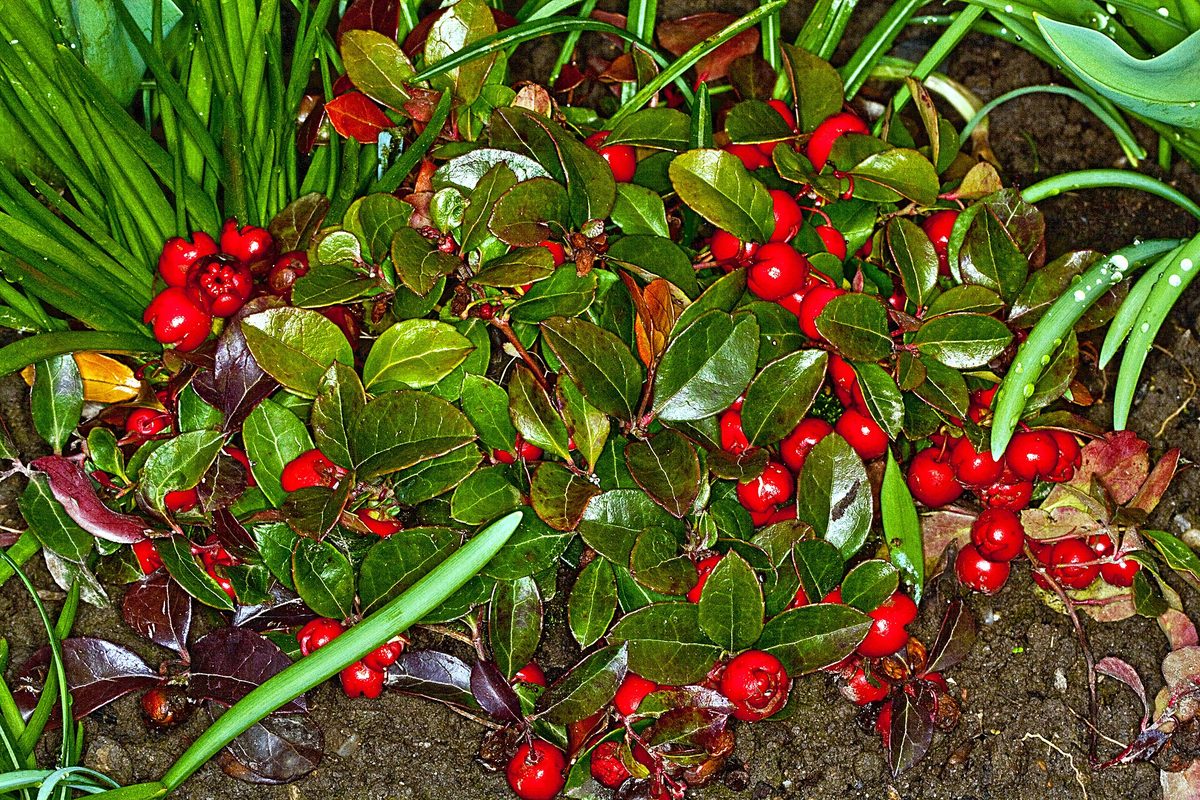
Photo: Hedwig Storch, CC BY-SA 3.0 via Wikimedia Commons

Quick facts
| Light: | Full sun, part shade and full shade (full sun preferred)112 |
|---|---|
| Soil: | Well drained, moist and occasionally dry11 source |
| Hardiness: | Zones 3a–7b11 source |
| Size: | 0.3–0.7 ft (0.1–0.2 m) × 0.5–1 ft (0.15–0.3 m)14 |
| Growth rate: | Slow11 source |
| Bloom: | Jun–Aug, White and pink125 |
| Cats: | Not documented by major sources |
| Dogs: | Not documented by major sources |
| Native range: | ALA, CNT, DEL, GEO, ILL, INI, KTY, MAI, MAN, MAS, MIC, MIN, MRY, NBR, NCA, NFL, NSC, NWH, NWJ, NWY, OHI, ONT, PEI, PEN, QUE, RHO, SCA, TEN, VER, VRG, WDC, WIS, WVA6 |
| Family: | Ericaceae |
How much light does an Eastern Teaberry need?
Eastern teaberry accepts full sun, part shade and full shade, and full sun is the preferred exposure. Dappled sunlight is described as shade through the upper canopy all day. Part shade means direct sunlight for only part of the day, about 2-6 hours.
Best soil for an Eastern Teaberry
Soil drainage for eastern teaberry is recorded as well drained, moist and occasionally dry. It grows best in moist, well-drained soil. Good drainage is the rating given in its plant listing. Moist soil is one of the recorded conditions. Occasionally dry soil is also on the list. Well-drained soil completes the three recorded conditions. The soil pH range is not documented on this page.
Hardiness and temperature
The hardiness range recorded for eastern teaberry is zones 3a–7b. Zone 3a is the coldest zone in that range. Zone 7b is the warmest zone in that range. Every half-step between them is listed too: 3a, 3b, 4a, 4b, 5a, 5b, 6a, 6b, 7a and 7b. A reader in zone 8 or warmer sits outside the recorded range. A reader in zone 2 or colder also sits outside it. No minimum temperature is documented on this page.
- Hardiness: Zones 3a–7b1
How to plant an Eastern Teaberry
Zones 3a–7b are the recorded range for planting eastern teaberry. The mature spread is 0.5–1 ft (0.15–0.3 m). The mature height is 0.3–0.7 ft (0.1–0.2 m). The light range runs from full sun to full shade, and full sun is preferred. Moist, well-drained soil is where it grows best. Growth is slow and maintenance is rated low. Planting dates are not documented on this page.
- Hardiness: Zones 3a–7b1
Winter care
Zones 3a through 7b make up the recorded hardiness range for this shrub. Gardeners in zone 3a sit at the cold edge of that range. Those in zone 7b sit at the warm edge. Eight other half-step zones lie between them. Zone 8 and warmer fall outside the recorded range. Zone 2 and colder fall outside it as well. Mulching, covering and other winter protection are not documented on this page.
- Hardiness: Zones 3a–7b1
How to propagate an Eastern Teaberry
Four propagation methods are recorded for eastern teaberry: seed, root cuttings, stem cuttings and layering. Two of the methods use cuttings, taken from either the roots or the stems. Layering and seed are the other two. Any one of the four is a recorded way to make more plants. Seed appears first in the list of methods. Layering appears last. Timing, rooting medium and success rates are not documented on this page.
- Propagation: Seed, root cuttings, stem cuttings and layering1
Common problems
Recorded pests for eastern teaberry are aphids, thrips and Stephanitis takeyai. The aphids and thrips are described as occasional pests. Recorded diseases are mildew, leaf spot, Phytophthora cinnamomi and Phytophthora ramorum. Mildew and leaf spot are described as occasional diseases. Phytophthora ramorum and Stephanitis takeyai both appear in the EPPO Global Database.
| Problem | Kind |
|---|---|
| Aphids | Pest |
| Thrips | Pest |
| Stephanitis takeyai | Pest |
| Mildew | Disease |
| Leaf spot | Disease |
| Phytophthora cinnamomi | Disease |
| Phytophthora ramorum | Disease |
Is Eastern Teaberry toxic to cats and dogs?
Recommended supplies
- Soil: a free-draining mix, and a pot with a drainage hole.
Questions and answers
- How much sun does eastern teaberry need?
- It takes full sun, part shade or full shade, and full sun is the preferred exposure. Part shade means direct sunlight for only part of the day, about 2-6 hours. Dappled sunlight means shade through the upper canopy all day.
- When does eastern teaberry bloom?
- The small, waxy, urn-shaped flowers bloom from June to August. They are listed as white and pink. They form at the base of the leaves.
- How big does eastern teaberry get?
- Mature height is 0.3–0.7 ft (0.1–0.2 m), and mature spread is 0.5–1 ft (0.15–0.3 m). It is a shrub. Its growth rate is slow.
Sources
- NC State Extension. https://plants.ces.ncsu.edu/plants/gaultheria-procumbens/. Accessed 14 October 2026.
- Lady Bird Johnson Wildflower Center. https://www.wildflower.org/plants/result.php?id_plant=gapr2. Accessed 14 October 2026.
- EPPO Global Database. https://gd.eppo.int/taxon/GAHPR/pests. Accessed 14 October 2026.
- USDA Forest Service Fire Effects Information System. https://www.fs.usda.gov/database/feis/plants/shrub/gaupro/all.html. Accessed 14 October 2026.
- Lady Bird Johnson Wildflower Center (Native Plant Database). https://www.wildflower.org/plants/result.php?id_plant=GAPR2. Accessed 14 October 2026.
- Royal Botanic Gardens, Kew (World Checklist of Vascular Plants). https://sftp.kew.org/pub/data-repositories/WCVP/wcvp.zip. Accessed 4 June 2026.
How this page was made
- Written with AI assistance from the sources listed on this page. AI is never the source of a fact.