Bird's-foot Trefoil (Lotus corniculatus)
Formerly Lotus delortii, Lotus catalaunicus, Lotus olgae
Bird's-foot trefoil (Lotus corniculatus) prefers full sun. It tolerates soil from medium to wet. The flowers are yellow and may turn orange or red. Growth is slow. It is rated for USDA zones 4a to 8b. Plants typically stay between 4 inches and 1 foot (0.1–0.3 m) tall. Toxicity to cats and dogs is not documented.
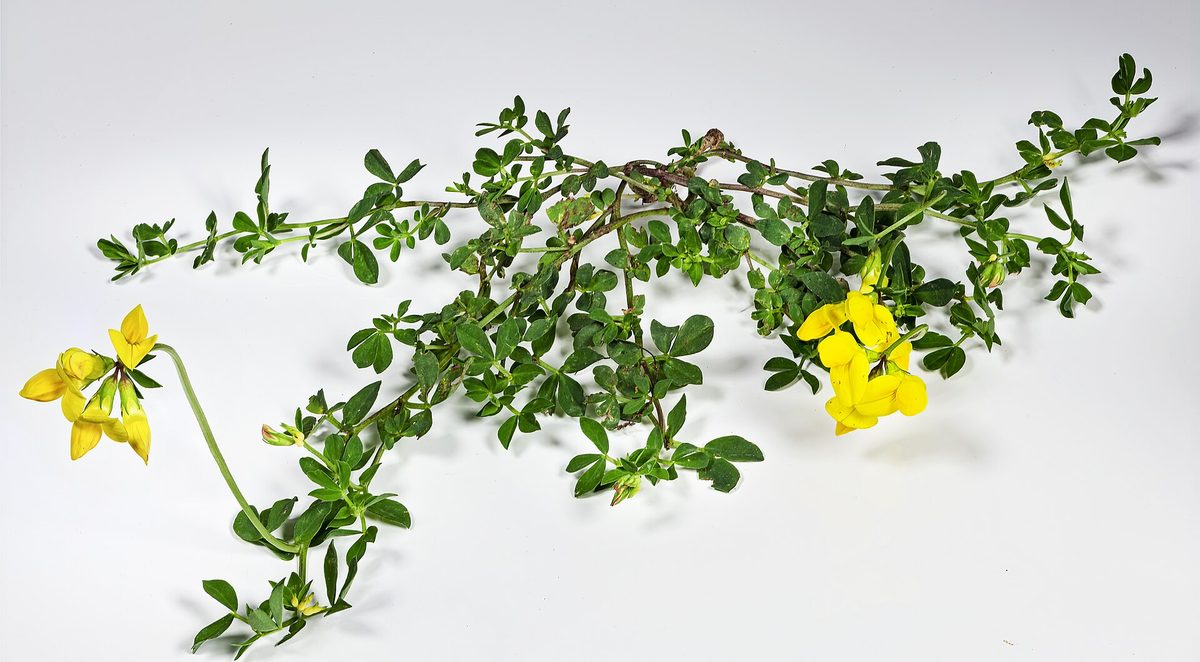
Photo: Didier Descouens, CC BY-SA 4.0 via Wikimedia Commons

Quick facts
| Light: | Full sun11 source |
|---|---|
| Water: | Medium to wet21 source |
| Soil: | Poorly drained and occasionally wet; pH 5.5–6231 source |
| Hardiness: | Zones 4a–8b21 source |
| Size: | 0.3–1 ft (0.1–0.3 m)61 source |
| Growth rate: | Slow732 |
| Bloom: | May–Aug, Yellow, orange and red86271 source |
| Cats: | Not documented by major sources |
| Dogs: | Not documented by major sources |
| Native range: | AFG, ALB, ALG, AUT, AZO, BAL, BGM, BLR, BLT, BUL, CNY, COR, CYP, CZE, DEN, EAI, EGY, EHM, ERI, ETH, FIN, FOR, FRA, GER, GRB, GRC, GST, HUN, IRE, IRN, IRQ, ITA, KAZ, KEN, KRA, KRI, KRY, LBS, LBY, MDR, MOR, MYA, NCS, NEP, NET, NOR, PAK, PAL, POL, POR, ROM, RUC, RUE, RUN, RUS, RUW, SAR, SIC, SPA, SUD, SWE, SWI, TAN, TCS, TUE, TUN, TUR, UKR, WHM, WSB, YEM, YUG9 |
| Family: | Fabaceae |
How much light does a Bird's-foot Trefoil need?
Bird's-foot trefoil prefers full sun, and full sun is the only outdoor light level on record for it. It thrives in direct light and in nutrient-poor soils of varying moisture levels. Choose an open, sunny site for it outdoors. Its flowers are yellow and may become orange or red, and they open from late spring to late summer.
- Light: Full sun1
How often to water a Bird's-foot Trefoil
Bird's-foot trefoil is highly tolerant of waterlogged soil. The water range on record for this plant runs from medium to wet. Poorly drained soil and occasionally wet soil are both listed for it. Check how damp the soil is rather than following a fixed routine, because a site that stays wet sits inside its recorded range. Tolerating waterlogged soil is not the same as needing it, and medium moisture is also within the range.
- Water: Medium to wet2
Best soil for a Bird's-foot Trefoil
The soil drainage on record for this plant is poorly drained and occasionally wet. It is highly tolerant of waterlogged soil. It also thrives in nutrient-poor soils of varying moisture levels. The soil pH on record runs from 5.5 to 6.0. Lime is the amendment named for bringing soil to a pH of 5.5–6.0. In the record, poorly drained soil, occasionally wet soil and a pH of 5.5–6.0 describe the site it suits.
Hardiness and temperature
Bird's-foot trefoil is rated for USDA hardiness zones 4a to 8b. The zone figures come with 25–40 inches (64–102 cm) of precipitation or irrigation per year. No humidity figure or minimum temperature is recorded alongside the zones. Hardiness is the main temperature fact available for this plant.
- Hardiness: Zones 4a–8b2
How to plant a Bird's-foot Trefoil
Bird's-foot trefoil suits USDA hardiness zones 4a to 8b. Plants typically grow between 4 inches and 1 foot (0.1–0.3 m) high in garden and landscape settings. It can be slow to establish and does not compete well with existing vegetation. Poorly drained and occasionally wet sites are both within its recorded soil range. In the contiguous United States it is an introduced plant. Its recorded native range includes Finland, Germany, Spain and Turkey.
- Hardiness: Zones 4a–8b2
Winter care
The coldest zone on record for bird's-foot trefoil is 4a. The warmest is 8b. Gardeners in zone 3 or colder are outside the recorded range. Gardeners in zone 9 or warmer are also outside it. Only the zone range is recorded, with no minimum temperature or protective steps.
- Hardiness: Zones 4a–8b2
How to propagate a Bird's-foot Trefoil
Seed is the propagation method on record for bird's-foot trefoil. The seeds are very small, with an average of 375,000 seeds per pound (about 827,000 per kg). Seedlings are slow-growing. The plant can be slow to establish and does not compete well with existing vegetation. Seed is the only method recorded for it.
- Propagation: Seed2
Common problems
Meloidogyne chitwoodi and Heterodera glycines are the pests on record for this plant. The diseases on record are Clavibacter insidiosus, Nepovirus nicotianae and Fusarium. Bird's-foot trefoil is not as resistant as alfalfa to Fusarium-type diseases. Two pests and three diseases are on record in total.
| Problem | Kind |
|---|---|
| Meloidogyne chitwoodi | Pest |
| Heterodera glycines | Pest |
| Clavibacter insidiosus | Disease |
| Nepovirus nicotianae | Disease |
| Fusarium | Disease |
Is Bird's-foot Trefoil toxic to cats and dogs?
Recommended supplies
- Soil: it tolerates heavy, slow-draining ground; no grit is needed.
Questions and answers
- Does bird's-foot trefoil need full sun?
- Full sun is the outdoor light level on record for it. It thrives in direct light and in nutrient-poor soils of varying moisture levels. No other light level is listed for the plant.
- Can bird's-foot trefoil grow in wet soil?
- It is highly tolerant of waterlogged soil. Poorly drained and occasionally wet soils are both listed for it, and its water range runs from medium to wet.
- How tall does bird's-foot trefoil grow?
- It typically grows between 4 inches and 1 foot (0.1–0.3 m) high in garden and landscape settings. Growth is slow, and the seedlings are slow-growing.
Sources
- University of Minnesota Extension. https://extension.umn.edu/identify-invasive-species/birdsfoot-trefoil. Accessed 12 October 2026.
- Oregon State University Extension Service. https://extension.oregonstate.edu/catalog/pub/em9319?reference=catalog. Accessed 12 October 2026.
- University of Missouri Extension. https://extension.missouri.edu/publications/g4640. Accessed 28 October 2026.
- EPPO Global Database. https://gd.eppo.int/taxon/LOTCO/pests. Accessed 12 October 2026.
- Penn State Extension. https://extension.psu.edu/birdsfoot-trefoil. Accessed 12 October 2026.
- University of Minnesota Extension. https://extension.umn.edu/natural-resources/forestry-and-wildlife/invasive-species/birdsfoot-trefoil. Accessed 14 October 2026.
- Oregon State University Extension Service. https://extension.oregonstate.edu/catalog/pub/em9319. Accessed 28 October 2026.
- University of Minnesota Extension. https://extension.umn.edu/weeds/birdsfoot-trefoil. Accessed 27 October 2026.
- Royal Botanic Gardens, Kew (World Checklist of Vascular Plants). https://sftp.kew.org/pub/data-repositories/WCVP/wcvp.zip. Accessed 4 June 2026.
How this page was made
- Written with AI assistance from the sources listed on this page. AI is never the source of a fact.