Black Chokeberry (Aronia melanocarpa)
Formerly Sorbus melanocarpa, Aronia nigra, Pyrus melanocarpa
Black chokeberry, Aronia melanocarpa, grows in full sun to part shade and in soil moisture from dry to wet. It is a deciduous shrub that reaches 3–10 ft (0.91–3.05 m) tall. Its hardiness range is zones 3a to 8b. Its flowers are white and pink. Toxicity for cats and dogs is not documented on this page.
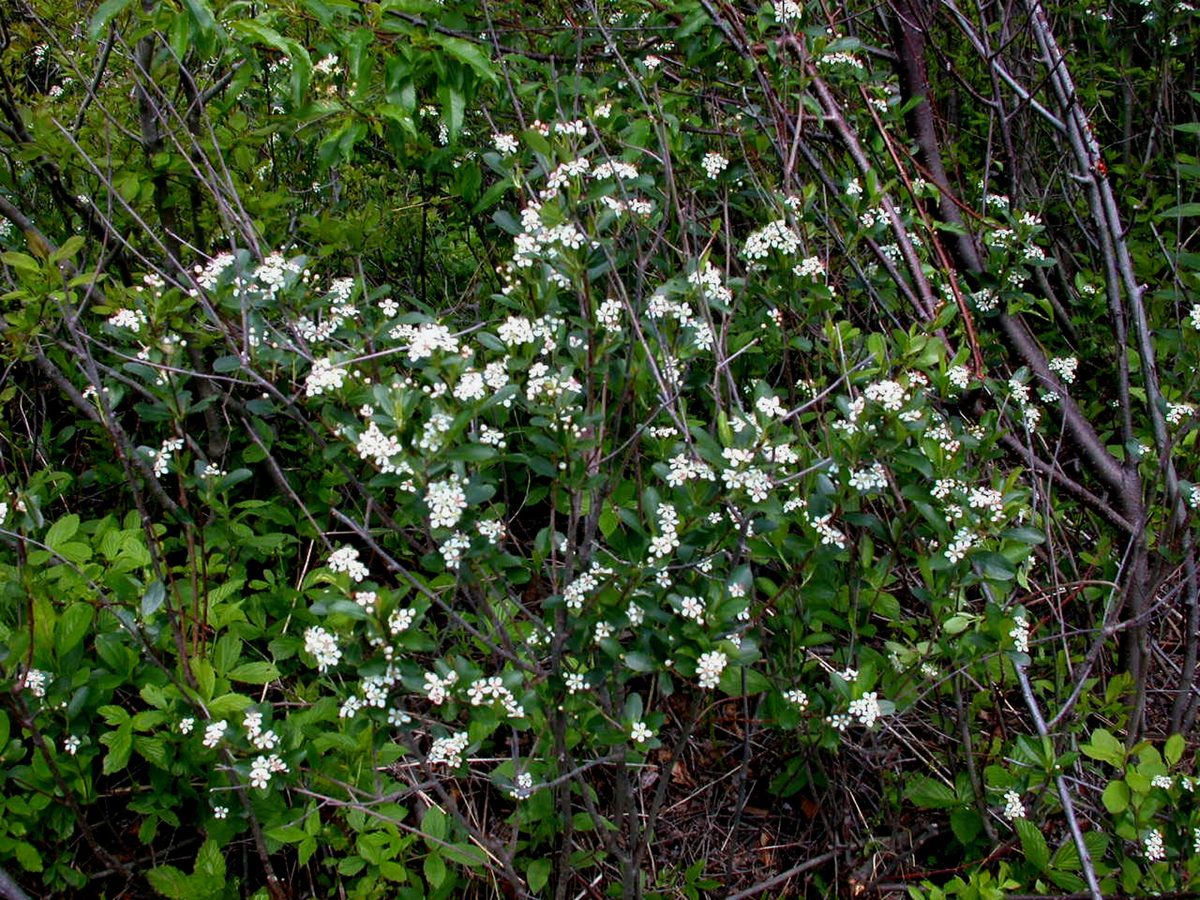
Photo: Wikimedia Commons contributor, CC BY-SA 4.0 via Wikimedia Commons

Quick facts
| Light: | Full sun and part shade (full sun preferred)123 |
|---|---|
| Water: | Dry to wet31 source |
| Soil: | Well drained, moist, occasionally dry, occasionally wet and poorly drained; pH 5–8123 |
| Hardiness: | Zones 3a–8b12 |
| Size: | 3–10 ft (0.91–3.05 m) × 2–6 ft (0.61–1.83 m)121 source |
| Bloom: | May–Jun, White and pink175 |
| Cats: | Not documented by major sources |
| Dogs: | Not documented by major sources |
| Native range: | ALA, ARK, CNT, DEL, FLA, GEO, ILL, INI, IOW, KTY, MAI, MAS, MIC, MIN, MRY, MSO, NBR, NCA, NFL, NSC, NWH, NWJ, NWY, OHI, ONT, PEI, PEN, QUE, RHO, SCA, TEN, VER, VRG, WDC, WIS, WVA8 |
| Family: | Rosaceae |
How much light does a Black Chokeberry need?
Full sun, meaning 6 or more hours of direct sunlight a day, is the preferred exposure for black chokeberry. The shrub also tolerates part shade. Plant it in full sun when you can, and choose part shade only where the site cannot offer six hours of direct light.
How often to water a Black Chokeberry
Black chokeberry accepts soil moisture from dry to wet. The range reaches from dry soil to wet soil, and it includes occasionally saturated or very wet conditions. The drainage listing also names moist, occasionally dry, occasionally wet and well drained soil. Poorly drained soil is listed as well.
- Water: Dry to wet3
Best soil for a Black Chokeberry
Black chokeberry can tolerate acid to alkaline soil, with a pH from 5 to 8. Soil drainage can be well drained, moist, occasionally dry, occasionally wet or poorly drained. Poorly drained to well drained soils, and moist to wet ones, are both within its range. The matching water listing for this shrub runs from dry at the low end to wet at the high end.
Hardiness and temperature
Black chokeberry is listed for USDA hardiness zones 3a to 8b. That range covers twelve half-zone steps from 3a through 8b. Another description gives hardiness zones 3 to 8. The span covers the cold zones 3a and 3b as well as the warmer zones 8a and 8b. The shrub is deciduous. No minimum temperature or humidity figure is documented for it.
Fertilizing a Black Chokeberry
Fertilizer needs are light for black chokeberry, with one yearly feeding. The feeding is split into two halves, each applied at a separate time. The plant's overall maintenance level is rated low. Soil for this shrub can fall anywhere between pH 5 and pH 8.
- Fertilizer: Light, once a year (Mar, May)4
Pruning a Black Chokeberry
Pruning for black chokeberry is light shaping. Very little is required other than thinning out the bush every 5 to 8 years. Its maintenance level is low. Mature height runs 3–10 ft (0.91–3.05 m), with a spread of 2–6 ft (0.61–1.83 m).
- Pruning: Light shaping4
How to plant a Black Chokeberry
Your zone should fall between 3a and 8b before you plant black chokeberry. Space plants with its mature spread of 2–6 ft (0.61–1.83 m) in mind. Expect a mature height of 3–10 ft (0.91–3.05 m). Choose a site with full sun, though part shade is tolerated. The soil can range from pH 5 to 8 and from well drained to poorly drained. The shrub is native in the lower 48 United States.
Winter care
Winter care starts with your zone: black chokeberry is listed for zones 3a to 8b. It is a deciduous shrub. Gardeners in zone 3a sit at the cold edge of the listed range, while those in zone 8b sit at the warm edge. No cited source records a minimum temperature, and this page gives no degree figure for winter cold.
Care calendar
| Task | Jan | Feb | Mar | Apr | May | Jun | Jul | Aug | Sep | Oct | Nov | Dec |
|---|---|---|---|---|---|---|---|---|---|---|---|---|
| Fertilize | Fertilize in Mar | Fertilize in May | ||||||||||
| Bloom | Bloom in May | Bloom in Jun |
How to propagate a Black Chokeberry
Black chokeberry can be propagated either by seed or by stem cuttings. The cutting method named is softwood cuttings. Seed and stem cuttings are the two methods listed. Each new plant can reach a mature spread of 2–6 ft (0.61–1.83 m) and a height of 3–10 ft (0.91–3.05 m).
- Propagation: Seed and stem cuttings5
Common problems
San Jose scale and Pochazia shantungensis are the two pests recorded for black chokeberry. The diseases recorded are fire blight, cedar quince rust and cotton root rot. Those are the five problems this page lists. This page gives no treatment advice for any of them.
| Problem | Kind |
|---|---|
| San jose scale | Pest |
| Pochazia shantungensis | Pest |
| Fire blight | Disease |
| Cedar quince rust | Disease |
| Cotton root rot | Disease |
Is Black Chokeberry toxic to cats and dogs?
Recommended supplies
- Soil: a free-draining mix, and a pot with a drainage hole.
Questions and answers
- How much sun does black chokeberry need?
- Full sun is preferred, which means 6 or more hours of direct sunlight a day. It also tolerates part shade. The plant is a deciduous shrub that grows 3–10 ft (0.91–3.05 m) tall.
- How big does black chokeberry get?
- Mature height is 3–10 ft (0.91–3.05 m). Mature spread is 2–6 ft (0.61–1.83 m). It is a shrub with white and pink flowers. Very little pruning is needed other than thinning every 5 to 8 years.
- Can black chokeberry grow in wet soil?
- Its water range runs from dry to wet, including occasionally saturated or very wet soil. Drainage listings include poorly drained, occasionally wet and well drained soil. The pH range is 5 to 8.
Sources
- NC State Extension Gardener Plant Toolbox. https://plants.ces.ncsu.edu/plants/aronia-melanocarpa/. Accessed 14 October 2026.
- University of Minnesota Extension. https://extension.umn.edu/garden-and-home/yard-and-garden/lawns-and-landscapes-in-minnesota/trees-and-shrubs/black-chokeberry. Accessed 14 October 2026.
- Cornell University CALS Woody Plants Database. https://woodyplants.cals.cornell.edu/plant/29. Accessed 14 October 2026.
- Oregon State University Extension Service. https://extension.oregonstate.edu/catalog/em-9182-growing-berries-oregon-coast-gooseberries-currants-other-minor-berry-crops. Accessed 28 October 2026.
- Lady Bird Johnson Wildflower Center. https://www.wildflower.org/plants/result.php?id_plant=ARME6. Accessed 14 October 2026.
- EPPO Global Database. https://gd.eppo.int/taxon/ABOME/pests. Accessed 14 October 2026.
- Chicago Botanic Garden. https://www.chicagobotanic.org/plant-information/plant-finder/aronia-melanocarpa-black-chokeberry. Accessed 21 October 2026.
- Royal Botanic Gardens, Kew (World Checklist of Vascular Plants). https://sftp.kew.org/pub/data-repositories/WCVP/wcvp.zip. Accessed 4 June 2026.
How this page was made
- Written with AI assistance from the sources listed on this page. AI is never the source of a fact.