Eastern Redbud (Cercis canadensis)
Formerly Cercis nitida, Cercis dilatata, Cercis mexicana
Keep eastern redbud alive with full sun and moisture from dry to medium. Part shade and full shade are also listed. This tree does not tolerate drought. Wet soils are not tolerated either. Its hardiness range is zones 4a to 9b. This page has no verified toxicity listing for cats or dogs. It is a deciduous tree.
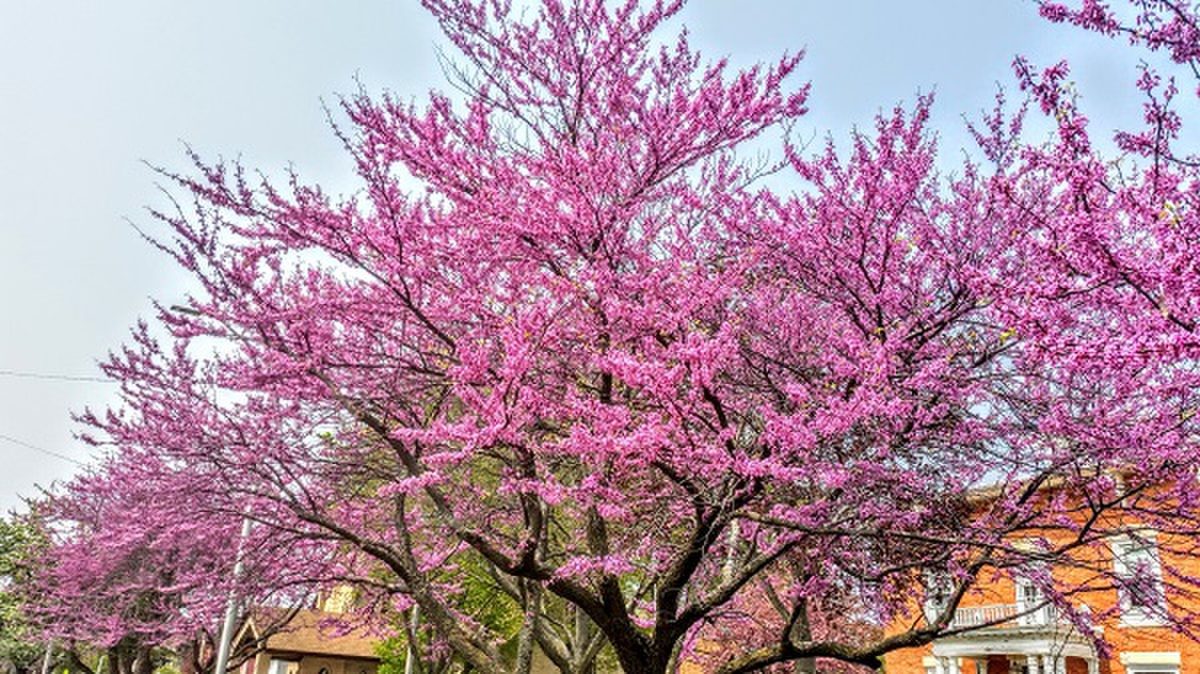
Photo: Downspec, CC BY-SA 4.0 via Wikimedia Commons

Quick facts
| Light: | Full sun, part shade and full shade (full sun preferred)123 |
|---|---|
| Water: | Dry to medium11 source |
| Soil: | Well drained, moist and occasionally dry; pH 5–842 |
| Hardiness: | Zones 4a–9b11 source |
| Size: | 20–35.1 ft (6.1–10.7 m) × 20–35.1 ft (6.1–10.7 m)14 |
| Growth rate: | Moderate11 source |
| Bloom: | Mar–May, Pink, purple and red121 source |
| Cats: | Not documented by major sources |
| Dogs: | Not documented by major sources |
| Native range: | ALA, ARK, CNT, DEL, FLA, GEO, ILL, INI, IOW, KAN, KTY, LOU, MAS, MIC, MRY, MSI, MSO, MXC, MXE, MXG, NCA, NEB, NWJ, NWM, NWY, OHI, OKL, PEN, SCA, TEN, TEX, VRG, WDC, WIS, WVA5 |
| Family: | Fabaceae |
How much light does an Eastern Redbud need?
Full sun is the preferred exposure for eastern redbud, Cercis canadensis. The listed range also includes part shade and full shade. One source defines part shade as direct sunlight for only part of the day, about 2 to 6 hours. Another source lists part shade and shade among the light conditions for this tree. Both of those are tolerances, and full sun remains the preferred choice.
How often to water an Eastern Redbud
The moisture range listed for this tree runs from dry to medium. One source says it does not tolerate heat or drought, which can stress the tree. The same source says it does not tolerate wet soils. Soil drainage is listed as well drained, moist and occasionally dry. Another source describes moist, fertile, well-drained soils.
- Water: Dry to medium1
Best soil for an Eastern Redbud
Soil drainage for eastern redbud is listed as well drained, moist and occasionally dry. One source describes moist, fertile, well-drained soils. Occasional periods of dry soil also appear in the listing. The tree can tolerate acid to alkaline soil, from pH 5.0 to 8.0. Wet soils are not tolerated. In short, the listing points to soil that drains well and sits between pH 5 and 8.
Hardiness and temperature
Eastern redbud is rated for USDA hardiness zones 4a to 9b. Zone 4a is the cold end of the listed range and 9b is the warm end. That range covers every half-zone from 4a through 9b. One source also says the tree does not tolerate heat or drought. No cited source records a minimum temperature or a humidity preference for it. The tree is deciduous. Your local zone is the figure to compare against the rating.
- Hardiness: Zones 4a–9b1
How to plant an Eastern Redbud
Zones 4a to 9b are the hardiness range listed for this tree. Eastern redbud is a deciduous tree. Mature height is 20–35.1 ft (6.1–10.7 m). Mature spread is also 20–35.1 ft (6.1–10.7 m). Allow room for that spread when you choose a spot. Full sun is the preferred light. Its native status in the lower 48 states is native. Its growth rate is moderate.
- Hardiness: Zones 4a–9b1
Winter care
Winter hardiness for eastern redbud is given as zones 4a to 9b. The listing runs through every half-zone: 4a, 4b, 5a, 5b, 6a, 6b, 7a, 7b, 8a, 8b, 9a and 9b. Find your own zone and see whether it falls inside that run. This is a deciduous tree. One source calls it a native, deciduous, small tree or shrub.
- Hardiness: Zones 4a–9b1
How to propagate an Eastern Redbud
The propagation method on record for this tree is seed. One source calls the simplest way to grow redbuds scarifying the seeds and planting them outdoors. The record lists seed alone. Eastern redbud is classed as a tree. Its growth rate is listed as moderate.
- Propagation: Seed2
Common problems
Leafhoppers, caterpillars, borers, Japanese beetles, treehoppers, scale and webworms are the insect pests listed for eastern redbud. Cornell notes that canker and verticillium wilt can cause damage. Dieback, leaf spot, blight and mildew are also listed as diseases.
| Problem | Kind |
|---|---|
| Leafhoppers | Pest |
| Caterpillars | Pest |
| Borers | Pest |
| Japanese beetles | Pest |
| Treehoppers | Pest |
| Scale insects | Pest |
| Webworms | Pest |
| Canker | Disease |
| Dieback | Disease |
| Leaf spot | Disease |
| Verticillium wilt | Disease |
| Blight | Disease |
| Mildew | Disease |
Is Eastern Redbud toxic to cats and dogs?
Recommended supplies
- Soil: a free-draining mix, and a pot with a drainage hole.
Questions and answers
- What hardiness zones suit eastern redbud?
- Eastern redbud is rated for zones 4a to 9b. That range runs from 4a at the cold end to 9b at the warm end. It is a deciduous tree.
- Does eastern redbud need full sun?
- Full sun is the preferred light for this tree. Part shade and full shade are also listed. One source defines part shade as direct sunlight for only part of the day, about 2 to 6 hours.
- What pests and diseases affect eastern redbud?
- Listed insect pests include leafhoppers, caterpillars, borers, Japanese beetles, treehoppers, scale and webworms. Canker and verticillium wilt can cause damage. Dieback, leaf spot, blight and mildew are also listed.
Sources
- NC State Extension Gardener Plant Toolbox. https://plants.ces.ncsu.edu/plants/cercis-canadensis/. Accessed 14 October 2026.
- Lady Bird Johnson Wildflower Center. https://www.wildflower.org/plants/result.php?id_plant=ceca4. Accessed 14 October 2026.
- Clemson Cooperative Extension HGIC. https://hgic.clemson.edu/factsheet/redbud/. Accessed 14 October 2026.
- Cornell University CALS Woody Plants Database. https://woodyplants.cals.cornell.edu/plant/52. Accessed 14 October 2026.
- Royal Botanic Gardens, Kew (World Checklist of Vascular Plants). https://sftp.kew.org/pub/data-repositories/WCVP/wcvp.zip. Accessed 4 June 2026.
How this page was made
- Written with AI assistance from the sources listed on this page. AI is never the source of a fact.