Sassafras (Sassafras albidum)
Formerly Sassafras variifolium, Laurus albida, Laurus sassafras
Grow sassafras in full sun to part shade outdoors. It also tolerates full shade. Keep the soil moisture somewhere between dry and medium. This tree is deciduous. It grows at a moderate rate. It is hardy in USDA zones 4a through 9b. No cited source on this page lists a toxicity status for cats or dogs.
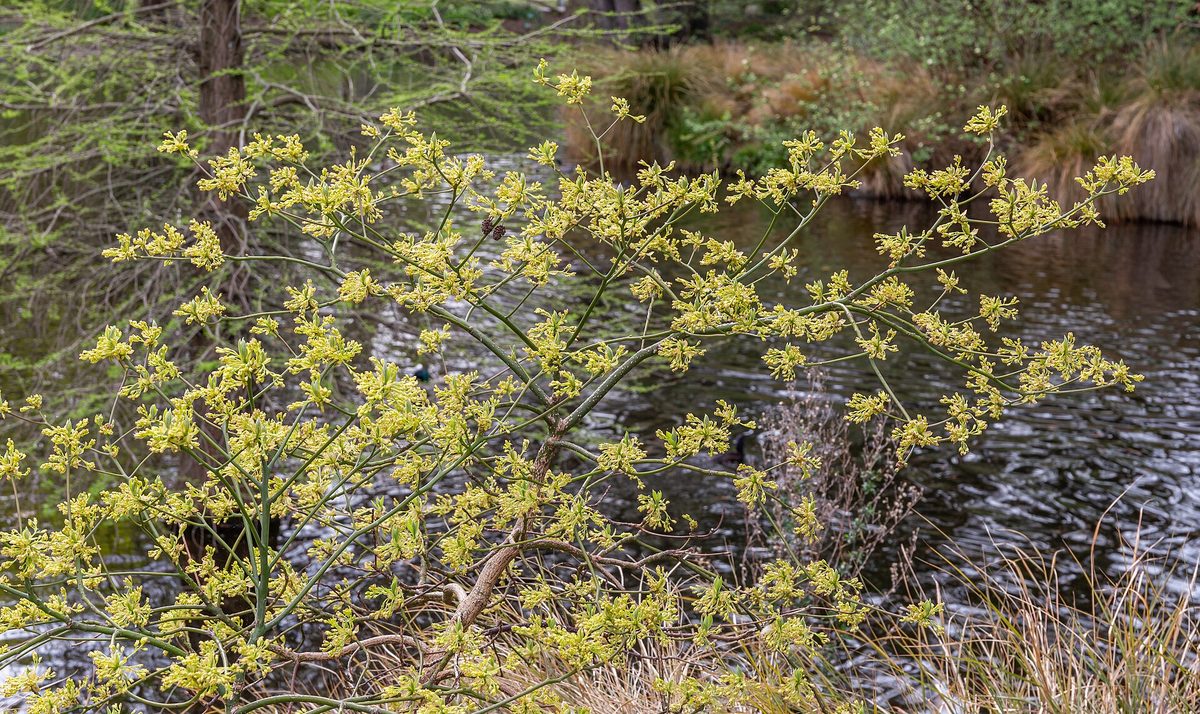
Photo: Wikimedia Commons contributor, CC BY-SA 4.0 via Wikimedia Commons

Quick facts
| Light: | Full sun, part shade and full shade (full sun preferred)123455 |
|---|---|
| Water: | Dry to medium61 source |
| Soil: | Well drained, moist, occasionally dry and occasionally wet; pH 5–7.4152 |
| Hardiness: | Zones 4a–9b11 source |
| Size: | 30–60 ft (9.14–18.29 m) × 25–40 ft (7.62–12.19 m)5432 |
| Growth rate: | Moderate41 |
| Bloom: | Yellow, green and brown132 |
| Cats: | Not documented by major sources |
| Dogs: | Not documented by major sources |
| Native range: | ALA, ARK, CNT, DEL, FLA, GEO, ILL, INI, IOW, KAN, KTY, LOU, MAI, MAS, MIC, MRY, MSI, MSO, NCA, NWH, NWJ, NWY, OHI, OKL, ONT, PEN, RHO, SCA, TEN, TEX, VER, VRG, WDC, WVA9 |
| Family: | Lauraceae |
How much light does a Sassafras need?
Full sun suits sassafras best outdoors, meaning six or more hours of direct sunlight a day. Part shade and full shade are also listed as tolerated conditions for it outdoors. Full sun remains the single preferred choice among the three light levels recorded for this species.
How often to water a Sassafras
Give sassafras soil moisture that ranges from dry to medium, and nothing wetter than that. This tree tolerates both ends of that range, from dry soil to medium moisture. Medium moisture is the upper limit recorded for this species, and dry soil is the lower limit.
- Water: Dry to medium6
Best soil for a Sassafras
Sassafras grows well in soil that stays consistently moist and well drained at the same time. It also tolerates occasional spells of dry soil and occasional stretches of wet or saturated soil. Its recorded soil pH range runs from 5.0 to 7.4, covering acid to neutral soil. That range stretches from the acid end to the neutral end of the pH scale.
Hardiness and temperature
Sassafras is rated for USDA hardiness zones 4a through 9b when grown outdoors in the ground. That full range spans twelve separate zones in total, from 4a up to 9b. Listed zones in between include 4b, 5a, 5b, 6a, 6b, 7a, 7b, 8a and 8b.
- Hardiness: Zones 4a–9b1
Pruning a Sassafras
Prune sassafras while it is still young to shape a single trunk suited to landscape planting. You can also let it grow with multiple trunks instead. Beyond shaping the trunk early in its life, this tree only needs light shaping overall.
How to plant a Sassafras
Mature sassafras trees reach 30 to 60 ft (9.14 to 18.29 m) tall and spread 25 to 40 ft (7.62 to 12.19 m) wide. Choose a planting site with room for that full spread. USDA hardiness zones 4a through 9b mark the range where it is rated to grow outdoors. Sassafras is native to the contiguous United States. Its native range includes dozens of states and provinces, from Texas and Florida to Maine and Ontario.
- Hardiness: Zones 4a–9b1
Winter care
Gardens colder than zone 4a fall outside the range listed for this tree. Zone 9b marks the warm edge of that same range. Within zones 4a through 9b, this tree is rated to survive the winter outdoors. That range covers twelve zones in total, each one listed for this species.
- Hardiness: Zones 4a–9b1
How to propagate a Sassafras
Seed, root cuttings and stem cuttings are the three methods on record for propagating this tree outdoors. Each of the three methods is recorded as a way to grow a new sassafras tree. Root cuttings in particular are named alongside seed as a direct way to start this tree. Stem cuttings are the third method listed alongside seed and root cuttings.
Common problems
This tree is susceptible to laurel wilt. Other recorded diseases include cotton root rot, bacterial leaf scorch, vascular streak dieback, root rot and leaf spot. Pests recorded on this tree include the redbay ambrosia beetle, the Japanese beetle, the spotted lanternfly and the brown marmorated stink bug. Other pests on record are the glassy winged sharpshooter, the whitemarked tussock moth, white peach scale, the Asian ambrosia beetle and bagworms.
- Common pests: redbay ambrosia beetle, japanese beetle, spotted lanternfly, brown marmorated stink bug, glassy winged sharpshooter, whitemarked tussock moth, white peach scale, asian ambrosia beetle and bagworms85
- Common diseases: laurel wilt, cotton root rot, bacterial leaf scorch, vascular streak dieback, root rot and leaf spot1
| Problem | Kind |
|---|---|
| Redbay ambrosia beetle | Pest |
| Japanese beetle | Pest |
| Spotted lanternfly | Pest |
| Brown marmorated stink bug | Pest |
| Glassy winged sharpshooter | Pest |
| Whitemarked tussock moth | Pest |
| White peach scale | Pest |
| Asian ambrosia beetle | Pest |
| Bagworms | Pest |
| Laurel wilt | Disease |
| Cotton root rot | Disease |
| Bacterial leaf scorch | Disease |
| Vascular streak dieback | Disease |
| Root rot | Disease |
| Leaf spot | Disease |
Is Sassafras toxic to cats and dogs?
Recommended supplies
- Soil: a free-draining mix, and a pot with a drainage hole.
Questions and answers
- What kind of soil does sassafras need?
- Sassafras does best in soil that stays consistently moist and drains well, though it also tolerates occasional dry or wet spells. Its soil pH can range from 5.0 to 7.4, covering acid to neutral conditions.
- How fast does sassafras grow?
- Sassafras has a moderate growth rate. Over time it grows into a tree 30 to 60 ft (9.14 to 18.29 m) tall with a spread of 25 to 40 ft (7.62 to 12.19 m).
- How do you propagate sassafras?
- You can propagate sassafras from seed, from root cuttings or from stem cuttings. Seed and root cuttings are named directly as ways to start new plants.
Sources
- NC State Extension Gardener Plant Toolbox. https://plants.ces.ncsu.edu/plants/sassafras-albidum/. Accessed 14 October 2026.
- Lady Bird Johnson Wildflower Center. https://www.wildflower.org/plants/result.php?id_plant=saal5. Accessed 14 October 2026.
- Lady Bird Johnson Wildflower Center. https://www.wildflower.org/plants/result.php?id_plant=SAAL5. Accessed 14 October 2026.
- University of Florida IFAS Extension (EDIS). https://ask.ifas.ufl.edu/publication/ST584. Accessed 14 October 2026.
- Cornell University CALS Woody Plants Database. https://woodyplants.cals.cornell.edu/plant/233. Accessed 14 October 2026.
- Penn State Extension. https://extension.psu.edu/programs/master-gardener/counties/york/native-plants/fact-sheets/native-plants-for-sunny-dry-areas. Accessed 14 October 2026.
- University of Florida IFAS Extension (EDIS). https://ask.ifas.ufl.edu/st584. Accessed 14 October 2026.
- EPPO Global Database. https://gd.eppo.int/taxon/SSAAL/pests. Accessed 14 October 2026.
- Royal Botanic Gardens, Kew (World Checklist of Vascular Plants). https://sftp.kew.org/pub/data-repositories/WCVP/wcvp.zip. Accessed 4 June 2026.
How this page was made
- Written with AI assistance from the sources listed on this page. AI is never the source of a fact.