Red Clover (Trifolium pratense)
Formerly Trifolium sativum, Trifolium pensylvanicum, Lagopus pratensis
Red clover (Trifolium pratense) is a herbaceous perennial. Give it full sun, with six or more hours of direct light a day. Choose well drained soil with a pH of 6 to 7. It is listed for zones 3a to 9b. Its flowers are pink. It grows rapidly and reaches 0.5–2 ft (0.15–0.61 m) tall. The pet toxicity of this plant is not documented on this page.
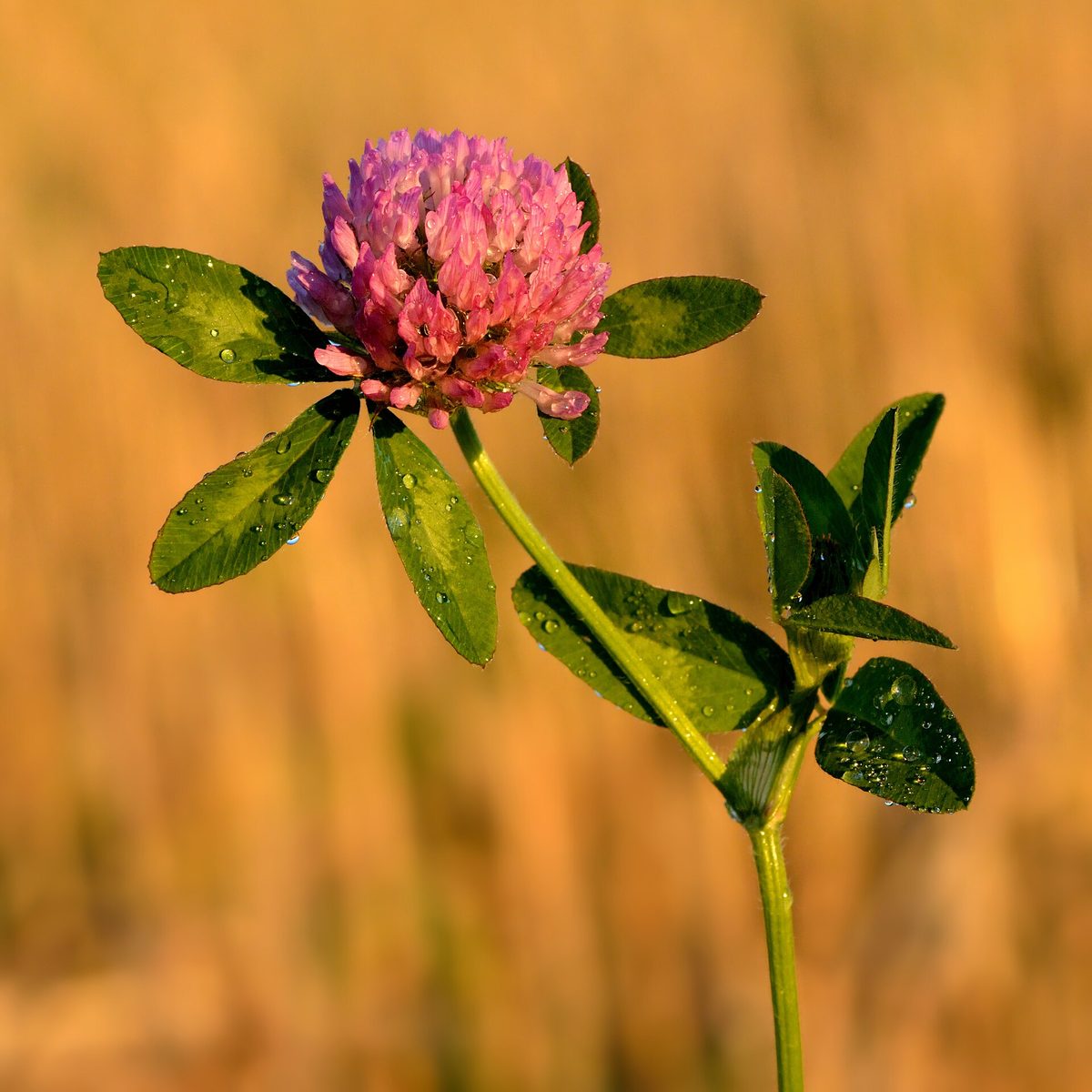
Photo: Ivar Leidus, CC BY-SA 4.0 via Wikimedia Commons

Quick facts
| Light: | Full sun11 source |
|---|---|
| Soil: | Well drained and occasionally dry; pH 6–7121 source |
| Hardiness: | Zones 3a–9b11 source |
| Size: | 0.5–2 ft (0.15–0.61 m) × 0.7–1.7 ft (0.2–0.51 m)11 source |
| Growth rate: | Rapid11 source |
| Bloom: | Pink11 source |
| Cats: | Not documented by major sources |
| Dogs: | Not documented by major sources |
| Native range: | AFG, ALB, ALG, ALT, AUT, AZO, BGM, BLR, BLT, BRY, BUL, CHX, CNY, COR, CZE, DEN, EHM, FIN, FOR, FRA, GER, GRB, GRC, HUN, IND, IRE, IRK, IRN, IRQ, ITA, KAZ, KGZ, KRA, KRY, MDR, MON, MOR, NCS, NEP, NET, NOR, PAK, POL, POR, ROM, RUC, RUE, RUN, RUS, RUW, SAR, SIC, SPA, SWE, SWI, TCS, TKM, TUE, TUN, TVA, TZK, UKR, UZB, WHM, WSB, YUG5 |
| Family: | Fabaceae |
How much light does a Red Clover need?
Full sun is the light level listed for red clover outdoors. Full sun means six or more hours of direct sunlight a day. That is the only light level listed for this plant. Pick a spot that receives at least six hours of direct sun each day. Shadier corners of a garden do not match the light this plant is listed for.
Best soil for a Red Clover
Red clover grows in well drained soil that is occasionally dry. Good drainage is the soil condition listed for it. Aim for a soil pH between 6 and 7. Clovers as a group perform best within that pH range. A pH below 6 or above 7 sits outside the range listed for clovers. Weigh the drainage and the pH range together when you choose a planting site.
Hardiness and temperature
USDA hardiness zones 3a through 9b are listed for red clover. The listing names each half zone in that span: 3a, 3b, 4a, 4b, 5a, 5b, 6a, 6b, 7a, 7b, 8a, 8b, 9a and 9b. Gardeners in zone 3a, the coldest zone listed, sit at the cool end of that span. Gardeners in zone 9b sit at the warm end of the span.
- Hardiness: Zones 3a–9b1
How to plant a Red Clover
Plant red clover in full sun with well drained soil. It suits USDA zones 3a through 9b. Each plant spreads 0.7–1.7 ft (0.2–0.51 m) wide, so measure that much room for it. It reaches 0.5–2 ft (0.15–0.61 m) tall. A soil pH of 6 to 7 is listed as best for clovers. Seed is the listed way to start it. Its flowers are pink.
- Hardiness: Zones 3a–9b1
Winter care
Zone 3a is the coldest zone in the listing for this plant. Red clover is listed for zones 3a through 9b. Zones colder than 3a fall outside the listed range. It is a herbaceous perennial. Zone 9b is the warmest zone listed. Compare your own USDA zone against that span.
- Hardiness: Zones 3a–9b1
How to propagate a Red Clover
Seed is the propagation method listed for red clover. No other method, such as cuttings or division, is listed for it. The plant you raise from seed is a herbaceous perennial. Its growth rate is listed as rapid. Mature plants reach 0.5–2 ft (0.15–0.61 m) tall. Its habit is erect and spreading.
- Propagation: Seed1
Common problems
Four pests are listed for red clover: clover leaf weevil, Japanese beetle, spotted cucumber beetle and stem nematode. Two of the four listed pests are beetles. Three diseases are listed: clover rot, powdery mildew and clover yellow edge phytoplasma. Clover rot can be an issue. Powdery mildew may damage accumulated growth.
| Problem | Kind |
|---|---|
| Clover leaf weevil | Pest |
| Japanese beetle | Pest |
| Spotted cucumber beetle | Pest |
| Stem nematode | Pest |
| Clover rot | Disease |
| Powdery mildew | Disease |
| Clover yellow edge phytoplasma | Disease |
Is Red Clover toxic to cats and dogs?
Recommended supplies
- Soil: a free-draining mix, and a pot with a drainage hole.
Questions and answers
- How much sun does red clover need?
- Red clover needs full sun. That means six or more hours of direct sunlight a day. Full sun is the only light level listed for it.
- What soil does red clover grow best in?
- Choose well drained soil that is occasionally dry. Clovers perform best when the soil pH is between 6 and 7. A pH outside that range is not the one listed.
- Which hardiness zones suit red clover?
- Red clover is listed for USDA zones 3a through 9b. That range covers every half zone from 3a to 9b. It is a herbaceous perennial.
Sources
- NC State Extension Gardener Plant Toolbox. https://plants.ces.ncsu.edu/plants/trifolium-pratense/. Accessed 21 October 2026.
- Clemson Cooperative Extension Home & Garden Information Center. https://hgic.clemson.edu/factsheet/cover-crops/. Accessed 21 October 2026.
- EPPO Global Database. https://gd.eppo.int/taxon/TRFPR/pests. Accessed 21 October 2026.
- University of Florida IFAS Extension (EDIS). https://ask.ifas.ufl.edu/publication/DS127. Accessed 21 October 2026.
- Royal Botanic Gardens, Kew (World Checklist of Vascular Plants). https://sftp.kew.org/pub/data-repositories/WCVP/wcvp.zip. Accessed 4 June 2026.
How this page was made
- Written with AI assistance from the sources listed on this page. AI is never the source of a fact.