Camellia (Camellia japonica)
Formerly Thea japonica, Thea nakaii, Thea camellia
Grow this camellia outdoors in part shade, where it gets direct sun for two to six hours a day, and give it medium water. Water it about an inch every 10 days to 2 weeks. The ASPCA lists this plant as non-toxic to both cats and dogs.
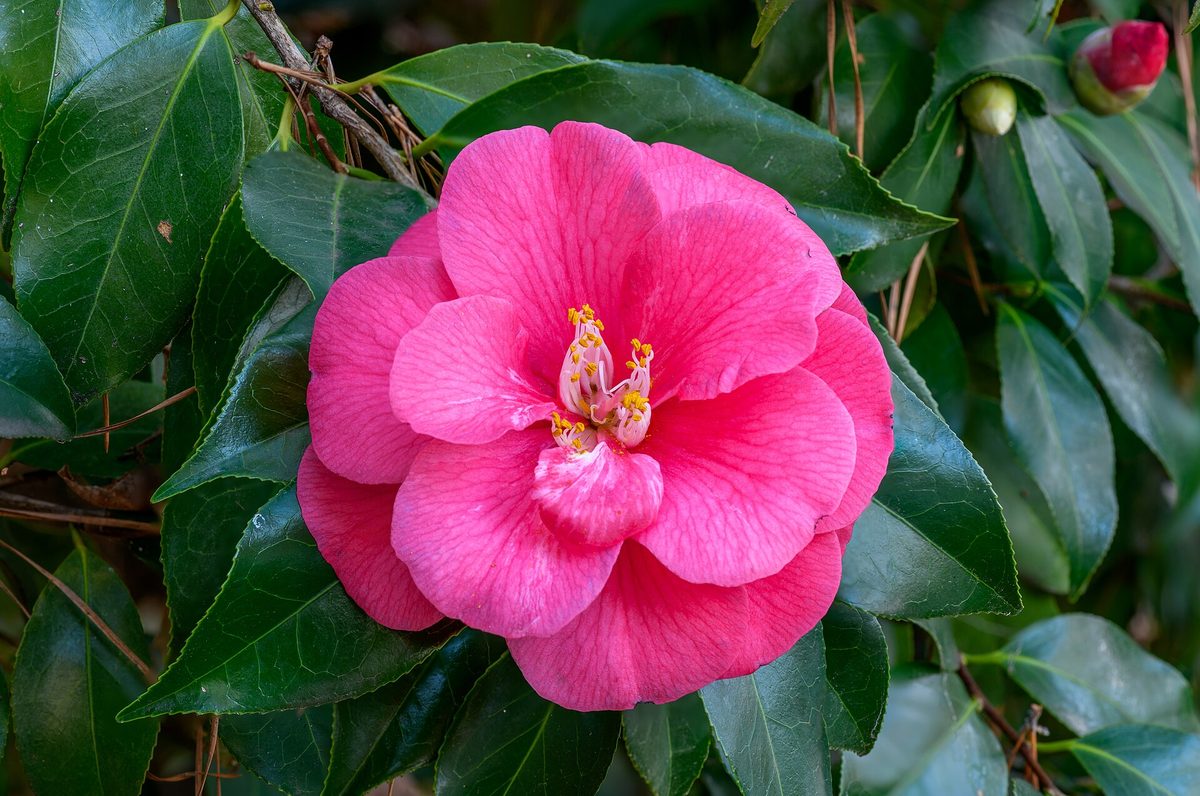
Photo: PumpkinSky, CC BY-SA 3.0 via Wikimedia Commons

Quick facts
| Light: | Part shade123 |
|---|---|
| Water: | Medium41 source |
| Soil: | Well drained, moist and occasionally wet; pH 5.5–6.5143 |
| Hardiness: | Zones 7a–9b11 source |
| Size: | Sources differ: Cornell University CALS Woody Plants Database × 5–10 ft (1.52–3.05 m)371Sources differ |
| Growth rate: | Slow13111 |
| Bloom: | White, pink, red and multicoloured13 |
| Cats: | Non-toxic to cats 61 |
| Dogs: | Non-toxic to dogs 61 |
| Native range: | CHN, CHS, JAP, KOR, NNS, TAI8 |
| Family: | Theaceae |
How much light does a Camellia need?
Camellia japonica performs best outdoors in a spot with part shade. That means direct sunlight for only part of the day, somewhere between two and six hours. Two to six hours of direct sun a day is the window the partial-shade rating for this species is based on.
How often to water a Camellia
Medium water, not a dry or a wet regime, is what this camellia needs outdoors. Apply about an inch of water to it every 10 days to two weeks outdoors. Its minimum and its maximum watering need both fall at the same medium level outdoors.
- Water: Medium4
Best soil for a Camellia
Camellias prefer fertile soil that is high in organic matter and drains well outdoors. Good drainage is one of this plant's basic soil needs. The soil can also stay moist or occasionally wet outdoors. Keep the soil pH slightly acidic, in a range from 5.5 to 6.5. A pH below 5.5 or above 6.5 falls outside the range recommended for this camellia.
Hardiness and temperature
This camellia grows well outdoors across USDA hardiness zones 7a through 9b. Zone 7a is the coldest zone listed for it, and zone 9b is the warmest. A site colder than zone 7a or warmer than zone 9b falls outside that range. That range covers six zone ratings from 7a to 9b.
- Hardiness: Zones 7a–9b1
Fertilizing a Camellia
A light application of fertilizer made for azaleas and camellias suits this plant in spring. This camellia needs that feeding only once a year. Once a year, in that single light spring dose, is enough feeding for this plant outdoors.
- Fertilizer: Light, once a year (Mar–Jun)3
Pruning a Camellia
Late winter or very early spring, right after this camellia finishes blooming, is the time for any shaping or grooming. Keep the work light, and remove only dead growth beyond that light shaping. This plant's pruning needs are limited to light shaping and removing dead wood, nothing heavier.
- Pruning: Light shaping and Remove dead growth only (Feb–Mar)2
How to plant a Camellia
Give this camellia room to grow to its mature spread of 5 to 10 ft (1.52-3.05 m). This camellia also grows outdoors in USDA hardiness zones 7a through 9b. A planting site that falls outside USDA zones 7a to 9b sits outside the range listed for this species.
- Hardiness: Zones 7a–9b1
Winter care
Outdoors, this camellia's hardiness is rated for USDA zones 7a through 9b. Gardens in zone 7a sit at the cold edge of that rated range. Gardens in zone 9b sit at the warm edge of it. Winters colder than zone 7a fall outside the range this camellia is rated to handle outdoors.
- Hardiness: Zones 7a–9b1
Care calendar
| Task | Jan | Feb | Mar | Apr | May | Jun | Jul | Aug | Sep | Oct | Nov | Dec |
|---|---|---|---|---|---|---|---|---|---|---|---|---|
| Fertilize | Fertilize in Mar | Fertilize in Apr | Fertilize in May | Fertilize in Jun | ||||||||
| Prune | Prune in Feb | Prune in Mar |
How to propagate a Camellia
Stem cuttings, layering, grafting, and seed are the propagation methods recorded for camellia. Stem cuttings and layering are named specifically for propagating this plant outdoors. Take stem cuttings from spring growth once it has hardened. Grafting and growing from seed are the other two methods recorded for propagating this species of camellia outdoors.
Common problems
Camellia japonica can attract scale insects, aphids, planthoppers, and spider mites outdoors. Scale is a pest that causes particular trouble for this plant. This species is also prone to leaf spot, anthracnose, petal blight, canker, and root rot. Petal blight fungus affects all camellias of this type.
| Problem | Kind |
|---|---|
| Scale insects | Pest |
| Aphids | Pest |
| Planthoppers | Pest |
| Spider mites | Pest |
| Leaf spot | Disease |
| Anthracnose | Disease |
| Petal blight | Disease |
| Canker | Disease |
| Root rot | Disease |
Is Camellia toxic to cats and dogs?
The ASPCA lists camellia as non-toxic to cats. The ASPCA also lists it as non-toxic to dogs. NC State Extension's Plant Toolbox also lists this species as non-toxic to cats. It lists the same non-toxic rating for dogs. The ASPCA's listing covers both cats and dogs together, giving each the same non-toxic rating. This camellia is not on record as toxic to either cats or dogs.
Recommended supplies
- Soil: a free-draining mix, and a pot with a drainage hole.
Questions and answers
- Is camellia (Camellia japonica) toxic to cats or dogs?
- The ASPCA lists camellia as non-toxic to cats and non-toxic to dogs. NC State Extension's Plant Toolbox lists the same non-toxic rating for both pets.
- How much light does camellia need outdoors?
- Camellia japonica performs best outdoors in part shade, with direct sun for only part of the day, around two to six hours each day.
- How often does camellia need fertilizer?
- This camellia needs only a light application of fertilizer once a year, applied in spring. Use a fertilizer formulated for azaleas and camellias for that single yearly feeding.
Sources
- NC State Extension Gardener Plant Toolbox. https://plants.ces.ncsu.edu/plants/camellia-japonica/. Accessed 14 October 2026.
- University of Florida IFAS Extension (EDIS). https://ask.ifas.ufl.edu/ep002. Accessed 14 October 2026.
- Clemson Cooperative Extension HGIC. https://hgic.clemson.edu/factsheet/camellia/. Accessed 14 October 2026.
- University of Florida IFAS Extension (EDIS). https://ask.ifas.ufl.edu/publication/EP002. Accessed 14 October 2026.
- Clemson Cooperative Extension Home & Garden Information Center. https://hgic.clemson.edu/factsheet/camellia-diseases-insect-pests/. Accessed 14 October 2026.
- ASPCA Animal Poison Control Center. https://www.aspca.org/pet-care/aspca-poison-control/toxic-and-non-toxic-plants/camellia. Accessed 14 October 2026.
- Cornell University CALS Woody Plants Database. https://woodyplants.cals.cornell.edu/plant/428. Accessed 14 October 2026.
- Royal Botanic Gardens, Kew (World Checklist of Vascular Plants). https://sftp.kew.org/pub/data-repositories/WCVP/wcvp.zip. Accessed 4 June 2026.
How this page was made
- Written with AI assistance from the sources listed on this page. AI is never the source of a fact.