Horse Chestnut (Aesculus hippocastanum)
Formerly Pawia hippocastanum, Aesculus procera, Aesculus septenata
Give Aesculus hippocastanum full sun, though part shade is also accepted, and do not let its soil dry out. Its water range runs from medium to wet. It is a deciduous tree that reaches 50–75 ft (15.24–22.86 m) tall. The NC State listing marks it as a problem for both cats and dogs.
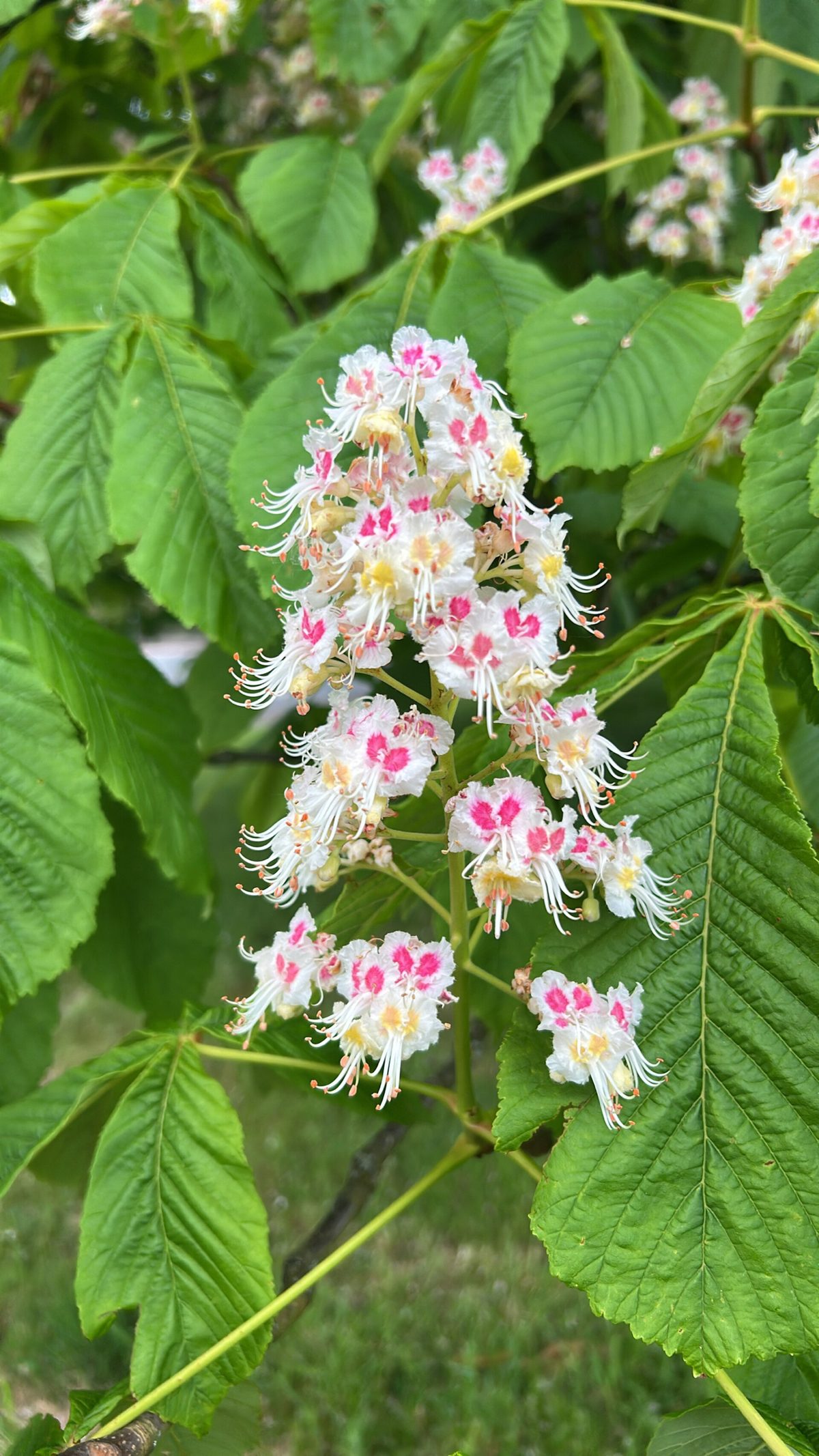
Photo: kmortimerjones, CC BY 4.0 via Wikimedia Commons

Quick facts
| Light: | Full sun and part shade (full sun preferred)123 |
|---|---|
| Water: | Medium to wet14 |
| Soil: | Well drained and moist; pH 5–8132 |
| Hardiness: | Zones 4a–7b15 |
| Size: | 50–75 ft (15.24–22.86 m) × 40–70 ft (12.19–21.34 m)271 |
| Growth rate: | Moderate11 source |
| Bloom: | Apr (the Piedmont), White311 source |
| Cats: | Toxic to cats (1 source) 6 |
| Dogs: | Toxic to dogs (1 source) 6 |
| Native range: | ALB, BUL, GRC, TKM, TUR, YUG8 |
| Family: | Sapindaceae |
How much light does a Horse Chestnut need?
This tree grows in full sun or part shade, and full sun is the preferred setting. Cornell's woody plants database says full sun or light shade suits it. NC State describes the range as sun to partial shade. Clemson Extension reports that it grows best in well-drained soils in partial shade, but will grow in full sun. Those sources differ a little on which light is best, but all of them accept full sun and part shade.
How often to water a Horse Chestnut
Dry soil is a condition this tree dislikes. The recorded water range runs from medium to wet. NC State pairs moist, well-drained soil with that dislike of dry soil. Utah State Extension says the tree prefers moist, protected sites, and that it will generally scorch its leaves on hot, dry sites. Cornell's listing also advises avoiding extremely dry situations.
Best soil for a Horse Chestnut
The drainage record for this tree lists two conditions, well drained and moist. NC State lists moist, well-drained soil as the match and notes that the tree dislikes dry soil. Clemson Extension says it grows best in well-drained soils. Cornell says it can tolerate acid to alkaline soil, from pH 5.0 to 8.0. That gives a tolerated pH band of 5–8.
Hardiness and temperature
Hardiness for this tree is given as Zones 4a–7b. That range spans eight half-zone steps, from 4a up through 7b. NC State names each step: 4a, 4b, 5a, 5b, 6a, 6b, 7a and 7b. Florida IFAS writes the same range as 4A through 7B. The tree is deciduous.
How to plant a Horse Chestnut
Choose a site in USDA zones 4a through 7b for this tree. Pick a spot with moist, well-drained soil and full sun or part shade. Mature trees reach 50–75 ft (15.24–22.86 m) in height and 40–70 ft (12.19–21.34 m) in spread. Its growth rate is moderate. The US register lists it as introduced in the lower 48 states. Its native range is recorded as ALB, BUL, GRC, TKM, TUR and YUG.
Winter care
As a deciduous tree, it is listed for Zones 4a–7b. Zone 4a is the cold end of that range, and 7b is the warm end. The listing stops at those limits, so zone 3 and colder, or zone 8 and warmer, fall outside it. NC State notes that the leaves often die in early fall.
Common problems
Leaf blotch, powdery mildew and leaf scorch are the diseases listed for this tree. NC State adds that its leaves often die in early fall. Clemson reports that leaf blotch affects this tree and most buckeye species. Utah State Extension links leaf scorch to hot, dry sites.
| Problem | Kind |
|---|---|
| Leaf blotch | Disease |
| Powdery mildew | Disease |
| Leaf scorch | Disease |
Is Horse Chestnut toxic to cats and dogs?
The NC State Extension Gardener Plant Toolbox flags Aesculus hippocastanum, the horse chestnut, as a problem for cats. The same listing flags it as a problem for dogs. On this page, the position for cats is toxic. The position for dogs is also toxic. Both the cat entry and the dog entry are recorded separately, and each reads toxic. Neither entry on file is marked as non-toxic or as uncertain.
Pet-safe alternatives
Recommended supplies
- Soil: a free-draining mix, and a pot with a drainage hole.
Questions and answers
- Is Aesculus hippocastanum toxic to cats and dogs?
- The NC State listing flags it as a problem for cats and as a problem for dogs. This page records both positions as toxic. The cat entry and the dog entry are recorded separately.
- Which hardiness zones suit this tree?
- It is listed for Zones 4a–7b. That runs from 4a at the cold end to 7b at the warm end. Florida IFAS writes the range as 4A through 7B. It is a deciduous tree.
- How big does Aesculus hippocastanum get?
- Mature height is 50–75 ft (15.24–22.86 m). Mature spread is 40–70 ft (12.19–21.34 m). Its growth rate is moderate. It is recorded as a tree.
Sources
- NC State Extension Gardener Plant Toolbox. https://plants.ces.ncsu.edu/plants/aesculus-hippocastanum/. Accessed 14 October 2026.
- Cornell University CALS Woody Plants Database. https://woodyplants.cals.cornell.edu/plant/17. Accessed 14 October 2026.
- Clemson Cooperative Extension HGIC. https://hgic.clemson.edu/factsheet/buckeyes-horsechestnuts/. Accessed 14 October 2026.
- Utah State University Extension. https://extension.usu.edu/treebrowser/catalog/horsechestnut.php. Accessed 14 October 2026.
- University of Florida IFAS Extension (EDIS). https://ask.ifas.ufl.edu/st062. Accessed 14 October 2026.
- NC State Extension Gardener Plant Toolbox. https://plants.ces.ncsu.edu/plants/aesculus-hippocastanum/common-name/common-horse-chestnut/. Accessed 14 October 2026.
- University of Minnesota Extension. https://extension.umn.edu/about/our-stories/news/yard-and-garden-news/climate-resilient-landscape-trees-for-minnesota. Accessed 14 October 2026.
- Royal Botanic Gardens, Kew (World Checklist of Vascular Plants). https://sftp.kew.org/pub/data-repositories/WCVP/wcvp.zip. Accessed 4 June 2026.
How this page was made
- Written with AI assistance from the sources listed on this page. AI is never the source of a fact.