Cabbage Palmetto (Sabal palmetto)
Formerly Inodes palmetto, Corypha palmetto, Chamaerops palmetto
Sabal palmetto grows best in full sun but tolerates part shade. Once established, it handles both drought and wet soil. It is a tree that keeps its leaves year-round. Its growth rate is moderate. Its native range includes the southeastern United States and the Caribbean. No cited source lists this palm's toxicity to cats or dogs. Its mature spread can reach about 10 ft (3 m).
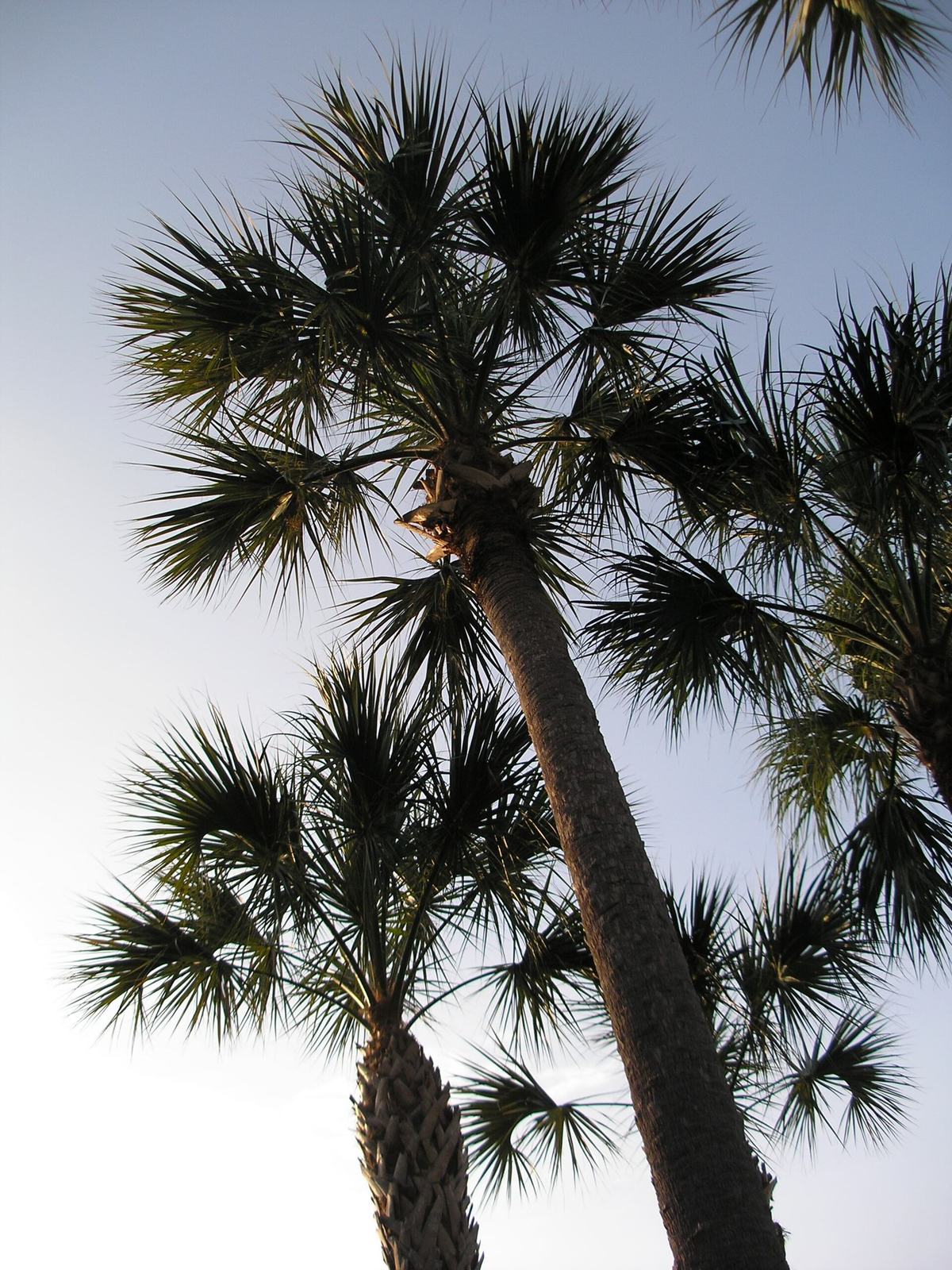
Photo: William Bumgarner (en.wp:Zsinj), Public domain via Wikimedia Commons

Quick facts
| Light: | Full sun and part shade (full sun preferred)12 |
|---|---|
| Water: | Dry to wet11 source |
| Soil: | Well drained, moist and occasionally wet11 source |
| Hardiness: | Zones 7b–11b11 source |
| Size: | Sources differ: USDA Forest Service Fire Effects Information System; Lady Bird Johnson Wildflower Center; Lady Bird Johnson Wildflower Center; Clemson Cooperative Extension Home & Garden Information Center; Clemson Cooperative Extension Home & Garden Information Center; Clemson Cooperative Extension HGIC; USDA Forest Service Fire Effects Information System; Clemson Cooperative Extension Home & Garden Information Center × 10 ft (3.05 m)352417Sources differ |
| Growth rate: | Moderate14148 |
| Bloom: | White21 |
| Cats: | Not documented by major sources |
| Dogs: | Not documented by major sources |
| Native range: | ALA, BAH, CUB, FLA, GEO, NCA, SCA, TCI9 |
| Family: | Arecaceae |
How much light does a Cabbage Palmetto need?
Give Sabal palmetto a spot in full sun. Full sun means at least six hours of direct light each day. This palm also tolerates part shade. Outdoors in the garden, either light level works well for it. Sabal palmetto is a tree with a moderate growth rate.
How often to water a Cabbage Palmetto
Sabal palmetto tolerates a wide range of soil moisture. Once it is established, it handles both drought and flooding. Its water needs run from dry soil on one end to standing water on the other. This palm also grows in soil that drains well, stays moist, or is occasionally wet. This palm's spread at maturity reaches about 10 ft (3 m).
- Water: Dry to wet1
Best soil for a Cabbage Palmetto
Good drainage is best for Sabal palmetto. It also tolerates soil that stays moist or becomes occasionally wet. Its native range includes the southeastern United States and the Caribbean. In the continental United States, it is considered a native plant. It is a tree with a moderate growth rate. Its flowers are creamy white and fragrant. It propagates only from seed.
- Soil drainage: Well drained, moist and occasionally wet1
Hardiness and temperature
USDA hardiness zones 7b through 11b suit Sabal palmetto. It is cold hardy to about 15°F (-9°C). Zone 7b marks its coldest limit, and zone 11b marks its warmest. This palm keeps its leaves year-round as an evergreen. It tolerates both full sun and part shade outdoors. Once established, it also tolerates both drought and flooding. A mature Sabal palmetto spreads about 10 ft (3 m) wide.
Fertilizing a Cabbage Palmetto
Feed Sabal palmetto once a year. Use a palm-specific fertilizer or a general slow-release fertilizer. This light, annual feeding is enough for this palm. Sabal palmetto itself has a moderate growth rate. It is an evergreen tree that keeps its leaves year-round.
- Fertilizer: Light, once a year1
Pruning a Cabbage Palmetto
Only remove leaves from Sabal palmetto that are completely dead or loose. You can also remove leaves and fruit that are badly damaged or diseased. Leave healthy green leaves in place. This palm is an evergreen tree with a moderate growth rate. Its native range includes the southeastern United States and the Caribbean.
- Pruning: Remove dead growth only4
How to plant a Cabbage Palmetto
Plant Sabal palmetto in USDA hardiness zones 7b through 11b. Give it a spot in full sun or part shade. Choose soil with good drainage, or soil that stays moist or becomes occasionally wet. Leave enough room for its mature spread of about 10 ft (3 m). Once established, this palm handles both drought and flooding. Its flowers are creamy white and fragrant, growing in a cluster about 3 ft (0.9 m) long that opens in July.
- Hardiness: Zones 7b–11b1
Winter care
Winter care for Sabal palmetto depends on your hardiness zone. This palm grows outdoors in USDA zones 7b through 11b. It is cold hardy to about 15°F (-9°C). Zone 7b is the coldest zone where it is hardy, and zone 11b is the warmest. This palm is evergreen, keeping its leaves through winter. Once established, it also tolerates both drought and flooding through the year. Sabal palmetto's spread at maturity is about 10 ft (3 m). It also grows in soil that drains well, stays moist, or is occasionally wet.
How to propagate a Cabbage Palmetto
Growers propagate Sabal palmetto only from seed. Its seeds need no pretreatment to break dormancy. This tree's native range includes the southeastern United States and the Caribbean. It grows at a moderate rate. This palm's mature spread is about 10 ft (3 m). It also keeps its leaves year-round as an evergreen tree.
Common problems
Several pests can affect Sabal palmetto. These include Diocalandra frumenti, Haplaxius crudus, Paysandisia archon, the red palm weevil, the South American palm weevil, and Ripersiella hibisci. Lethal bronzing disease is a serious threat to this palm in Florida. Sabal palmetto itself grows at a moderate rate and keeps its leaves year-round.
| Problem | Kind |
|---|---|
| Diocalandra frumenti | Pest |
| Haplaxius crudus | Pest |
| Paysandisia archon | Pest |
| Red palm weevil | Pest |
| South american palm weevil | Pest |
| Ripersiella hibisci | Pest |
| Lethal bronzing disease | Disease |
Is Cabbage Palmetto toxic to cats and dogs?
Recommended supplies
- Soil: a free-draining mix, and a pot with a drainage hole.
Questions and answers
- What light does Sabal palmetto need?
- Give it full sun, though it also tolerates part shade. Outdoors, either light level works well for this palm. This tree also has a moderate growth rate.
- How often should you fertilize Sabal palmetto?
- Feed it once a year with a palm-specific or general slow-release fertilizer. This light, annual feeding is enough for this palm. It also keeps its leaves year-round as an evergreen tree.
- How cold can Sabal palmetto tolerate?
- It is cold hardy to about 15°F (-9°C). This palm grows in USDA hardiness zones 7b through 11b. Zone 7b marks the coldest zone where it survives outdoors.
Sources
- NC State Extension. https://plants.ces.ncsu.edu/plants/sabal-palmetto/. Accessed 13 October 2026.
- Lady Bird Johnson Wildflower Center. https://www.wildflower.org/plants/result.php?id_plant=sapa. Accessed 13 October 2026.
- UF/IFAS Extension (EDIS). https://ask.ifas.ufl.edu/publication/ST575. Accessed 13 October 2026.
- Clemson Cooperative Extension HGIC. https://hgic.clemson.edu/factsheet/palms-cycads/. Accessed 21 October 2026.
- USDA Forest Service Fire Effects Information System. https://www.fs.usda.gov/database/feis/plants/tree/sabpal/all.html. Accessed 13 October 2026.
- EPPO Global Database. https://gd.eppo.int/taxon/SABPA/pests. Accessed 13 October 2026.
- University of Florida IFAS Extension (EDIS). https://ask.ifas.ufl.edu/publication/EP020. Accessed 13 October 2026.
- University of Florida IFAS Extension (EDIS). https://ask.ifas.ufl.edu/publication/EH157. Accessed 29 October 2026.
- Royal Botanic Gardens, Kew (World Checklist of Vascular Plants). https://sftp.kew.org/pub/data-repositories/WCVP/wcvp.zip. Accessed 4 June 2026.
How this page was made
- Written with AI assistance from the sources listed on this page. AI is never the source of a fact.