Eastern White Pine (Pinus strobus)
Formerly Leucopitys strobus, Pinus nivea, Strobus weymouthiana
Give eastern white pine full sun, with part shade also accepted, and soil that is moist and well drained. Its water needs run from dry to medium. No cited source records a pet-toxicity position for cats or dogs, so that position is not documented on this page.
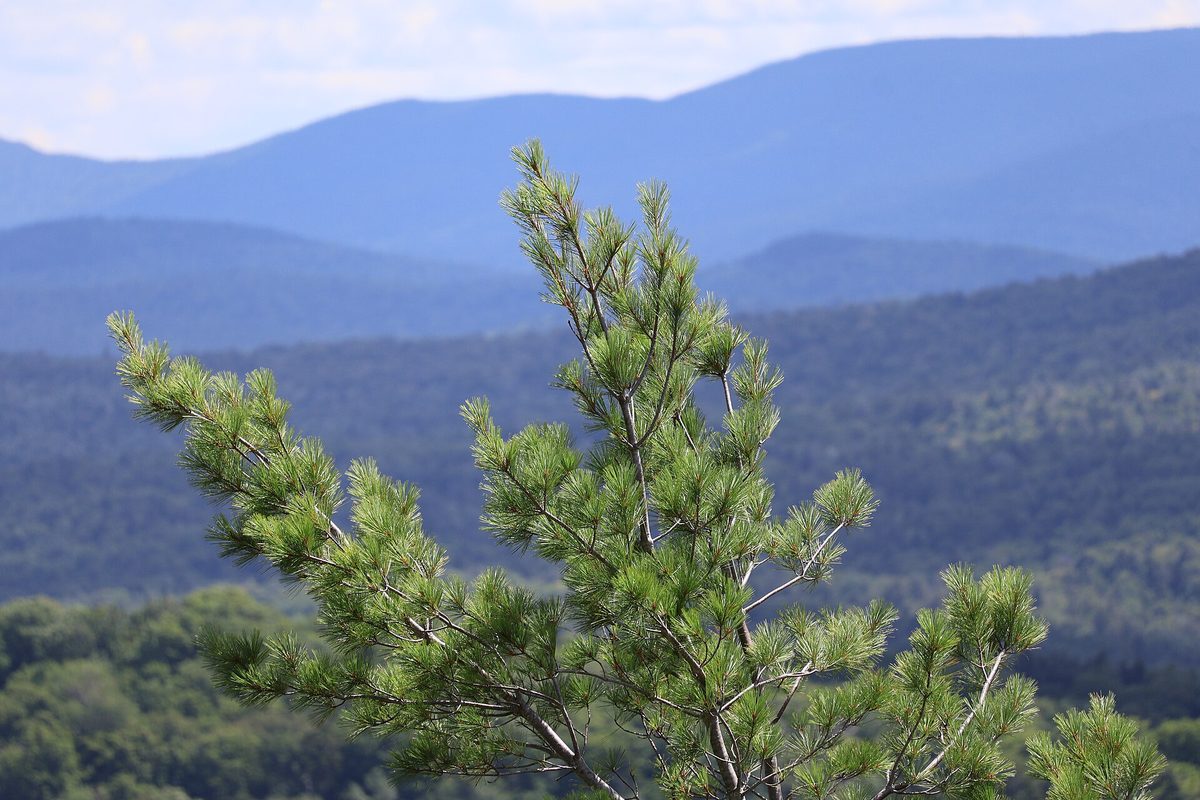
Photo: Serebit, CC BY-SA 4.0 via Wikimedia Commons

Quick facts
| Light: | Full sun and part shade (full sun preferred)12 |
|---|---|
| Water: | Dry to medium11 source |
| Soil: | Well drained, moist and occasionally dry; pH 5–7.412 |
| Hardiness: | Zones 3a–7b31 source |
| Size: | 50–80 ft (15.24–24.38 m) × 20–40 ft (6.1–12.19 m)12 |
| Growth rate: | Rapid18 |
| Bloom: | Apr–May, Yellow, green and red911 source |
| Cats: | Not documented by major sources |
| Dogs: | Not documented by major sources |
| Native range: | ALA, CNT, DEL, GEO, ILL, INI, IOW, KTY, MAI, MAN, MAS, MIC, MIN, MRY, NBR, NCA, NFL, NSC, NWH, NWJ, NWY, OHI, ONT, PEI, PEN, QUE, RHO, SCA, TEN, VER, VRG, WIS, WVA10 |
| Family: | Pinaceae |
How much light does an Eastern White Pine need?
Eastern white pine prefers full sun, meaning six or more hours of direct sunlight a day. Part shade is also listed among the conditions it takes. Full sun stays the preferred setting, and part shade is the accepted alternative. The plant's listing pairs that sun preference with cool, humid climates.
How often to water an Eastern White Pine
Water needs for eastern white pine range from dry to medium. The tree prefers moist, well-drained, fertile sandy loams. It also tolerates occasional periods of dry soil. Cool, humid climates suit it, and its humidity preference is listed as high. The water range runs from dry at one end to medium at the other.
- Water: Dry to medium1
Best soil for an Eastern White Pine
Eastern white pine prefers moist, well-drained, fertile sandy loams. Its drainage record lists well drained, moist and occasionally dry soil. Moist ground and occasional dry spells are both on that record, alongside well-drained conditions. For acidity, the tree tolerates acid to neutral soil, with a pH from 5 to 7.4. Soil anywhere inside that pH band falls within the stated tolerance.
Hardiness and temperature
Eastern white pine is hardy in USDA zones 3a through 7b. Zone 7b is the warmest zone in that listed range. No cited source records a minimum temperature for the tree. Its humidity preference is high, and the listing names cool, humid climates as the setting it prefers.
- Hardiness: Zones 3a–7b3
Pruning an Eastern White Pine
Pruning for eastern white pine is light shaping. The record places that shaping in spring. The cited guidance describes pruning one-half of the new growth tips in spring. Light shaping is the only pruning type recorded for this tree, and spring is its listed timing.
- Pruning: Light shaping (Mar–May)4
How to plant an Eastern White Pine
Plant eastern white pine in USDA zones 3a through 7b. Allow room for a tree that reaches 50 to 80 ft (15.24 to 24.38 m) tall and 20 to 40 ft (6.1 to 12.19 m) wide. Choose a spot with full sun, with part shade as the accepted alternative. The soil should be moist, well-drained, fertile sandy loam.
- Hardiness: Zones 3a–7b3
Winter care
Eastern white pine is a needled evergreen. It is hardy in USDA zones 3a through 7b. No cited source records a minimum temperature for it. Zone 3a is the coldest end of the listed range. The tree prefers cool, humid climates. The listing places it in the Pinaceae (pine) family.
- Hardiness: Zones 3a–7b3
Care calendar
| Task | Jan | Feb | Mar | Apr | May | Jun | Jul | Aug | Sep | Oct | Nov | Dec |
|---|---|---|---|---|---|---|---|---|---|---|---|---|
| Prune | Prune in Mar | Prune in Apr | Prune in May | |||||||||
| Bloom | Bloom in Apr | Bloom in May |
How to propagate an Eastern White Pine
Eastern white pine is propagated by seed. Seed production is generally good every three to five years. Good seed crops come at intervals of three to five years, not every year. No other method, such as cuttings or division, appears in the record for this tree.
- Propagation: Seed5
Common problems
Pests recorded for eastern white pine include white pine weevil, bark beetles, white pine shoot borer, Zimmerman pine moth, pine sawfly, scale insects, aphids and spider mites. Diseases include white pine blister rust, blights, cankers and rusts. Of these, white pine blister rust is usually fatal, and the tree is very susceptible to it.
| Problem | Kind |
|---|---|
| White pine weevil | Pest |
| Bark beetles | Pest |
| White pine shoot borer | Pest |
| Zimmerman pine moth | Pest |
| Pine sawfly | Pest |
| Scale insects | Pest |
| Aphids | Pest |
| Spider mites | Pest |
| White pine blister rust | Disease |
| Blights | Disease |
| Cankers | Disease |
| Rusts | Disease |
Is Eastern White Pine toxic to cats and dogs?
Recommended supplies
- Soil: a free-draining mix, and a pot with a drainage hole.
- Humidity: it wants humid air; a pebble tray or a humidifier is the usual fix.
Questions and answers
- What sun does eastern white pine need?
- It prefers full sun, which is 6 or more hours of direct sun daily. Part shade is also listed among the conditions it takes. Full sun remains the preferred setting.
- How big does eastern white pine get?
- It reaches 50 to 80 ft (15.24 to 24.38 m) tall. The spread is 20 to 40 ft (6.1 to 12.19 m). Its growth rate is rapid.
- Which diseases affect eastern white pine?
- Recorded diseases are white pine blister rust, blights, cankers and rusts. White pine blister rust is usually fatal. The tree is very susceptible to it, and the rust is linked to Cronartium ribicola.
Sources
- NC State Extension Gardener Plant Toolbox. https://plants.ces.ncsu.edu/plants/pinus-strobus/. Accessed 21 October 2026.
- Cornell University CALS Woody Plants Database. https://woodyplants.cals.cornell.edu/plant/181. Accessed 21 October 2026.
- University of Florida IFAS Extension (EDIS). https://ask.ifas.ufl.edu/publication/ST476. Accessed 21 October 2026.
- Clemson Cooperative Extension Home & Garden Information Center. https://hgic.clemson.edu/factsheet/pine/. Accessed 21 October 2026.
- University of Minnesota Extension. https://extension.umn.edu/natural-resources/forestry-and-wildlife/forestry/managing-woodlands/managing-eastern-white-pine-forests. Accessed 21 October 2026.
- University of Wisconsin-Madison Division of Extension (Wisconsin Horticulture). https://hort.extension.wisc.edu/articles/zimmerman-pine-moth/. Accessed 21 October 2026.
- EPPO Global Database. https://gd.eppo.int/taxon/PIUST. Accessed 21 October 2026.
- USDA Forest Service Fire Effects Information System. https://www.fs.usda.gov/database/feis/plants/tree/pinstr/all.html. Accessed 14 October 2026.
- Lady Bird Johnson Wildflower Center (Native Plant Database). https://www.wildflower.org/plants/result.php?id_plant=PIST. Accessed 21 October 2026.
- Royal Botanic Gardens, Kew (World Checklist of Vascular Plants). https://sftp.kew.org/pub/data-repositories/WCVP/wcvp.zip. Accessed 4 June 2026.
How this page was made
- Written with AI assistance from the sources listed on this page. AI is never the source of a fact.