Black Poui (Jacaranda mimosifolia)
Formerly Jacaranda chelonia, Jacaranda ovalifolia
Jacaranda mimosifolia is a fast-growing tree grown outdoors. Mature trees reach 25-50 ft (7.62-15.24 m) tall and are hardy in USDA zones 9b-13b. It does best in full sun but also tolerates part shade. The ASPCA lists this tree as non-toxic to both cats and dogs.
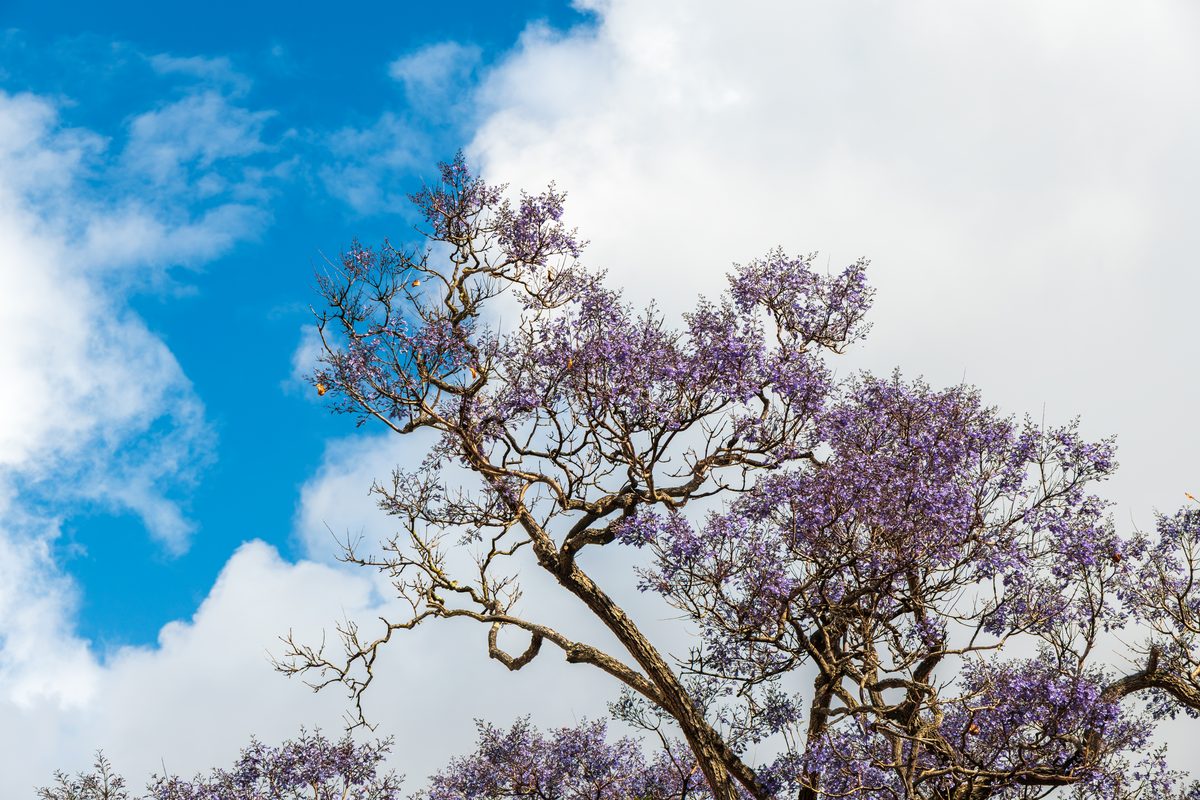
Photo: NorbertNagel, CC BY-SA 4.0 via Wikimedia Commons

Quick facts
| Light: | Full sun and part shade (full sun preferred)12 |
|---|---|
| Soil: | Well drained12 |
| Hardiness: | Zones 9b–13b11 source |
| Size: | 25–50 ft (7.62–15.24 m) × 45–60 ft (13.72–18.29 m)12 |
| Growth rate: | Rapid1512 |
| Bloom: | Blue and purple12 |
| Cats: | Non-toxic to cats 14 |
| Dogs: | Non-toxic to dogs 14 |
| Native range: | AGW, BOL, PAR6 |
| Family: | Bignoniaceae |
How much light does a Black Poui need?
Grow Jacaranda mimosifolia outdoors in full sun, meaning six or more hours of direct sunlight each day. This tree also tolerates part shade, though full sun is the light level it prefers. Full sun is the light requirement listed for this species when grown outdoors in the ground.
Best soil for a Black Poui
When you plant Jacaranda mimosifolia outdoors, choose a planting site with soil that has good drainage. University extension sources describe this species thriving outdoors in sandy, well-drained soils in the ground. Good drainage is the soil condition that extension sources list for this particular species outdoors.
Hardiness and temperature
Outdoors, Jacaranda mimosifolia is hardy in USDA zones 9b through 13b. Extension sources place this range from zone 9b up to zone 13b, covering 9b, 10a, 10b, 11a, 11b, 12a, 12b, 13a, and 13b. Outside of that listed hardiness range, this tree is not described as reliably hardy outdoors in the ground.
- Hardiness: Zones 9b–13b1
Pruning a Black Poui
Prune Jacaranda mimosifolia with light shaping rather than heavy cuts. Keep branches less than half the diameter of the trunk, which keeps the tree intact and more durable. Light shaping is the type of pruning recommended for this species when grown outdoors in the ground.
- Pruning: Light shaping2
How to plant a Black Poui
Choose a planting site in USDA hardiness zones 9b to 13b for this tree. Give it room to grow, since mature trees spread 45-60 ft (13.72-18.29 m) wide. Mature trees also reach 25-50 ft (7.62-15.24 m) tall. If you garden outside that zone range, this tree is not a reliable pick for a permanent outdoor planting site. In Hawaii, the continental United States, and Puerto Rico, this species is classified as introduced.
- Hardiness: Zones 9b–13b1
Winter care
Jacaranda mimosifolia survives winters outdoors only within USDA zones 9b to 13b. This tree is deciduous outdoors. Gardeners in colder zones outside that range do not have the winter conditions this tree needs to survive outdoors. Zone 9b marks the coldest zone where this tree is listed as hardy outdoors.
- Hardiness: Zones 9b–13b1
How to propagate a Black Poui
Outdoors, you can propagate Jacaranda mimosifolia from seed, from stem cuttings, or by grafting. Extension sources describe softwood stem cuttings as one propagation method for this species, alongside grafting and growing new plants from seed. Stem cutting is one of the propagation methods specifically listed for this species by extension sources.
Common problems
Jacaranda mimosifolia can be prone to scale insects and aphids outdoors. Other pests recorded on this species include spiraling whitefly, polyphagous shot hole borer, pink hibiscus mealybug, and jacaranda leafminer. Root rot can be a problem in poorly drained soil. Xylella fastidiosa is also recorded as a disease of this tree.
| Problem | Kind |
|---|---|
| Scale insects | Pest |
| Aphids | Pest |
| Spiraling whitefly | Pest |
| Polyphagous shot hole borer | Pest |
| Pink hibiscus mealybug | Pest |
| Jacaranda leafminer | Pest |
| Root rot | Disease |
| Xylella fastidiosa | Disease |
Is Black Poui toxic to cats and dogs?
The ASPCA's Animal Poison Control Center lists Jacaranda mimosifolia as non-toxic to cats. The same ASPCA listing also classifies this tree as non-toxic to dogs. NC State Extension's Plant Toolbox separately lists this species as non-toxic for cats. The same Plant Toolbox entry lists it as non-toxic for dogs as well. This tree is not among the plants the ASPCA classifies as toxic to either cats or dogs.
Recommended supplies
- Soil: a free-draining mix, and a pot with a drainage hole.
Questions and answers
- Is Jacaranda mimosifolia toxic to cats or dogs?
- The ASPCA lists this tree as non-toxic to both cats and dogs. NC State Extension's Plant Toolbox also marks it as non-toxic for each of these pets.
- What USDA hardiness zones suit Jacaranda mimosifolia outdoors?
- This species grows outdoors across USDA hardiness zones 9b to 13b. That range runs from zone 9b up through zone 13b, covering nine zones in total.
- What light does Jacaranda mimosifolia need outdoors?
- Outdoors, this tree grows best with full sun, meaning at least six hours of direct light daily. It can also handle part shade, though full sun remains its preferred light level.
Sources
- NC State Extension Gardener Plant Toolbox. https://plants.ces.ncsu.edu/plants/jacaranda-mimosifolia/. Accessed 24 September 2026.
- University of Florida IFAS Extension (EDIS). https://ask.ifas.ufl.edu/publication/ST317. Accessed 24 September 2026.
- EPPO Global Database. https://gd.eppo.int/taxon/IACMI/pests. Accessed 24 September 2026.
- ASPCA Animal Poison Control Center. https://www.aspca.org/pet-care/aspca-poison-control/toxic-and-non-toxic-plants/caroba. Accessed 1 November 2026.
- University of Florida IFAS Extension (EDIS). https://ask.ifas.ufl.edu/st317. Accessed 24 September 2026.
- Royal Botanic Gardens, Kew (World Checklist of Vascular Plants). https://sftp.kew.org/pub/data-repositories/WCVP/wcvp.zip. Accessed 4 June 2026.
How this page was made
- Written with AI assistance from the sources listed on this page. AI is never the source of a fact.