Templetree (Plumeria rubra)
Formerly Plumeria incarnata, Plumeria acutifolia, Plumeria lutea
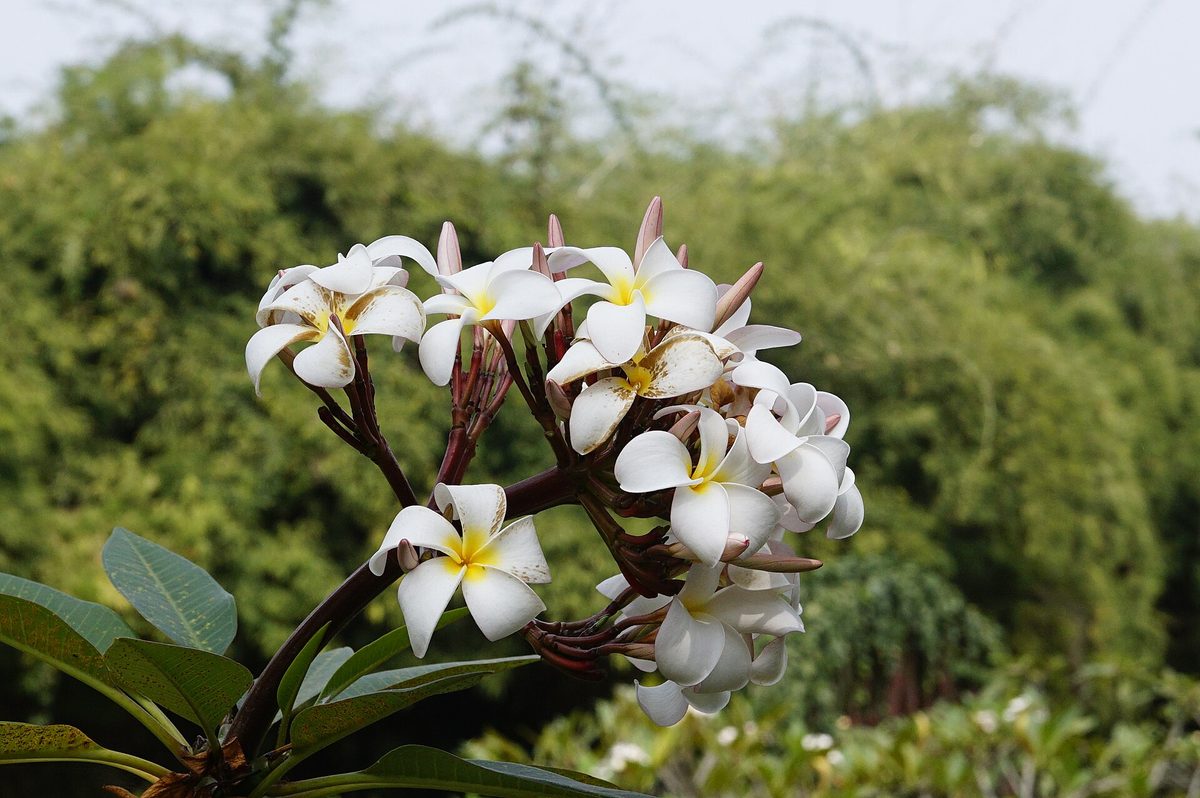
Photo: Vengolis, CC BY-SA 4.0 via Wikimedia Commons

Quick facts
| Soil: | Well drained11 source |
|---|---|
| Size: | 24.9–25 ft (7.6–7.62 m)11 source |
| Bloom: | Jan–Apr, Pink, red, white, yellow and multicoloured211 source |
| Cats: | Not documented by major sources |
| Dogs: | Not documented by major sources |
| Native range: | BLZ, CLM, COS, ELS, GUA, HON, MXC, MXE, MXG, MXN, MXS, MXT, NIC, PAN, VEN3 |
| Family: | Apocynaceae |
Best soil for a Templetree
Templetree needs well-drained soil. The soil should not dry out, and it should not remain soggy. Along with that soil, the plant needs bright sun, warm temperatures and appropriate moisture to thrive. Good drainage is the soil condition named for this tree, which grows up to 25 feet (7.6 m) tall.
- Soil drainage: Well drained1
How to propagate a Templetree
Templetree can be propagated by seed or by stem cuttings. Cuttings are taken from leafless stem tips in spring. Each cutting should be 12 to 18 inches (30 to 46 cm) long. A cutting of that length from a leafless tip is the form described for the stem cutting method. Seed is the second method recorded for this species.
- Propagation: Seed and stem cuttings1
Common problems
Spider mites, whiteflies, mealybugs, frangipani hornworm and tessellated scale are the pests recorded for templetree. It is very susceptible to spider mites. Whiteflies, mealybugs, the frangipani hornworm and tessellated scale are also on the list. That makes five recorded pests in all.
- Common pests: spider mites, whiteflies, mealybugs, frangipani hornworm and tessellated scale1
| Problem | Kind |
|---|---|
| Spider mites | Pest |
| Whiteflies | Pest |
| Mealybugs | Pest |
| Frangipani hornworm | Pest |
| Tessellated scale | Pest |
Is Templetree toxic to cats and dogs?
Recommended supplies
- Soil: a free-draining mix, and a pot with a drainage hole.
Questions and answers
- How much sun does a templetree need?
- Templetree needs bright sun, warm temperatures and appropriate moisture to thrive. Its outdoor light preference is full sun. The soil should be well drained, and it should not dry out or stay soggy.
- When does templetree bloom, and what colors are the flowers?
- Templetree blooms from January to April, with pink to red flowers in that window. Flower colors include pink, red, white and yellow, or pastel bicolors.
- How tall does a templetree grow?
- Templetree is a tree that grows up to 25 feet (7.6 m) tall. The source describes it as rangy. In Puerto Rico, its US native status is introduced.
Sources
- University of Wisconsin-Madison Division of Extension (Wisconsin Horticulture). https://hort.extension.wisc.edu/articles/plumeria/. Accessed 11 October 2026.
- Chicago Botanic Garden. https://www.chicagobotanic.org/plant-information/plant-finder/plumeria-rubra-nosegay-frangipani. Accessed 21 October 2026.
- Royal Botanic Gardens, Kew (World Checklist of Vascular Plants). https://sftp.kew.org/pub/data-repositories/WCVP/wcvp.zip. Accessed 4 June 2026.
How this page was made
- Written with AI assistance from the sources listed on this page. AI is never the source of a fact.