Giant Reed (Arundo donax)
Formerly Arundo coleotricha, Cynodon donax, Scolochloa donax
Giant reed is a tall, fast-growing, bamboo-like grass, and full sun suits it best. Part shade is also tolerated, and its water needs run from medium to wet. Toxicity to cats and to dogs is not documented for this plant, so this page makes no claim either way.
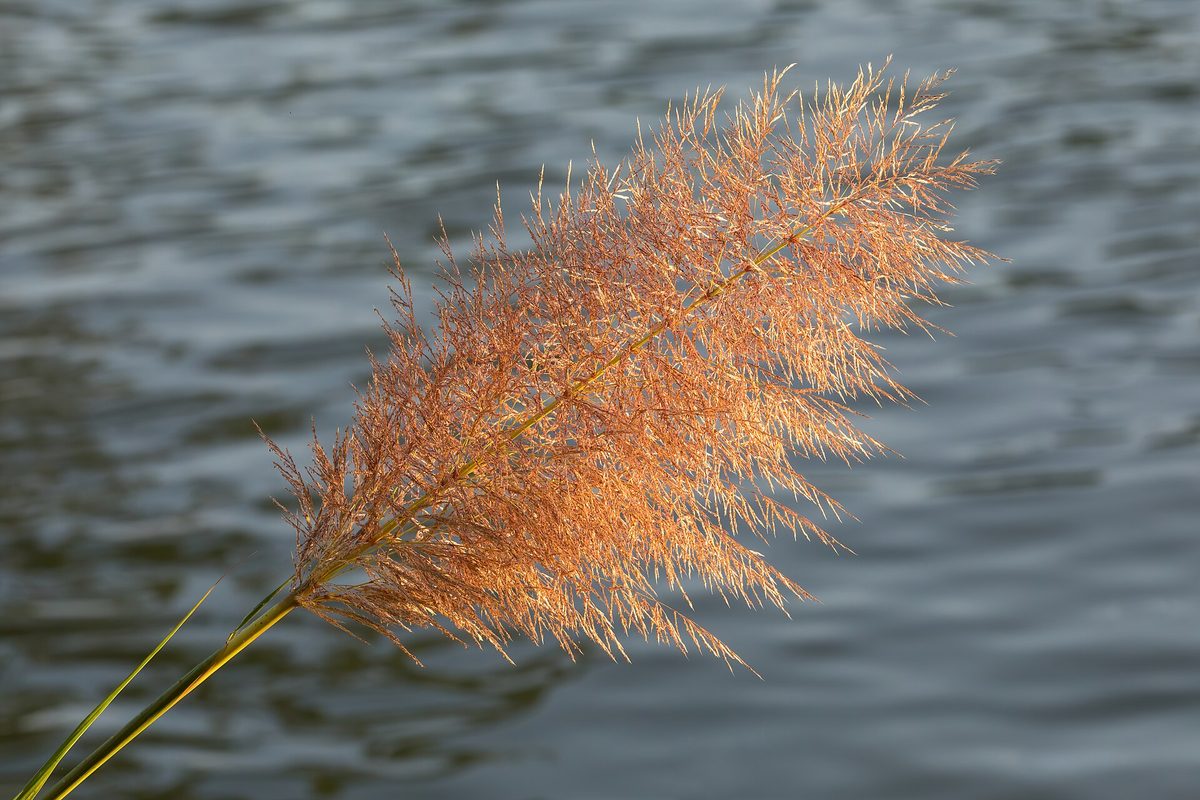
Photo: Basile Morin, CC BY-SA 4.0 via Wikimedia Commons

Quick facts
| Light: | Full sun and part shade (full sun preferred)11 source |
|---|---|
| Water: | Medium to wet23 |
| Soil: | Moist and occasionally wet21 source |
| Hardiness: | Zones 5a–10b11 source |
| Size: | 14–30 ft (4.27–9.14 m) × 5–9 ft (1.52–2.74 m)11 source |
| Growth rate: | Rapid121 |
| Bloom: | Jul–Aug and Sep–Oct, Brown, pink and red511 source |
| Cats: | Not documented by major sources |
| Dogs: | Not documented by major sources |
| Native range: | AFG, ASS, BAN, CBD, CHC, CHH, CHS, CHT, CYP, EHM, GST, IND, IRN, IRQ, JAP, KAZ, LAO, LBS, MYA, NEP, NNS, OGA, OMA, PAK, PAL, SIN, TCS, THA, TKM, TUR, TZK, UZB, VIE, WHM, YEM6 |
| Family: | Poaceae |
How much light does a Giant Reed need?
Full sun is the preferred exposure for giant reed, meaning six or more hours of direct sunlight a day. Part shade is also listed as an acceptable condition. Both full sun and part shade appear in the listing, and full sun comes first. Light levels beyond those two are not documented.
- Light: Full sun and part shade (full sun preferred)1
How often to water a Giant Reed
Water needs for giant reed run from medium to wet. The plant has high water use and grows best near water. The driest level listed is medium, and the wettest is wet. No cited source gives a watering schedule in days, so no schedule is stated here.
Best soil for a Giant Reed
Moist and occasionally wet soil suits giant reed. Those are the two drainage classes listed for the plant. That pairs with a water range of medium to wet. When you inspect a planting site, look for ground that is moist and sometimes wet. No cited source records a soil pH range for giant reed, so none is given here. Nor does any cited source name a soil texture such as sand, loam or clay.
- Soil drainage: Moist and occasionally wet2
Hardiness and temperature
Hardiness is listed as USDA zones 5a to 10b. That covers twelve steps: 5a, 5b, 6a, 6b, 7a, 7b, 8a, 8b, 9a, 9b, 10a and 10b. Zones 11 and warmer fall outside the listed range. No cited source records a minimum temperature or a humidity preference for this plant. Use your zone, not a single temperature figure, to judge whether it suits your garden.
- Hardiness: Zones 5a–10b1
How to plant a Giant Reed
Allow room for a mature height of 14 to 30 ft (4.27–9.14 m) and a width of 5 to 9 ft (1.52–2.74 m). Choose a site in full sun or part shade, with moist soil that is occasionally wet. The listed hardiness range is 5a to 10b, so confirm your zone before you plant. Its growth rate is rapid, which is worth keeping in mind when you pick the spot. No cited source gives a planting date or a spacing between plants, so none is stated.
- Hardiness: Zones 5a–10b1
Winter care
Zone 5a is the coldest zone listed for giant reed, and 10b is the warmest. Gardens in zone 4 or colder fall outside that range. No cited source records a minimum temperature, so no freezing threshold is given. No cited source describes winter protection, mulching or cutting back.
- Hardiness: Zones 5a–10b1
How to propagate a Giant Reed
Division is the recommended propagation strategy for giant reed. Division is the only method listed for this plant, so seed and cuttings are not covered here. No cited source describes the timing or technique, so this page gives no steps for dividing a clump.
- Propagation: Division4
Common problems
A wasp named Tetramesa romana was approved for release by the US Department of Agriculture in 2009. A scale insect was also being considered for biological control. Aphids are the third pest recorded for this plant. No cited source lists diseases for giant reed.
| Problem | Kind |
|---|---|
| Arundo wasp | Pest |
| Armored scale | Pest |
| Aphids | Pest |
Is Giant Reed toxic to cats and dogs?
Recommended supplies
- Soil: a mix that holds moisture without staying wet.
Questions and answers
- How big does giant reed get?
- A mature plant grows 14 to 30 ft (4.27–9.14 m) tall and 5 to 9 ft (1.52–2.74 m) wide. Its growth rate is rapid, and it is described as a tall, fast-growing, bamboo-like grass.
- When does giant reed bloom, and in what colors?
- The listed bloom time is July–August and September–October. Flower colors are brown, pink and red. No cited source describes the size or shape of the flowers.
- Is giant reed native to the United States?
- The native-status record lists giant reed as introduced in the lower 48 states, Hawaii and Puerto Rico. The native range record includes regions such as India (IND), Iran (IRN), Japan (JAP) and Turkey (TUR).
Sources
- NC State Extension. https://plants.ces.ncsu.edu/plants/arundo-donax/. Accessed 14 October 2026.
- University of Florida IFAS Extension (EDIS). https://ask.ifas.ufl.edu/publication/FR396. Accessed 14 October 2026.
- Clemson Cooperative Extension Home & Garden Information Center. https://hgic.clemson.edu/factsheet/plants-for-damp-or-wet-areas/. Accessed 14 October 2026.
- NC State Extension Gardener Plant Toolbox. https://plants.ces.ncsu.edu/plants/arundo-donax-variegata/common-name/giant-variegated-mediterranean-rush/. Accessed 1 November 2026.
- Chicago Botanic Garden. https://www.chicagobotanic.org/plant-information/plant-finder/arundo-donax-golden-chain-golden-chain-giant-reed. Accessed 21 October 2026.
- Royal Botanic Gardens, Kew (World Checklist of Vascular Plants). https://sftp.kew.org/pub/data-repositories/WCVP/wcvp.zip. Accessed 4 June 2026.
How this page was made
- Written with AI assistance from the sources listed on this page. AI is never the source of a fact.