Tree of Heaven (Ailanthus altissima)
Formerly Ailanthus glandulosa, Ailanthus giraldii, Ailanthus cacodendron
Give tree of heaven full sun, with part shade also in its listed range, and it tolerates soil moisture from dry to wet. It grows at a rapid rate and reaches 40–60 ft (12.19–18.29 m) tall. Pet toxicity for cats and dogs is not documented in the facts checked for this page. In the contiguous United States it is recorded as introduced.
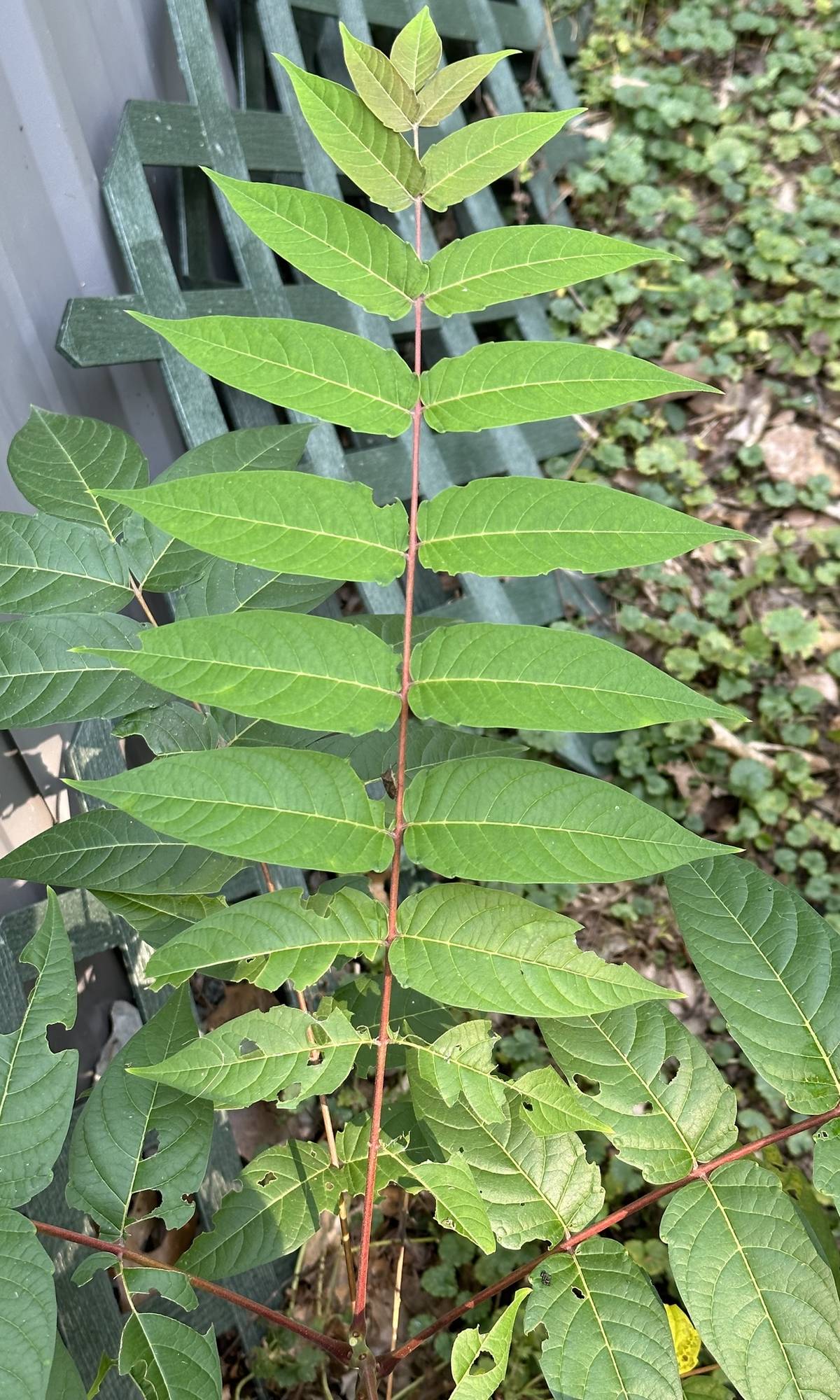
Photo: gpete, CC BY 4.0 via Wikimedia Commons

Quick facts
| Light: | Full sun and part shade (full sun preferred)12 |
|---|---|
| Water: | Dry to wet31 source |
| Soil: | Well drained, moist, occasionally dry and occasionally wet; pH 5–821 |
| Hardiness: | Zones 5a21 source |
| Size: | 40–60 ft (12.19–18.29 m) × 15–30 ft (4.57–9.14 m)12 |
| Growth rate: | Rapid14145 |
| Bloom: | Yellow, green and brown11 source |
| Cats: | Not documented by major sources |
| Dogs: | Not documented by major sources |
| Native range: | CHC, CHI, CHM, CHN, CHS, CHT, CHX, TAI6 |
| Family: | Simaroubaceae |
How much light does a Tree of Heaven need?
Tree of heaven prefers full sun, meaning 6 or more hours of direct sunlight a day. The listed range covers both full sun and part shade, with full sun preferred. Full sun is the preferred condition, and part shade is the lower end of the listed range. Check how many hours of direct sun a spot receives against the 6-hour mark for full sun.
How often to water a Tree of Heaven
Tree of heaven tolerates soil moisture from dry to wet. The listed tolerances include occasionally wet soil and well-drained soil. The drainage record gives well drained, moist, occasionally dry and occasionally wet conditions. Occasional dry periods and occasional wet periods both fall within the listed soil conditions. A spot with good drainage matches the listed conditions. No watering schedule is documented for this tree.
- Water: Dry to wet3
Best soil for a Tree of Heaven
Soil drainage for tree of heaven is listed as well drained, moist, occasionally dry and occasionally wet. Moist, well-drained soil is one of the listed conditions. Occasionally wet soil is also on the list, as are occasional periods of dry soil. The soil pH range is 5–8. That covers acid to alkaline soil. Listed soil textures include clay, sand and loam. Both alkaline and acidic soils appear among the tolerances.
Hardiness and temperature
Tree of heaven is listed as hardy to USDA zone 5a. The record gives zone 5a as both the minimum and the maximum zone. No cited source records a minimum temperature for this tree. Humidity is not documented for this page. Zone 5a is the only climate figure on file. Compare zone 5a with your own USDA zone.
How to plant a Tree of Heaven
Check that your USDA zone matches the listed zone 5a before planting. At maturity the tree grows 40–60 ft (12.19–18.29 m) tall and 15–30 ft (4.57–9.14 m) wide. Leave room for the full height and spread in the place you choose. The growth rate is rapid, and the tree is deciduous. The plant type is tree. In the contiguous United States and Hawaii its native status is introduced. Its recorded native range codes are CHC, CHI, CHM, CHN, CHS, CHT, CHX and TAI.
- Hardiness: Zones 5a2
Winter care
Winter hardiness is recorded as zone 5a. The record gives zone 5a as both the minimum and the maximum zone. The tree is deciduous. No cited source records a minimum temperature, so no temperature threshold can be given. Winter protection, mulching and wrapping are not documented for this tree. Compare your own USDA zone with 5a to judge whether the tree suits your winters.
How to propagate a Tree of Heaven
Tree of heaven is propagated by seed, and suckers are also named as a way it is propagated. Seed is the only method listed in the propagation record. The records for this page give no seed treatment, timing or sowing depth. Cuttings, division and grafting are not documented for this page.
- Propagation: Seed3
Common problems
Spotted lanternfly is the pest recorded for tree of heaven, which is a potential host for this invasive insect. Verticillium wilt is the disease named for this tree. The listing says no diseases are of major concern except verticillium wilt. No other pests or diseases are recorded in the facts for this page.
| Problem | Kind |
|---|---|
| Spotted lanternfly | Pest |
| Verticillium wilt | Disease |
Is Tree of Heaven toxic to cats and dogs?
Recommended supplies
- Soil: a free-draining mix, and a pot with a drainage hole.
Questions and answers
- How much sun does tree of heaven need?
- It prefers full sun, meaning 6 or more hours of direct sunlight a day. Part shade is also in its listed range. The listing runs from full sun to part shade, with full sun preferred.
- How big does tree of heaven get?
- Mature height is 40–60 ft (12.19–18.29 m), with a spread of 15–30 ft (4.57–9.14 m). The growth rate is rapid. The tree is also deciduous.
- What soil does tree of heaven tolerate?
- A soil pH of 5–8 is tolerated, from acid to alkaline. Drainage is listed as well drained, moist, occasionally dry and occasionally wet. Clay, sand and loam are the listed soil textures.
Sources
- NC State Extension Gardener Plant Toolbox. https://plants.ces.ncsu.edu/plants/ailanthus-altissima/. Accessed 11 October 2026.
- Cornell University CALS Woody Plants Database. https://woodyplants.cals.cornell.edu/plant/19. Accessed 11 October 2026.
- University of Florida IFAS Extension (EDIS). https://ask.ifas.ufl.edu/publication/ST067. Accessed 27 October 2026.
- USDA Forest Service Fire Effects Information System. https://www.fs.usda.gov/database/feis/plants/tree/ailalt/all.html. Accessed 11 October 2026.
- University of Florida IFAS Extension (EDIS). https://ask.ifas.ufl.edu/st067. Accessed 11 October 2026.
- Royal Botanic Gardens, Kew (World Checklist of Vascular Plants). https://sftp.kew.org/pub/data-repositories/WCVP/wcvp.zip. Accessed 4 June 2026.
How this page was made
- Written with AI assistance from the sources listed on this page. AI is never the source of a fact.