Honey Mesquite (Neltuma juliflora)
Formerly Prosopis juliflora, Acacia juliflora, Entada juliflora
Give honey mesquite full sun and a dry site, and plant it in USDA zones 7a–10b. Its growth rate is listed as slow. In the lower 48 US states it is native, and in Hawaii it is introduced. Indoor light needs and toxicity to cats and dogs are not documented for this page.
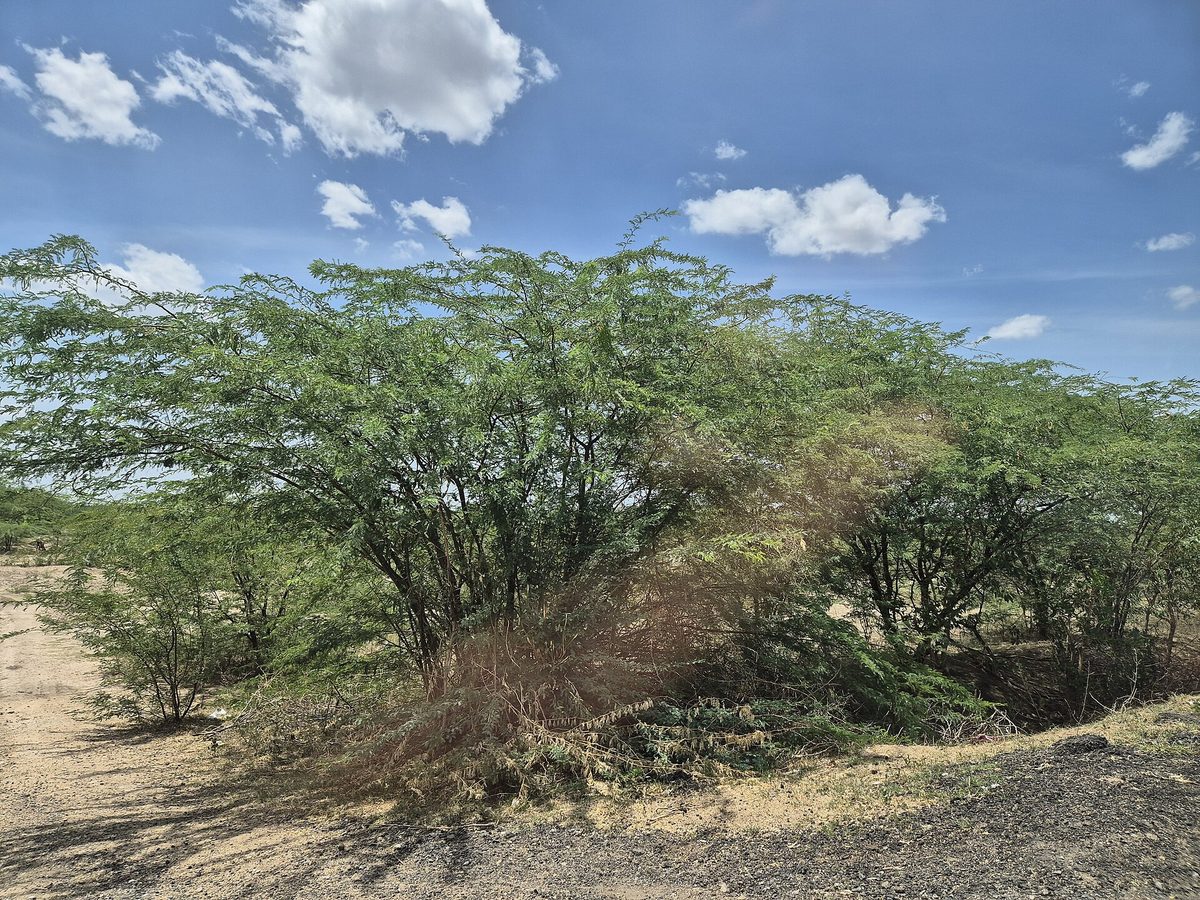
Photo: Siyaulhaque, CC BY-SA 4.0 via Wikimedia Commons

Quick facts
| Water: | Dry11 source |
|---|---|
| Soil: | Well drained231 source |
| Growth rate: | Slow321 source |
| Bloom: | Yellow3Not documented by major sources |
| Cats: | Not documented by major sources |
| Dogs: | Not documented by major sources |
| Native range: | ARU, BAH, BOL, CLM, COS, CUB, DOM, ECU, ELS, GAL, GUA, HAI, HON, LEE, MXC, MXE, MXG, MXN, MXS, MXT, NIC, NLA, PAN, PER, VEN, VNA, WIN5 |
| Family: | Fabaceae |
How often to water a Honey Mesquite
Dry conditions suit honey mesquite, and its water need is listed as dry. It tolerates heat, drought, high soil pH, and salinity, and it is quite long-lived. Because the listed range is dry at both its minimum and its maximum, no wetter condition is recorded for it. Its drainage rating also bears on watering, since tolerance of poor drainage is low.
- Water: Dry1
Best soil for a Honey Mesquite
Well-drained soil is the listed match for this tree. Tolerance of poor drainage is rated low in the source. The tolerance list also includes high soil pH and salinity. No soil pH range is recorded for this page. No soil texture is named in the drainage record either.
Common problems
Five insects are named for honey mesquite: mimosetes protractus, neltumius arizonensis, algarobius prosopis, algarobius bottimeri and prosopidosylla flava. Mimosetes protractus and Neltumius arizonensis are described as seed-feeding insects that were introduced to eastern South Africa. No common diseases are documented for this page. The record names the insects only and gives no damage or control details for the other three.
- Common pests: mimosetes protractus, neltumius arizonensis, algarobius prosopis, algarobius bottimeri and prosopidosylla flava4
| Problem | Kind |
|---|---|
| Mimosetes protractus | Pest |
| Neltumius arizonensis | Pest |
| Algarobius prosopis | Pest |
| Algarobius bottimeri | Pest |
| Prosopidosylla flava | Pest |
Is Honey Mesquite toxic to cats and dogs?
Recommended supplies
- Soil: a free-draining mix, and a pot with a drainage hole.
Questions and answers
- How much sun does honey mesquite need?
- It is listed for full sun outdoors and is described as shade intolerant. Full sun is the only outdoor light value recorded. Hardiness is listed as Zones 7a–10b. Indoor light needs are not documented for this page.
- Does honey mesquite grow fast?
- Its growth rate is listed as slow. The tree is also described as quite long-lived. Its water need is listed as dry, and it tolerates heat, drought and salinity. Well-drained soil is listed, and tolerance of poor drainage is low.
- Is honey mesquite native to the United States?
- It is native in the lower 48 states and introduced in Hawaii. The native range is recorded as a list of region codes, such as BOL, CUB and ECU. The record states these values and nothing more about habitat or climate.
Sources
- Utah State University Extension. https://extension.usu.edu/forestry/tree-identification/other-trees/honey-mesquite. Accessed 21 October 2026.
- Utah State University Extension (TreeBrowser). https://extension.usu.edu/treebrowser/catalog/mesquite-honey. Accessed 14 October 2026.
- Utah State University Extension (TreeBrowser). https://extension.usu.edu/treebrowser/catalog/mesquite-honey.php. Accessed 14 October 2026.
- EPPO Global Database. https://gd.eppo.int/taxon/PRCJU/datasheet. Accessed 14 October 2026.
- Royal Botanic Gardens, Kew (World Checklist of Vascular Plants). https://sftp.kew.org/pub/data-repositories/WCVP/wcvp.zip. Accessed 4 June 2026.
How this page was made
- Written with AI assistance from the sources listed on this page. AI is never the source of a fact.