Robusta Coffee (Coffea canephora)
Formerly Coffea robusta, Coffea ugandae, Coffea laurentii
Robusta coffee, Coffea canephora, is a tree that grows best in well drained soil. Outdoors it is usually grown in part shade, though it may be grown in full sun. Ground or whole coffee beans can potentially cause severe poisoning in dogs, so keep them out of reach.
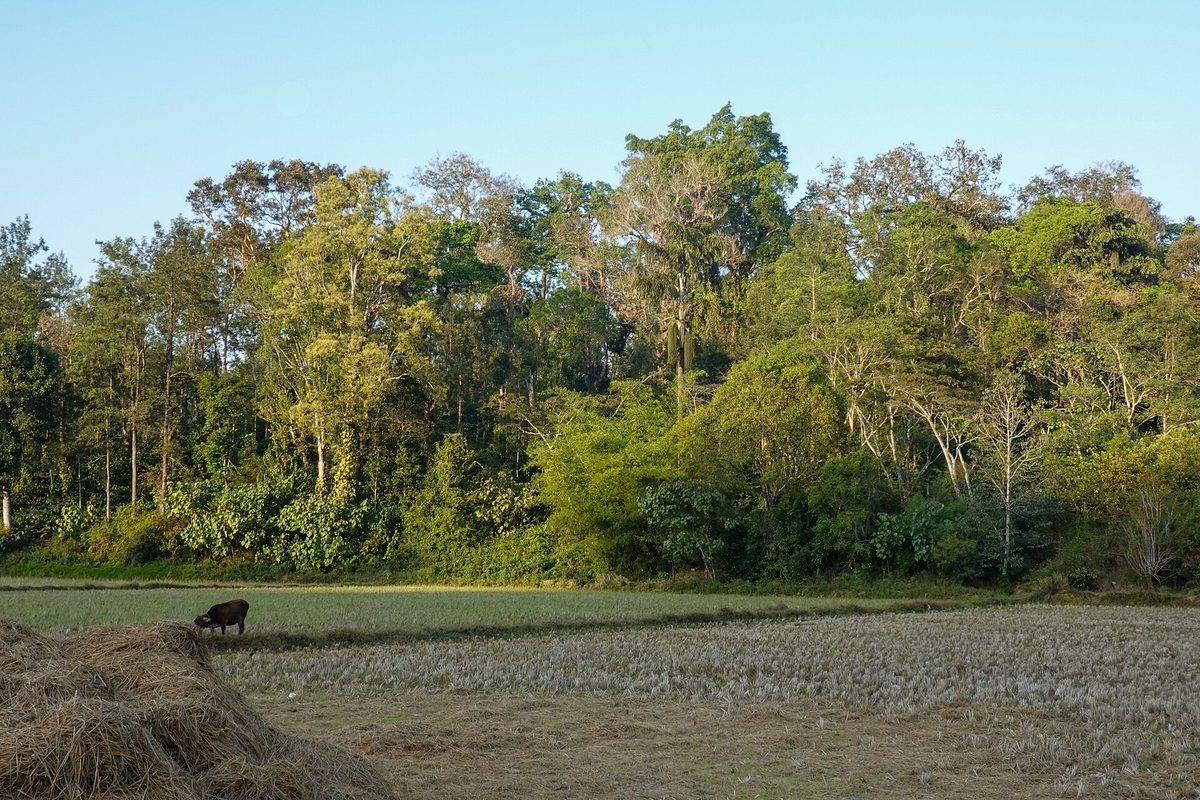
Photo: Wikimedia Commons contributor, CC BY-SA 4.0 via Wikimedia Commons

Quick facts
| Soil: | Well drained11 source |
|---|---|
| Bloom: | White11 source |
| Cats: | Not documented by major sources |
| Dogs: | Toxic to dogs (1 source) 3 |
| Native range: | ANG, BEN, CAB, CAF, CMN, CON, GAB, GHA, GNB, GUI, IVO, LBR, NGA, SUD, TAN, TOG, UGA, ZAI4 |
| Family: | Rubiaceae |
Best soil for a Robusta Coffee
Robusta coffee, Coffea canephora, grows best in soil that is well drained. The same description calls for soil that is slightly acid to neutral in pH. When you choose a planting spot, look for ground that drains well and falls in that pH range.
- Soil drainage: Well drained1
How to propagate a Robusta Coffee
You can propagate robusta coffee by stem cuttings or by grafting. For cuttings, the source describes stems 3/16 to 5/16 inches (5 to 8 mm) in diameter. Check the thickness of a stem against that range before you take a cutting. Grafting is the second method listed for Coffea canephora.
- Propagation: Stem cuttings and grafting1
Common problems
Five pests are recorded for robusta coffee. They are the black twig borer, coffee berry borer, coffee leaf miner, coffee mite and Mediterranean fruit fly. The black twig borer is recorded under the name Xylosandrus compactus. Look for any of these five when you inspect the tree.
- Common pests: black twig borer, coffee berry borer, coffee leaf miner, coffee mite and mediterranean fruit fly2
| Problem | Kind |
|---|---|
| Black twig borer | Pest |
| Coffee berry borer | Pest |
| Coffee leaf miner | Pest |
| Coffee mite | Pest |
| Mediterranean fruit fly | Pest |
Is Robusta Coffee toxic to cats and dogs?
Robusta coffee is listed as toxic to dogs. The Pet Poison Helpline states that ingesting ground or whole coffee beans can potentially cause severe poisoning in pets. Both ground beans and whole beans are named in that statement. Keep coffee beans away from your dog. The dog listing applies to Coffea canephora, the robusta coffee tree. The position for dogs is toxic. For cats, no cited source gives a toxicity position, so it is not documented.
Recommended supplies
- Soil: a free-draining mix, and a pot with a drainage hole.
Questions and answers
- Does robusta coffee grow in sun or shade outdoors?
- Coffee is usually grown under shaded conditions, but it may be grown in full sun. Part shade is the preferred setting for robusta coffee outdoors.
- What color are robusta coffee flowers?
- The flowers are white, with five petals and a single ovary. Robusta coffee itself is a tree.
- Where is robusta coffee native?
- Its native range is recorded as the regions coded ANG, BEN, CAB, CAF, CMN, CON, GAB, GHA, GNB, GUI, IVO, LBR, NGA, SUD, TAN, TOG, UGA and ZAI.
Sources
- University of Florida IFAS Extension (EDIS). https://ask.ifas.ufl.edu/publication/HS306. Accessed 14 October 2026.
- EPPO Global Database. https://gd.eppo.int/taxon/COFCA/pests. Accessed 14 October 2026.
- Pet Poison Helpline. https://www.petpoisonhelpline.com/poison/java-beans/. Accessed 14 October 2026.
- Royal Botanic Gardens, Kew (World Checklist of Vascular Plants). https://sftp.kew.org/pub/data-repositories/WCVP/wcvp.zip. Accessed 4 June 2026.
How this page was made
- Written with AI assistance from the sources listed on this page. AI is never the source of a fact.